The wait is over, and it has been over for a while. teamLab Borderless, the digital art museum that turned Tokyo’s Odaiba waterfront into one of the most Instagrammed destinations on earth before closing in August 2022, reopened on February 9, 2024, in a basement level of Azabudai Hills, the mega-development that is now central Tokyo’s tallest building complex. Nearly three years later, it is not a pop-up or a temporary installation: it is a fully operating museum with a regular booking calendar, dynamic ticket pricing, and the kind of sustained visitor traffic that suggests Mori Building’s bet on relocating paid off.
Some context on why this reopening mattered: the original Odaiba location, which opened in 2018, became the most-visited single-artist museum in the world within its first year and went on to win a Guinness World Record in 2021 for exactly that distinction. When it shut down in 2022, there was real uncertainty about whether teamLab — the Tokyo-based art collective founded in 2001 — would resurface with something comparable. Azabudai Hills, developed by Mori Building and opened in phases through 2023 and 2024, answered that question by giving the collective roughly 10,000 square meters across Garden Plaza B’s basement level, enough room to rebuild the “borderless” concept rather than simply relocate the old one.

The museum’s full name is MORI Building DIGITAL ART MUSEUM: teamLab Borderless, and it occupies Garden Plaza B, B1F, at 1-2-4 Azabudai, Minato-ku — a few minutes’ walk from Kamiyacho Station on the Hibiya Line (Exit 5) or Roppongi-itchome Station on the Namboku Line. That is a meaningfully more central location than Odaiba ever was, and it shows in the crowds: this is now routinely cited among the most-visited art museums in the world by attendance, alongside the Louvre and the Vatican Museums, according to The Art Newspaper’s annual survey.
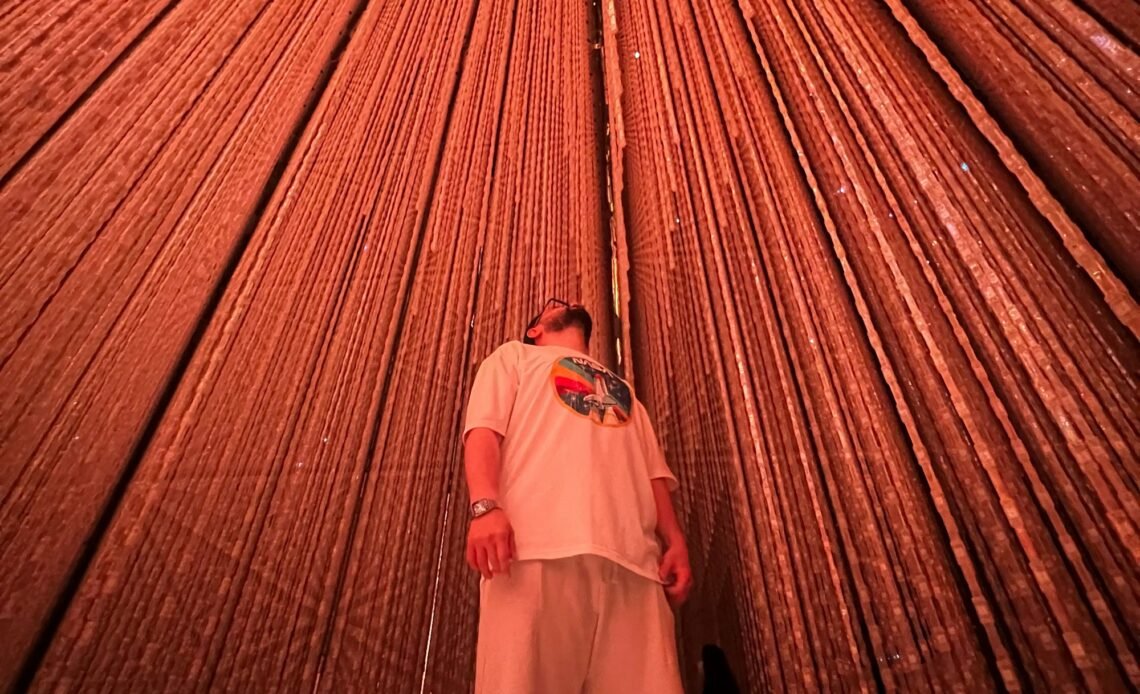
Inside, the work is organized around the same borderless philosophy — no walls, no fixed paths, no framed boundaries between pieces — but with new and evolved installations. Among the standouts: “Proliferating Immense Life,” a room of shifting flower forms that respond to visitors’ movement and eventually wither and scatter if left untouched; “Black Waves,” a rushing wall of ink-dark water rendered entirely in light; and “Universe of Water Particles,” a waterfall effect that visitors can walk directly into. The collective’s “Light Sculpture” series, including pieces like “Birth” and “Sea of Clouds,” expands on ideas first shown in Odaiba with denser, more responsive lighting rigs. A mirrored installation called Microcosmoses extends the infinity-room effect the original venue was known for. Upstairs, the EN TEA HOUSE lets visitors order a bowl of tea that triggers a flower to bloom and spread across the surface of the liquid and the table beneath it — a signature teamLab trick that blurs food, art, and performance.

Tickets are not a flat rate — teamLab prices admission dynamically by date and time slot, the same way an airline or hotel might, so prices climb on weekends, holidays, and evening slots. As of late 2026, adult admission booked in advance through the official site starts around ¥3,400 and can run higher depending on the date; visitors aged 13 to 17 pay roughly ¥2,800, children 4 to 12 around ¥1,500, and children 3 and under enter free. Visitors with a disability certificate and one accompanying companion each pay a reduced rate, roughly ¥1,700 per ticket. Buying same-day at the door costs more across the board, and weekend and evening slots sell out regularly, so advance booking through teamlab.art/e/tokyo is the reliable route; Klook is listed as an official ticketing partner for travelers who prefer to book that way.
Opening hours generally run from around 10:00 a.m. to 9:00 p.m., with last entry an hour before closing, though exact hours shift date by date — some days run from as early as 8:30 a.m., others close earlier for private events. The museum is closed on scattered Tuesdays rather than a fixed weekly day off, so the specific closed dates for any given month need checking against teamLab’s own calendar before booking travel around it. Most visitors budget two to three hours inside, and the museum recommends flat, closed-toe shoes since several installations involve wading through projected water or walking on reflective, occasionally slick flooring.
What hasn’t changed is the underlying idea. teamLab’s stated mission — dissolving the boundaries between artworks, between the viewer and the art, and between the body and the surrounding digital environment — reads the same on Azabudai Hills’ walls as it did in Odaiba. The collective still runs permanent and touring exhibitions from Shanghai to Jeddah, and teamLab Planets, its other major permanent Tokyo venue in Toyosu, continues to operate separately. But for travelers asking whether the famous “borderless” museum is actually open right now: yes, it has been open continuously since February 2024, it has already absorbed the crowds that once filled Odaiba, and at nearly three years into its second life, it looks less like a relaunch and more like teamLab’s permanent Tokyo address.
