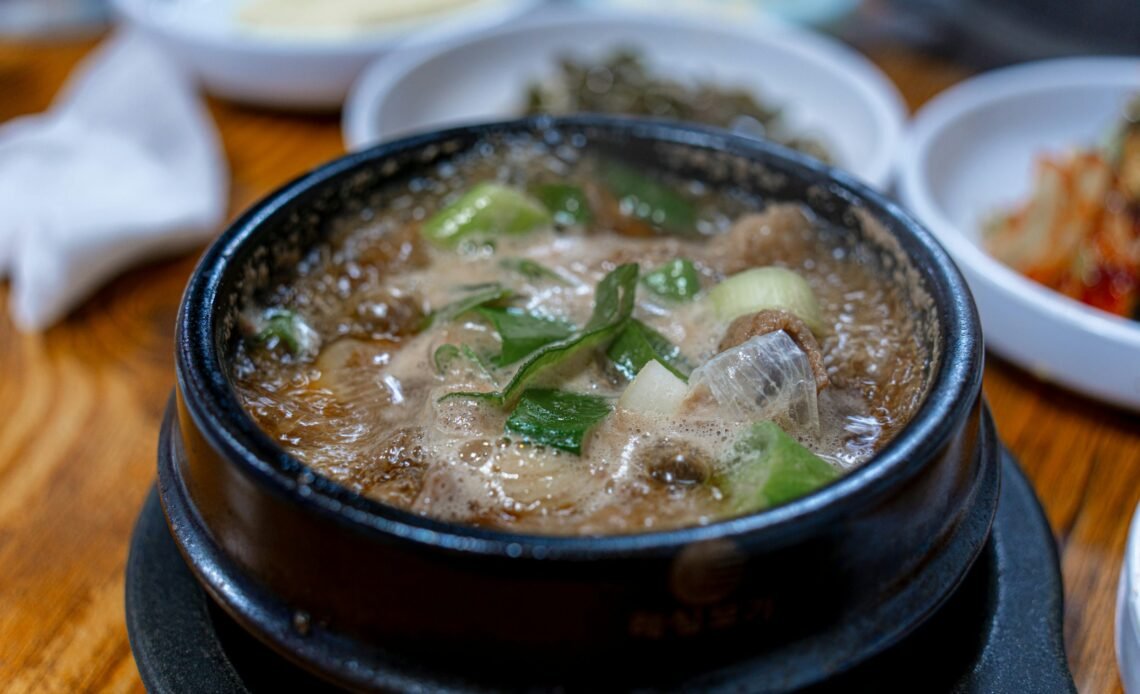
On West 3rd Street in Koreatown, a line still forms most evenings outside Jinsol Gukbap, where a cloudy pork broth that has simmered for the better part of a day gets ladled over rice and handed to strangers who, within a few spoonfuls, stop being strangers to the dish. Reviews logged as recently as April 2026 describe the same scene regulars have known for years: a packed room, little English on the walls, and a bowl of dwaeji gukbap, Busan’s signature pork-and-rice soup, doing the talking. The restaurant is still very much open — and still one of the few places in Los Angeles serving this specific regional dish with the patience it demands.
Gukbap: Korea’s original fast food
Gukbap simply means “soup rice” — guk (soup) plus bap (rice) — and it breaks a basic rule of Korean table etiquette, where soup and rice are traditionally served in separate bowls. Gukbap puts the rice directly into the broth, a format that goes back to the jumak, the roadside taverns of the late Joseon Dynasty where travelers needed something hot, filling, and fast. Food historians in Korea have called it the country’s first fast food and arguably its first delivery food, since jumak keepers could have a bowl ladled and on the table before a traveler had finished tying up a horse. That utilitarian root is still the dish’s defining trait: gukbap was never meant to be fussy. It was meant to get a tired, cold, or hungover person through the next few hours.
Why pork, and why Busan
The specific style Jinsol Gukbap serves — dwaeji gukbap, the milky-white pork version — has a harder, more recent history than the genteel beef broths like seolleongtang that Joseon-era nobility and commoners alike once shared. Dwaeji gukbap is widely traced to the Korean War, when hundreds of thousands of refugees poured into Busan, the port city at the southern tip of the peninsula that never fell to the North. Beef bones, the base of the older royal-court soups, were scarce and expensive. Pork bones, left over from the American military’s wartime supply chain and from port-town butchers, were cheap and plentiful. Refugees adapted the technique they knew — long-simmered bone broth over rice — to the only protein they could get, and dwaeji gukbap was born out of necessity around Busan Station. For years it was considered a low-status meal, the food of dockworkers and people with empty pockets and no hometown to return to; it didn’t become a point of civic pride until decades later. That history is why the dish still carries a specific emotional register in Korea — associated less with celebration than with comfort, cold mornings, and getting by.

What actually distinguishes Jinsol’s bowl
Jinsol Gukbap specializes specifically in Busan-style cooking rather than the broader Korean soup category, and the kitchen leans into the dish’s working-class origins instead of smoothing them over. The broth is simmered in cast-iron pots for roughly a full day with roots and vegetables until it turns opaque and milky-white, closer in body to a Vietnamese pho or a tonkotsu ramen base than to a clear consommé. It arrives scalding, with a spoonful of gochujang already melting at the bottom of the bowl rather than served on the side, and a diner’s job is to stir it in gradually and find their own heat level. The protein choices are the real tell of an authentic Busan-style spot: alongside the familiar thin-sliced pork belly, the menu runs to small intestines, tripe, and other offal cuts that a lot of Americanized Korean menus quietly drop. Each bowl comes with a full supporting cast — fermented shrimp (saeujeot) and ground sesame seeds to season the broth to taste, a side bowl of chewy flour noodles called milmyeon, rice, and banchan. The ordering ritual is unusual, too: regulars write their name on a slip of paper at the door and the kitchen calls them up — a holdover from the dish’s tavern-counter roots that most reviewers still remark on.

What to order, and what it costs
The pork soup with rice, served with a choice of pork slices, intestines, or a mixed cut, runs roughly $10 to $16 depending on portion — one recent review clocked the standard bowl at $15.95 with banchan included, while an earlier visit put a smaller version closer to $10. Jinsol’s hot-stone-pot bibimbap, finished tableside so the rice crisps against the bottom of the dol sot, is the other dish regulars point to, built around a heavy pour of toasted sesame oil rather than a sweet sauce. Beyond the gukbap itself, the kitchen runs boiled pork belly, spicy marinated pork ribs, a Jeju-style cold noodle, kimchi stew with pork belly sized for sharing, and a leek pancake (around $7) that most tables order as a starter. Most diners land a full, multi-dish meal for $15 to $20 a person — unusually gentle pricing for a sit-down Koreatown dinner in 2026, and a big part of why the dish’s blue-collar origin story still feels legible in the room.

Visiting in 2026
Jinsol Gukbap’s original Koreatown location is at 4031 W 3rd St, Los Angeles, CA 90020 — phone (213) 365-0097 — open Monday through Friday from 11 a.m. to 10 p.m. and Saturday and Sunday from 10 a.m. to 10 p.m. The concept has since expanded to a second Koreatown branch on 8th Street as well as locations in Buena Park, Rowland Heights, and, as of June 2026, a new outpost in Plano, Texas — a sign of how much appetite there is in the U.S. for a dish that spent decades as a regional secret even within Korea. But the 3rd Street original is still the one worth the trip: in a Koreatown landscape saturated with tabletop grills and late-night skewers, it remains one of the few rooms in the city serving Busan’s specific answer to a cold morning — unglamorous by design, and better for it.

As you savor each bite, you’re reminded that great food doesn’t always require elaborate seasoning; sometimes a day-long simmer and a handful of cheap ingredients, carried by a hard history, is enough. Jinsol Gukbap remains a culinary experience worth seeking out — a direct, unpolished line back to a Busan dockside kitchen, served nightly in the middle of Koreatown.
