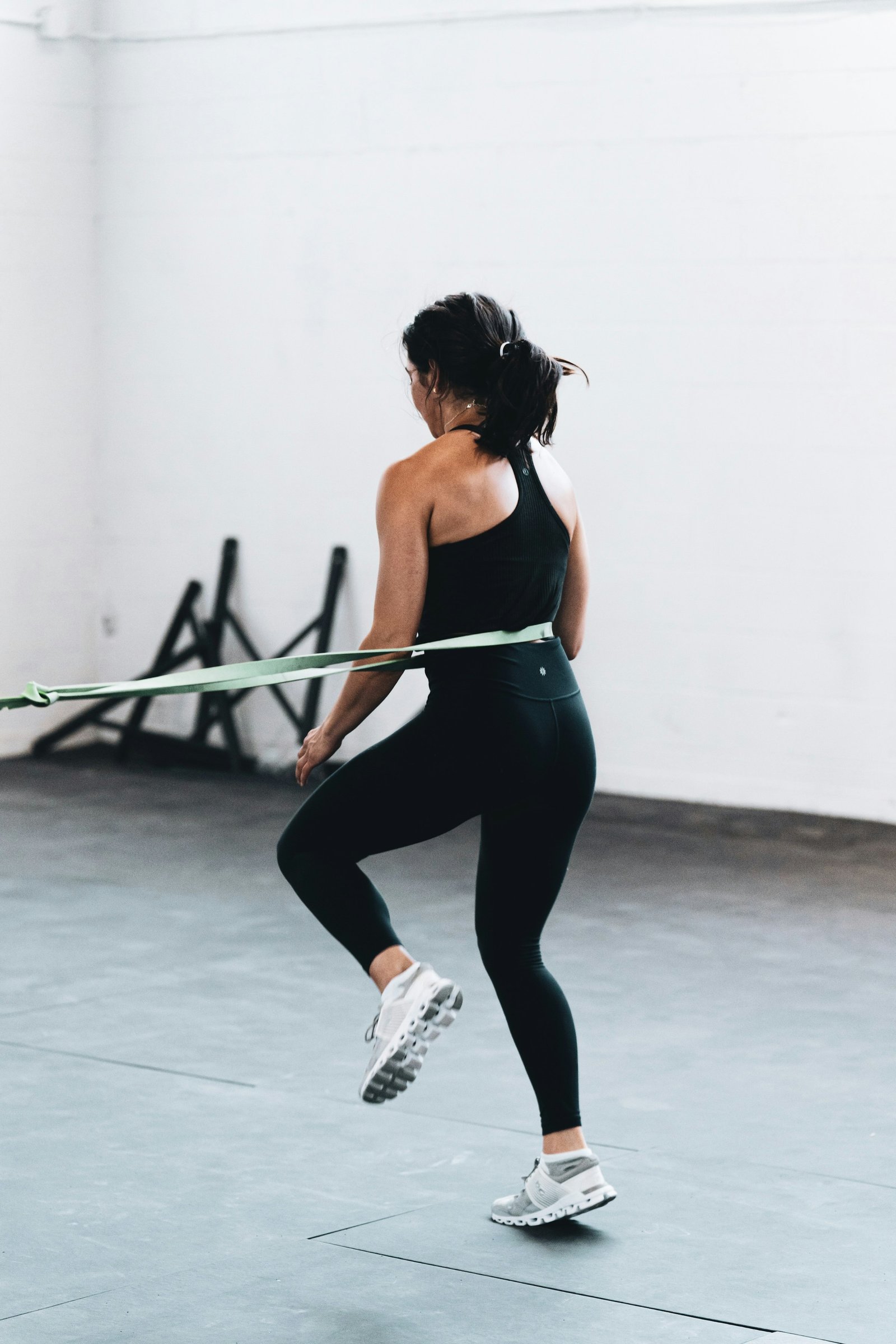
Jennifer Aniston has made no secret of what she credits for staying strong past 55: not yoga, not Pilates in the classic sense, but a low-impact resistance method called Pvolve. Seven years after two New Yorkers invented it to protect a bad back, the brand has quietly become one of the fastest-growing names in American fitness — with more than 45 studios now open across North America, a Jennifer Aniston equity partnership that’s lasted three years, and a university-run clinical trial behind its claims. Here’s what’s actually real about it, and what it costs to try.
What Pvolve actually is
Pvolve (styled P.volve until a 2023 rebrand) was founded in November 2017 by Rachel Katzman and Stephen Pasterino, with backing from Camelot Venture Group. Katzman, a former marketing executive who’d previously built and sold the haircare line Cuvée Beauty, developed the method after scoliosis made high-impact studio classes painful. The result is a “functional fitness” system built around slow, controlled movement and proprietary resistance equipment rather than free weights or cardio intervals — closer in spirit to physical therapy than to a typical sculpt class.
The equipment is the actual product. The P.3 Trainer ($94 on pvolve.com) bundles two resistance bands, two ankle straps, a handle and a 1.5-pound weighted ball into one system; the P.ball ($74) is a weighted, grippable ball used for isolating glutes and inner-thigh muscles during squats and lunges. Pvolve sells them in bundles — a seven-piece Essentials Bundle runs $174, and the full 13-piece Signature Bundle is priced around $620 — alongside a growing library of streamed classes.
The Jennifer Aniston effect
Aniston wasn’t a celebrity endorsement cold-called by a PR team — she’d been taking Pvolve classes since 2021 before the company announced her as an official partner and investor in June 2023. In that role she advises on programming and marketing rather than simply fronting ads, and the partnership has kept producing campaigns: the April 2025 “Sculpt Anywhere” push centered on a $274.99 travel bundle built around the equipment she says she packs on set. Her repeated line to press — that “we have to be kinder to our bodies” as the pounding catches up with us in our 40s and 50s — has become the brand’s de facto tagline, and it’s a large part of why Pvolve’s audience skews toward women managing perimenopause and menopause rather than the 20-something HIIT crowd.
The clinical study behind the marketing
Most celebrity-adjacent fitness brands stop at testimonials. Pvolve funded an actual trial. In partnership with the University of Exeter, researchers led by Professor Francis Stephens ran a 12-week “Healthy Aging Study” on 72 women aged 40 to 60, spanning pre-, peri- and post-menopausal participants, comparing a Pvolve routine against standard exercise guidance. Results released in January 2024 reported roughly a 19% improvement in lower-body strength and hip function, along with gains in lean muscle mass that didn’t come with a corresponding rise in total body weight — improvements that held up similarly across all three menopause stages. The obvious caveat: Pvolve paid for the study, the sample size is modest, and the company itself has described the results as preliminary rather than a full peer-reviewed replication. It’s real research, not just a research-adjacent press release, but it’s industry-funded research all the same.
From two studios to a national franchise
Pvolve started with brick-and-mortar classes in New York and Los Angeles plus a streaming app, but 2026 has been its franchise-expansion year. A September 30 company release put the count at more than 45 open studios across North America, with 30 to 50 more in active development depending on the source. Recent franchise awards landed in Tacoma, Washington, and Brookfield, Wisconsin, and the brand’s first Philadelphia location, at 1735 Market Street, is slated to open before year’s end. For a method that was studio-exclusive to two cities five years ago, that’s a meaningful bet that the Aniston halo and the Exeter data can carry a national rollout the way Pilates studios like SolidCore and Club Pilates did before it.
What it actually costs
Digital-only access — the way most people outside a franchise city will try it — runs $24.99 a month or $224.91 billed annually, which works out to roughly $18.75 a month; Pvolve offers a 14-day free trial before either plan kicks in. Studio class packages are priced locally by each franchise, similar to the Pilates and barre model. On the equipment side, Pvolve has run a recurring Black Friday discount in past years — a sitewide 20% off using a code like BF20, which has applied to kits including the Signature and Longevity bundles — though the exact code and start date shift year to year, so it’s worth checking pvolve.com directly as the holiday approaches rather than assuming a specific code is live before Black Friday itself.
Is it worth trying
Pvolve isn’t positioning itself as a replacement for yoga or strength training in the traditional sense — it’s explicitly a low-impact, joint-conscious alternative for people who’ve decided the high-intensity studio era of their 30s doesn’t work for their body anymore. The $24.99 monthly entry point is cheap enough to test against the 14-day trial before committing to equipment, and the Exeter data, caveats aside, is more substantiation than most resistance-band brands bother to produce. Whether it’s “the Jennifer Aniston workout” or just a smart rebrand of physical-therapy principles for a retail audience depends on what you’re measuring it against — but the studio count, the franchise pipeline and the funding behind the research all say this is a real, scaling business, not a trend that peaks with one magazine cycle.