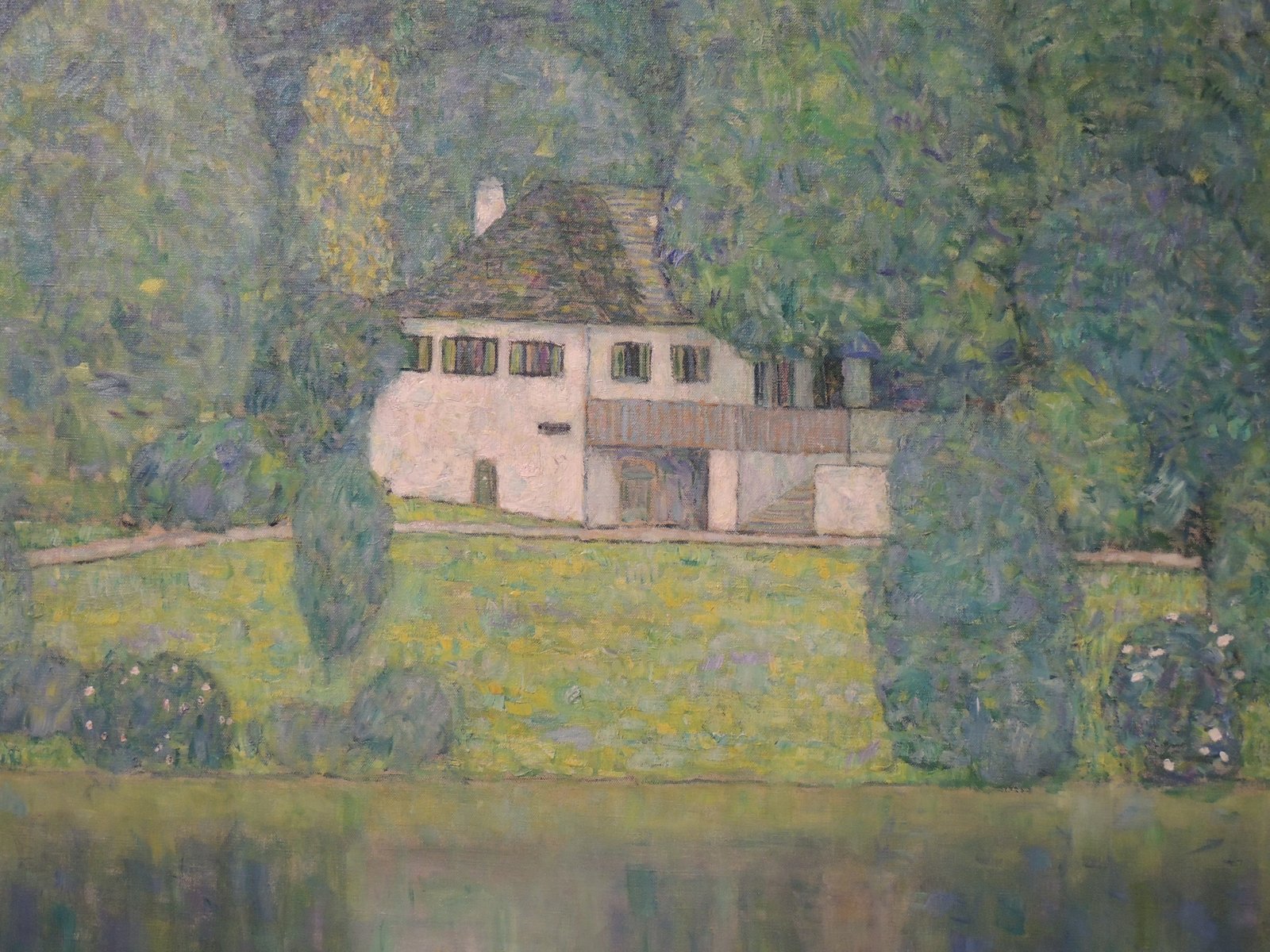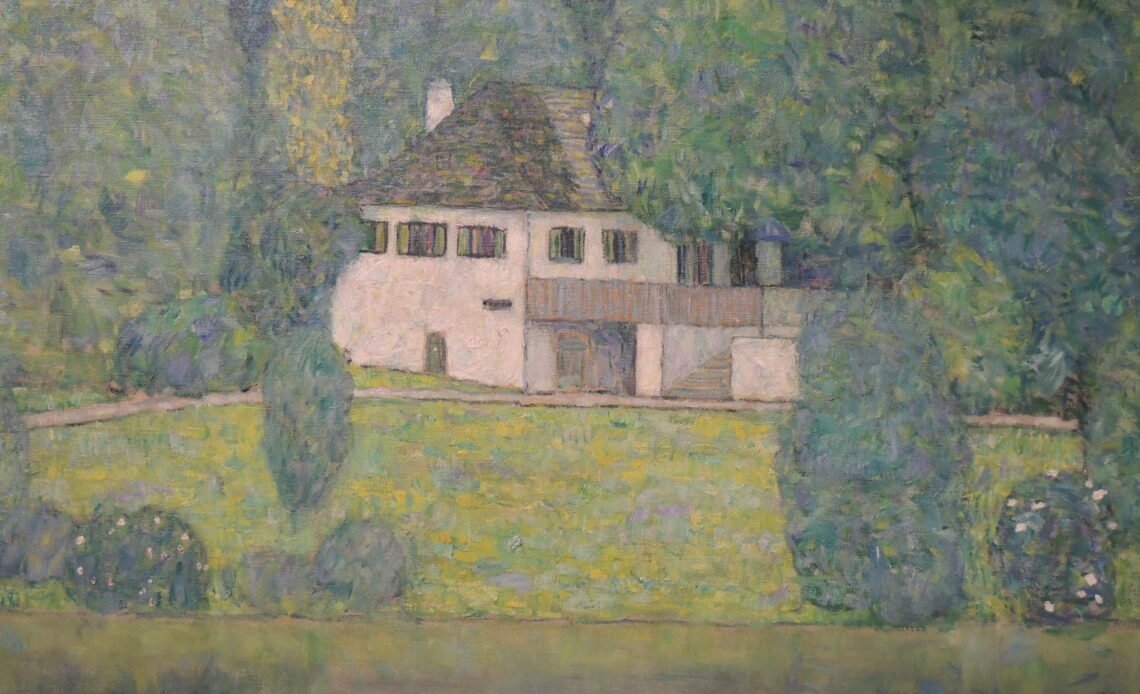
A Gustav Klimt lake scene that spent nearly thirty years hanging quietly in a private collection is about to have its moment under the gavel. On November 17, 2026, Christie’s will headline its 20th Century Evening Sale in New York with “Litzlbergkeller,” a 1915–16 landscape carrying a pre-sale estimate of $60 million to $80 million — a number that, if it lands anywhere near the high end, would more than double what the painting fetched the last time it changed hands.
The painting shows the Litzlbergkeller inn and brewery on the northern shore of Austria’s Lake Attersee, viewed from across the water with no human figures in sight — the kind of still, almost architectural composition Klimt favored during his summer painting retreats. He began the canvas in the summer of 1915 and finished it the following May in his Vienna studio, working, as he often did on his landscapes, with a telescope to fix the distant shoreline in place before laying down the thick, mosaic-like brushwork that defines his Attersee period.
The painting’s paper trail is almost as interesting as the image itself. It was commissioned privately by Otto Primavesi, the Austrian banker and industrialist who became one of Klimt’s most important patrons in the artist’s final years. From the Primavesi family it passed to Hugo Bernatzik, the Austrian photographer and anthropologist, and later to collector Kurt Wieser in the early 1930s before landing with Serge Sabarsky, the Vienna-born dealer who co-founded New York’s Neue Galerie with Ronald Lauder. When Sabarsky’s estate came to auction at Sotheby’s New York in May 1997, “Litzlbergkeller” sold for $14.7 million — a Klimt auction record at the time, equivalent to roughly $31 million today. The family that bought it then is the seller now, having kept the painting out of public view for most of three decades except for a long-term loan to Vienna’s Leopold Museum.
That makes the jump to a $60–80 million estimate a genuine test of where the Klimt market sits right now, rather than a routine resale. The artist’s auction record was reset just a year ago, in November 2025, when “Portrait of Elisabeth Lederer” sold for $236.4 million at Sotheby’s New York, becoming the most expensive work of modern art ever sold at auction and pushing past Klimt’s previous record of $108 million for “Lady with a Fan,” set in 2023. His landscapes trade in a different, though still rarefied, tier: “Birch Forest” brought $104.5 million at Christie’s in 2022. Christie’s has reportedly attached a financial guarantee to “Litzlbergkeller,” meaning the house (or a third party backing it) has assured the consignor a sale regardless of how the room responds on the night — standard practice now for a lot expected to anchor an evening sale, but also a signal of how much confidence the house is putting behind the number.
Before it reaches the saleroom, the painting is doing a short world tour of its own: Christie’s exhibited it in Hong Kong from October 27 to 29, timed to the city’s autumn marquee auction week, before it moves to the house’s Rockefeller Center galleries in New York for public viewing starting November 7, ahead of the sale ten days later. The Hong Kong stop is itself a tell about where the serious money has been moving — Sotheby’s, Christie’s and Phillips combined for more than HK$2 billion (about US$256 million) across their late-September Hong Kong evening sales this autumn, with buyers showing continued appetite for blue-chip Western modernism even as some contemporary names, including Yayoi Kusama, drew a notably cooler reception in the same rooms.
What makes “Litzlbergkeller” a cleaner story than many high-estimate lots is what it doesn’t carry: unlike several other Klimt works that have gone to auction over the past two decades — including “Litzlberg am Attersee,” a similarly named but different painting restituted to the heir of a Holocaust victim and sold in 2011 — this canvas has no restitution history attached to it. Its ownership chain, from the Primavesi commission through Bernatzik, Wieser and Sabarsky to the current family, is documented and undisputed, which likely makes underbidders more comfortable chasing a number this large.
For the broader art market, the sale functions as a check on how much appetite remains at the very top after a run of headline-grabbing results in 2025 and early 2026. A result near the top of the $60–80 million range would confirm that collectors are still willing to pay a premium for Klimt’s Attersee landscapes specifically — quieter, figure-free works that have historically traded for less than his gilded portraits but have been closing that gap steadily. A result that lands closer to the guarantee floor would suggest the market is getting more selective even among blue-chip names. Either way, November 17 will tell us something concrete about where Impressionist and Modern buying stands heading into 2027 — not from an index or a forecast, but from one painting of a brewery on a lake, forty years and three owners removed from the last time anyone outside a single family got to bid on it.