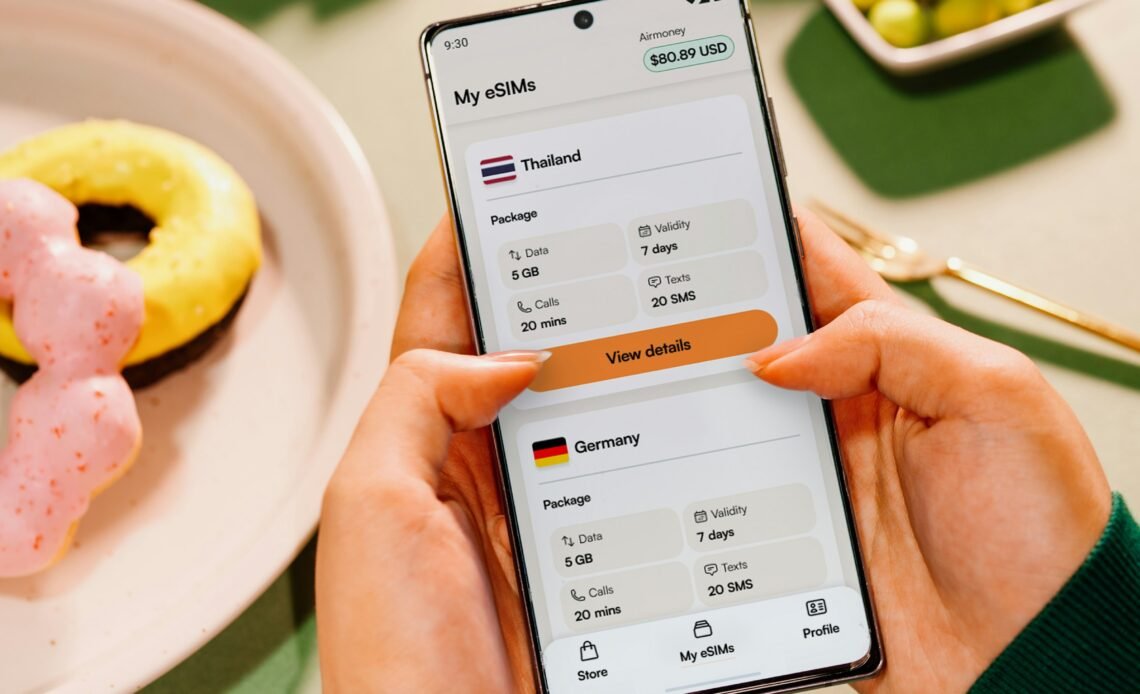
The airport SIM-card kiosk is basically dead. By late 2026, most travelers never touch a physical SIM at all — they buy a data plan from an app before boarding and it’s live the moment they land. The eSIM market has also completely reshuffled since the early “just use your iPhone’s built-in feature” days: there’s now a crowded field of third-party sellers, the big US carriers have overhauled their own travel passes, and even phone compatibility rules have shifted. Here’s what’s actually true right now, with real prices from the providers people actually use.
The eSIM marketplace, not just “your phone’s eSIM feature”
eSIM used to be framed as an iPhone party trick. It’s now a full marketplace. Airalo remains the biggest independent seller, with coverage in 200+ countries and both fixed-data and unlimited plans depending on the destination. Holafly sells unlimited-only plans and positions itself as the no-math option — one price, no data cap, no overage anxiety. Saily, built by the same company behind NordVPN, undercuts both on small, short-trip data allowances and lets you install one eSIM profile once, then keep buying new country plans inside the app without reinstalling. Alongside them, carriers now sell their own travel passes directly — T-Mobile, Verizon, and AT&T in the US, EE and Three in the UK — which activate on your existing number instead of a second profile.
None of these require an unlocked phone the way old roaming SIMs did, and none require you to find a kiosk. You buy, scan a QR code or tap “install,” and you’re done.
What it actually costs right now
Prices on all these platforms shift often, but here’s what each provider’s own site is charging as of November 2026 for unlimited-data plans in three destinations travelers ask about constantly:
| Destination / Provider | 7 days, unlimited | 30 days, unlimited |
|---|---|---|
| Japan — Airalo | $26.50 | $69.00 |
| Europe (41 countries) — Airalo | $27.00 | $71.00 |
| Thailand — Holafly | $27.50 | $73.90 |
If you don’t need unlimited — say, a long weekend where you’re mostly on hotel or cafe Wi-Fi and just need maps and messaging on the go — fixed-data plans are dramatically cheaper. Saily’s United States plans, for example, run $3.99 for 1GB over 7 days, $8.99 for 3GB over 30 days, $13.99 for 5GB, $22.99 for 10GB, and $36.99 for 20GB, with an unlimited 15-day option at $45.99 for heavier use.

If you’d rather stay on your home number entirely, Verizon’s TravelPass charges $12 per day in most of its 210+ covered destinations ($6/day in Mexico and Canada), bundling unlimited talk and text with 5GB of high-speed data per day before throttling to 3G speeds — and you’re only charged on days you actually use the phone abroad. It’s pricier per gigabyte than a dedicated eSIM, but there’s zero setup: your existing number just works.
How setup actually works now
The process has gotten boring in the best way:
- Buy the plan in the provider’s app (Airalo, Holafly, Saily all have one) while you’re still on home Wi-Fi, ideally a day or two before departure.
- Install the eSIM immediately — either by scanning a QR code or, on most current iPhones and Android flagships, a one-tap “Install eSIM” push straight from the app. You don’t need to be at your destination to install; most plans only start counting data days once they detect a network in the covered region.
- Keep your home SIM or eSIM active for calls and verification texts, and let the new eSIM carry data only. Nearly every current phone supports two active profiles (Dual SIM Dual Active or similar), so WhatsApp, iMessage, and your banking app’s 2FA codes keep working on your real number via Wi-Fi calling.
- On landing, toggle on data roaming for the new eSIM line specifically (not your primary line) in Settings, and confirm you’re on the local carrier it’s supposed to use — Airalo’s Japan plan rides SoftBank’s network, for instance, and the app tells you which one to expect.
Pre-installing before you fly also means you land already connected, instead of standing in an arrivals hall trying to get on airport Wi-Fi to download an app.
Does your phone actually support this
Almost certainly yes, with a couple of real exceptions worth checking. On iPhone, every model from the iPhone XS (2018) onward supports eSIM, and in the US specifically, every iPhone from the 14 series onward ships with no physical SIM tray at all — eSIM is the only option, whether you’re home or abroad. On Android, Google’s Pixel 4 and later and Samsung’s Galaxy S20 and later generally support it on unlocked models, but the catch is carrier-locked phones: a Galaxy bought directly from a US carrier has sometimes had eSIM access restricted in software even though the hardware supports it, so it’s worth checking Settings for an “Add eSIM” or “Add Carrier” option before you buy a plan. Older budget Android phones and most phones bought carrier-locked outside North America or Western Europe are the most likely to lack it entirely.
Every provider above — Airalo, Holafly, and Saily — also has a compatibility checker in-app that scans your specific device before you pay, which is the fastest way to confirm instead of guessing from the model number.
The bottom line
For a short trip with light data needs, a fixed-GB plan from Saily or Airalo is the cheapest route by a wide margin. For a longer stay, remote work, or anyone who doesn’t want to think about a data meter, an unlimited plan from Airalo or Holafly costs more per day but removes the guesswork. And if you’d rather not juggle a second profile at all, the carrier travel passes — Verizon’s $12/day TravelPass being the clearest current example — trade a higher per-gigabyte cost for staying on the number you already have. None of it requires finding a kiosk, flashing a new physical card, or waiting in an arrivals-hall line anymore.
Pricing above reflects each provider’s own published rates as of November 2026 and is subject to change — always confirm current pricing in-app before purchasing. Stay tuned for more similar articles on Traroro.com.
