Nvidia reported its fiscal third-quarter results after the closing bell on Tuesday, November 17 — the company’s first earnings report since Jensen Huang resigned as CEO five days earlier. The numbers beat Wall Street’s estimates on every major line: revenue, profit, and the outlook for the current quarter. None of that stopped the broader market from closing lower that same Tuesday, or kept Nvidia’s own shares from a volatile, direction-changing few hours once the report actually hit the wire.
The numbers, by the book
For the quarter ended October 25, Nvidia reported revenue of $115.8 billion, up 103% from a year earlier and up 20% from the prior quarter’s $96.2 billion, according to the company’s own earnings release. That topped Wall Street’s consensus estimate, which had clustered near $109 billion. Data Center revenue — the AI-chip business that now drives nearly all of Nvidia’s sales — came in at $107.6 billion, up 110% year-over-year and accounting for 93% of total revenue. GAAP diluted earnings per share were $2.70, roughly double the $1.30 Nvidia reported a year earlier; adjusted (non-GAAP) EPS was $2.68, ahead of the roughly $2.48 analysts had modeled. Gross margin held at 74.8% on a GAAP basis and 74.9% adjusted, and GAAP net income came in at $65.3 billion for the quarter.
Guidance, buybacks, and a dividend
Nvidia’s outlook came in ahead of expectations too. The company guided fourth-quarter fiscal 2027 revenue to about $130 billion, plus or minus 3%, versus a Wall Street estimate closer to $125 billion, with gross margin guided to a 71%-to-72% range and no Data Center compute revenue from China assumed in the forecast. On capital returns, Nvidia’s board approved a $150 billion increase to its share-repurchase authorization in September; after returning $28.1 billion to shareholders through buybacks and dividends during the quarter, the company still had $227.3 billion left under that authorization at quarter-end. The next quarterly dividend is $0.25 per share, payable December 23 to shareholders of record as of December 2. On the earnings call, interim CEO and CFO Colette Kress said: “Our momentum is real. Nvidia is an exceptional technology leader, powered by the relentless innovation of our people,” adding that “Vera Rubin is off to an explosive start, our roadmap is on track and our ambition has never been greater” — a reference to Nvidia’s next-generation AI chip platform.
A volatile Tuesday on Wall Street
The report landed at the end of a losing session for the broader market. The Dow Jones Industrial Average fell 848.75 points, or 1.6%, to close at 50,759.42 on November 17; the S&P 500 dropped 76.06 points, or 1%, to 7,340.53; and the Nasdaq Composite slid 181.37 points, or 0.7%, to 24,328.38, with Nvidia and other AI-linked stocks among the session’s biggest drags ahead of the report. Nvidia’s own shares had already fallen 4.1% the prior session, November 16, to close at $156.14 — a seventh straight weekly decline and roughly 33% below the stock’s October 2 closing level. Once the earnings numbers hit after Tuesday’s close, Nvidia shares initially jumped, pared most of that gain, then jumped again — rising more than 4% at one point — after Kress told analysts on the call that she was raising the company’s fiscal 2028 revenue-growth outlook to 75% from a prior 70%. Shares briefly turned negative at another point during the same call, underscoring how unsettled trading around the stock has become in the weeks since Huang’s exit.
The seat Kress is filling
Huang resigned as President, CEO, and a board member effective November 12, a move Nvidia’s board had telegraphed days earlier when it disclosed an independent investigation on November 8. Kress, Nvidia’s CFO since 2013, has run the company as interim chief executive since then, and led Tuesday’s earnings call in that capacity. Board Chair Harvey C. Jones, asked directly about Huang’s future at the company, said the board does not intend to reinstate him as CEO and that the search for a permanent successor will be thorough, drawing from both internal and external candidates. Nvidia’s own filings have not tied Huang’s resignation to a specific finding from the board’s review, and the company has said its day-to-day operations, customer commitments, and product roadmap are continuing without interruption under Kress.
The bottom line
Strip away the leadership drama and Tuesday’s filing is unambiguous: Nvidia grew revenue 103% year-over-year, beat its own guidance by a wide margin, raised its forward growth outlook, and expanded its buyback. None of that guaranteed the stock would rise, and the broader market’s decline the same day is a reminder that a single company’s earnings beat doesn’t set the direction for an index with hundreds of other constituents. Nothing here is a signal about where Nvidia shares, the Nasdaq, or any other security goes from this point forward, and nothing in this article is a recommendation to buy, sell, or hold any security.
This article is for educational purposes only and does not constitute investment advice. Always do your own research or consult a licensed financial advisor before making investment decisions. See our Financial Disclaimer for more.
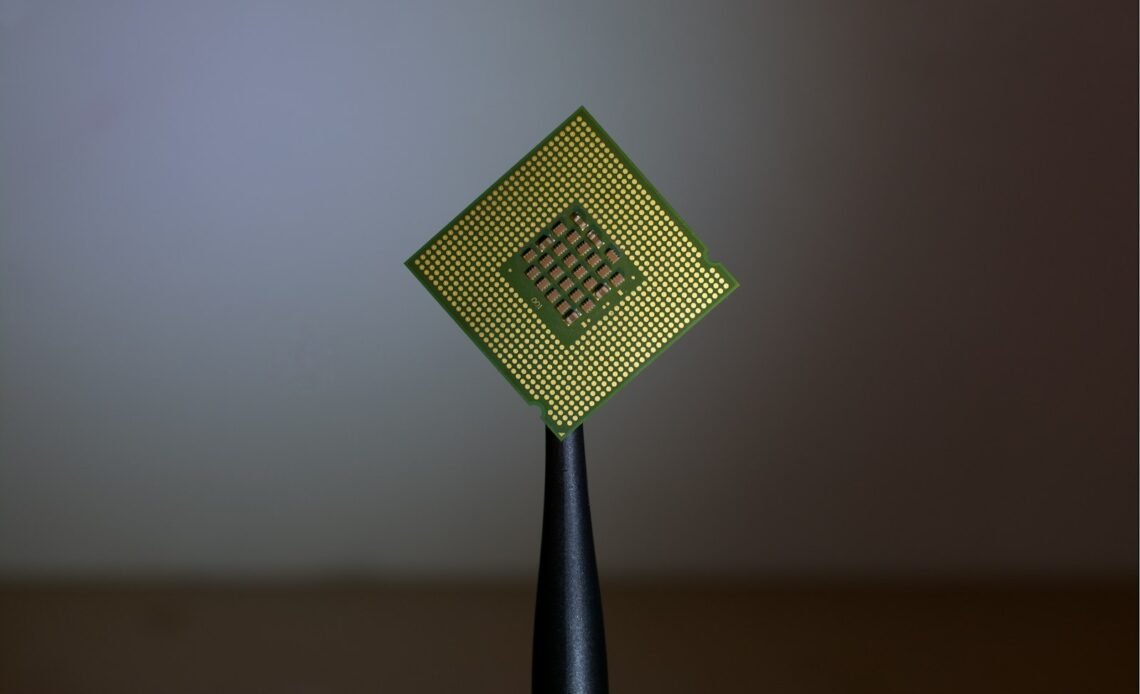
Featured image: a computer processor chip held with tweezers against a neutral background. Photo by Brian Kostiuk on Unsplash.
