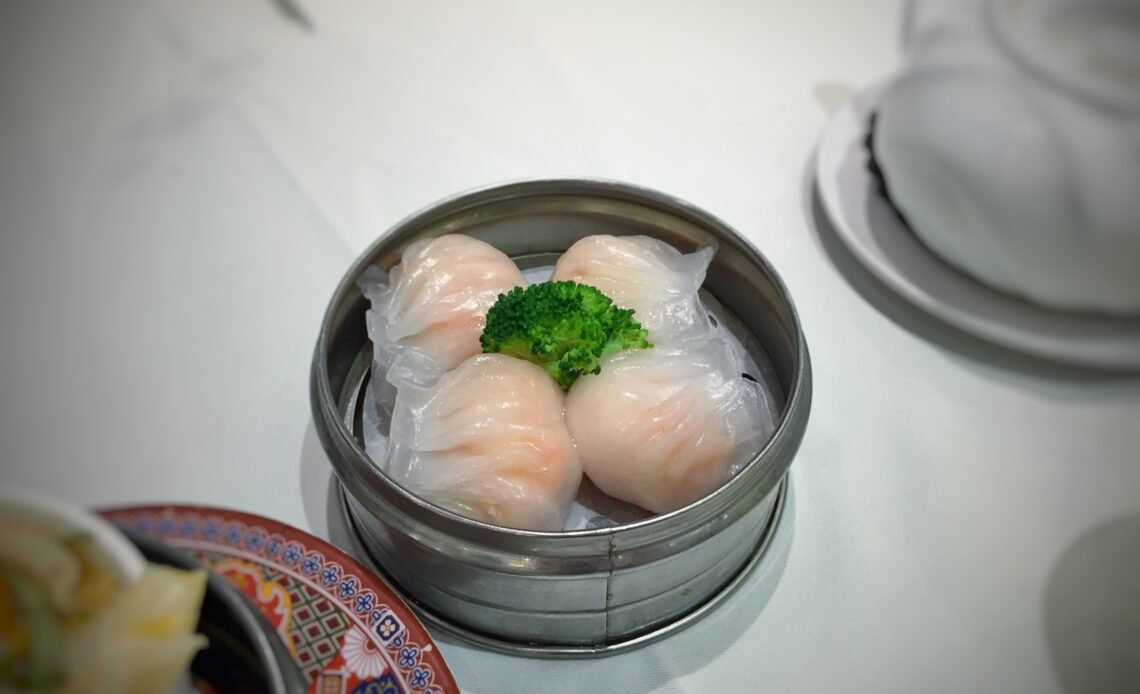
Walk into any Hong Kong dim sum hall and you’ll find har gow (蝦餃) on nearly every table — four or five crescent-shaped dumplings in a bamboo steamer, their wrappers thin enough to show the pink shrimp curled inside. It looks delicate. It’s supposed to. Among Cantonese chefs, har gow has long doubled as an informal skill test: if a cook can get the wrapper translucent, sturdy enough to survive steaming without tearing, and pleated by hand into a dozen even folds, they can be trusted with the rest of the menu.

A Teahouse Dish From Guangzhou
Food historians agree on where har gow comes from — Guangzhou, specifically the teahouses of Wufeng village on the city’s southern edge — but not exactly when. Some accounts trace it to a small Wufeng teahouse sometime in the early 1800s; others date the dish to the 1930s, when a family-run dim sum restaurant there is said to have popularized it under the name Wufeng har gow. What’s consistent is the setting: Cantonese teahouse culture, where diners ordered small steamed plates alongside tea for hours, rewarded dishes that were both inexpensive to make and impressive to look at. A near-transparent dumpling that showed off fresh shrimp through its own skin did both. Cantonese migrants carried it out of Guangdong through the 20th century, and it’s now a fixture on dim sum menus from Hong Kong to London to Los Angeles.
The Wrapper Is the Hard Part
Regular flour won’t work here — gluten makes a dough chewy and opaque, the opposite of what har gow needs. The wrapper is built from wheat starch (澄粉, tang flour — the starch left over after gluten is washed out of wheat flour), cut with a smaller amount of tapioca starch for elasticity. A reliable ratio, close to the one America’s Test Kitchen settled on after repeated testing, is about 3 parts wheat starch to 1 part tapioca starch by weight: 150g wheat starch, 50g tapioca starch, ½ teaspoon salt, and 1 teaspoon vegetable oil, moistened with 230ml (1 cup) of boiling water stirred in immediately with chopsticks until it turns shaggy. The water has to be fully boiling — it’s what “cooks” the wheat starch into a pliable, translucent dough rather than a gritty paste. Knead the warm dough (an oiled hand protects against the heat) until smooth, rest it covered for 10 minutes, then roll walnut-sized pieces into thin, roughly 3-inch rounds. Traditionally this is done not with a rolling pin but with the flat, wide side of a cleaver, pressed and dragged across the dough in one motion — a technique worth watching on video before attempting with a knife.
The Filling Needs Two Textures of Shrimp
For about 24 dumplings: 300g raw shrimp, peeled, deveined, and patted completely dry. Chop half into a rough paste and leave the other half in small chunks — the paste binds the filling, the chunks give it bite, and using only one or the other makes for a mushier or looser dumpling than the real thing. Add 2 tablespoons finely diced bamboo shoots or water chestnut for crunch, 1 teaspoon Shaoxing wine, ½ teaspoon each sugar and salt, a pinch of white pepper, 1 teaspoon cornstarch, and 1 teaspoon sesame oil. Some traditional versions also fold in a small amount of finely diced pork back fat for richness, a holdover from an era when fattier food read as more generous, though most modern versions skip it. Mix everything in one direction with chopsticks until it turns slightly sticky, then chill for 15–20 minutes before filling — cold filling is easier to wrap and holds its shape better in the steamer.
Pleating, Steaming, and the Part That Actually Matters
Place about a tablespoon of filling in the center of each round, fold it over into a half-moon, and pleat just one side — pinching small folds with your thumb and forefinger while the other hand holds the back edge flat — pressing each pleat against the unpleated side to seal. A traditional wrapper carries at least seven pleats, with ten or more considered the mark of real skill; fewer than that and the dumpling looks flat and amateurish, not dainty. Line a bamboo steamer with parchment paper or a cabbage leaf so the dumplings don’t stick, leave space between them since the wrappers will swell slightly, and steam over high heat for 5 to 6 minutes — any longer and the thin skins turn gummy or split. Serve them straight out of the steamer, ideally with a small dish of black vinegar and julienned ginger on the side, which cuts through the shrimp’s sweetness the way soy sauce alone doesn’t.
It’s a dish with almost no margin for shortcuts: the dough has to be the right temperature to roll, the filling has to be cold enough to handle, and the pleats have to be even enough to seal without tearing. That’s exactly why Cantonese kitchens have used it, for the better part of two centuries, as the dumpling that tells you whether a chef can actually cook.
