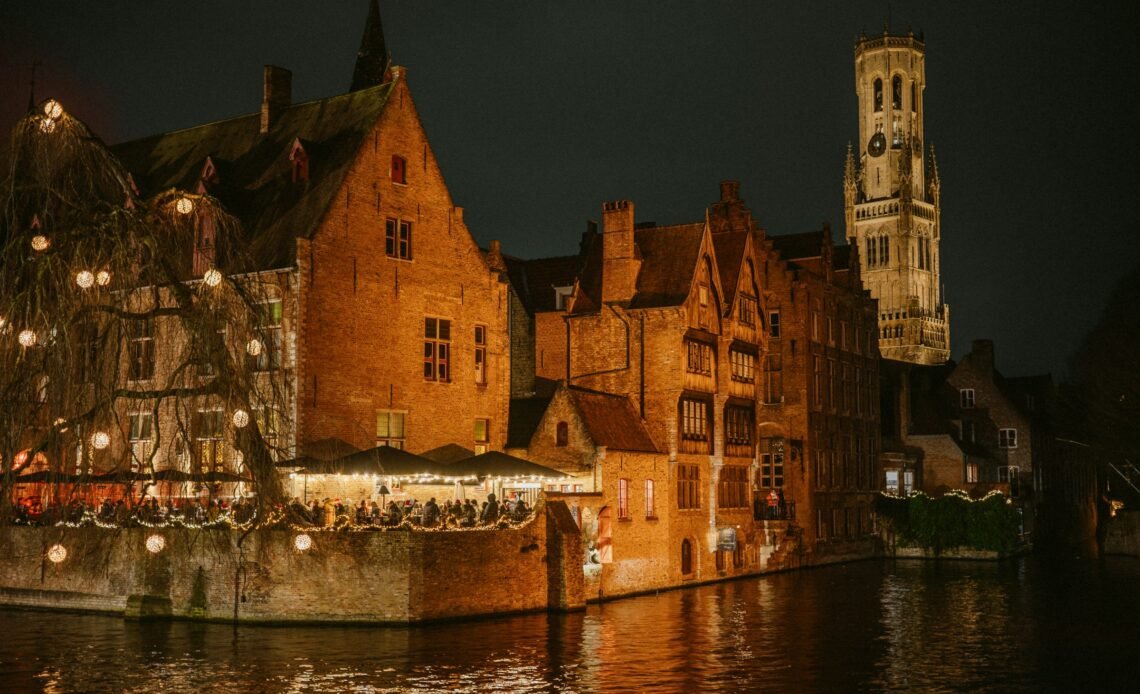
Belgium rewards a tight itinerary better than almost anywhere else in Europe — Brussels, Ghent, and Bruges sit close enough together that you can stand in a medieval cloth hall at breakfast and a Gothic belfry by dinner. Two days isn’t enough to linger, but it’s enough to see why this stretch of Flanders produced some of the most contested, most stolen, and most quietly rebuilt art and architecture on the continent: a cathedral painting with a missing panel the police never closed the case on, a city square the French burned to rubble and the guilds rebuilt out of spite, and a Michelangelo that ended up hidden in an Austrian salt mine.

Day 1: Brussels
Start at the Grand Place, which looks uniformly Baroque today only because the French don’t. In August 1695, a 70,000-strong army under Marshal François de Neufville, duc de Villeroy, bombarded Brussels to draw Allied forces away from a siege elsewhere — and flattened nearly the entire square, leaving only the Town Hall’s facade and tower standing. The guilds rebuilt it within about four years, each house a little showier than its neighbor’s, under rules the city council imposed on the reconstruction. UNESCO inscribed the result as a World Heritage Site in 1998, calling it the best surviving example of the civic architecture of a prosperous northern European trading city. The Brewers’ Guild House, one of the few structures that actually survived the bombardment, still holds a brewers’ museum today.
A five-minute walk away, the Manneken Pis draws the kind of crowd a 61-centimeter bronze statue has no business drawing — it’s been dressed in costumes from the City of Brussels’ own wardrobe of more than 1,000 outfits since at least the 18th century, with a new one for most weeks of the year. For lunch, join the line at Maison Antoine on Place Jourdan, the fritkot that’s been frying potatoes twice in beef fat since 1948 and has reportedly fed Belgium’s own king. In the afternoon, take the metro to the Atomium, built for the 1958 World’s Fair as a 165-billion-times-magnified iron crystal and meant to stand for six months; current single adult admission to the observation deck runs €17. Close the day with mussels and a Trappist beer in the Sainte-Catherine neighborhood, then walk back through the Grand Place lit up after dark — it’s free, and the guild houses look even more deliberately excessive by floodlight.
Day 2, Morning: Ghent
Trains from Brussels-Central to Ghent-Sint-Pieters run roughly every 15-20 minutes and take about 35 minutes — an easy first move. Ghent’s wealth was built on medieval cloth trading, and the Gravensteen, the “Castle of the Counts” built around 1180 by Philip of Alsace, was positioned deliberately to remind the city’s increasingly rich and rebellious merchants who was still in charge; it’s open daily 10am-6pm (last admission 4:40pm), adult tickets €15. Climb the 14th-century Belfry next door (adult tickets €11) for a rooftop view of the whole historic core, then walk to Saint Bavo’s Cathedral to see the real draw: the Ghent Altarpiece, Jan and Hubert van Eyck’s 1432 masterpiece and one of the most stolen artworks in history. Napoleon’s troops took panels in 1794; the Nazis took the whole thing in World War II. Stranger still, one panel — “The Just Judges” — was stolen from the cathedral on the night of April 10, 1934, and has never been recovered. The lead suspect, Arsène Goedertier, died of a heart attack that November without fully confessing; a Ghent police detective reportedly remains formally assigned to the case to this day. The panel now hanging in its place is a copy by restorer Jef Van der Veken — who, as a quiet joke, gave one of its horsemen the face of Belgium’s king at the time, Leopold III. Separate admission to the altarpiece’s visitor centre runs about €12.50. Grab a quick bite nearby: Tierenteyn-Verlent, a mustard shop on the Groentenmarkt dating to 1790, still fills customers’ own jars by hand and sells nowhere else — buy a pot for the road before you leave.
Day 2, Afternoon and Evening: Bruges
Direct trains from Ghent-Sint-Pieters to Bruges run about every 20-30 minutes and take roughly 25-30 minutes, so there’s no need to double back through Brussels. Bruges earned its “Venice of the North” nickname honestly — the canals aren’t decorative, they’re what let a 12th-century inland town function as one of medieval Europe’s busiest ports until the Zwin channel silted up and the sea trade moved to Antwerp, leaving Bruges’s entire medieval core frozen in place by accident rather than design. Climb the Belfort (adult admission €15 in the current off-season rate, 366 steps) for the view, then walk to the Church of Our Lady, home to Michelangelo’s “Madonna of Bruges” — the only sculpture of his to leave Italy during his own lifetime, originally bought around 1504 by two Bruges merchant brothers. The Nazis seized it from the church in September 1944; Allied “Monuments Men” recovered it the following year from Austria’s Altaussee salt mine, where retreating German forces had stockpiled looted art. Standard museum admission is €8. Finish along the Rozenhoedkaai canal bend at golden hour — the single most photographed view in Belgium, and for once, the postcard undersells it.
Practical Notes
Basing in Brussels or Ghent both work since trains between all three cities run frequently throughout the day; buy tickets via the SNCB-NMBS app rather than at the station to skip queues. Budget roughly €70-100 a day per person outside lodging once you’ve covered the Atomium, Gravensteen, Belfry, altarpiece, and Bruges Belfort admissions plus sit-down meals. Spring and early autumn bring milder weather and shorter lines at all three cities’ main sights than peak summer; book the Ghent Altarpiece visitor centre slot a few days ahead regardless of season, since it’s the one attraction here that reliably sells out.
