Kyoto was Japan’s imperial capital for 1,074 years — from 794, when Emperor Kanmu moved the court here and named it Heian-kyo (“capital of peace and tranquility”), until 1868, when the Meiji government shifted power to Tokyo. That run left the city with a density of real history rare anywhere: more than 1,600 Buddhist temples and 400 Shinto shrines inside the city limits, several of them older than most European nations. It has also made Kyoto openly fight its own popularity: in 2019, residents of the historic Gion district voted to ban tourist photography on its private side streets, backed by a ¥10,000 fine, after geisha and maiko complained of being chased and grabbed at for selfies. Late November is arguably the best window to see it without the spring crush — the city’s ginkgo trees are peaking in yellow right around now, with the maples following at a red peak forecast around December 11, 2026. Five days is enough to cover Kyoto’s four historic quarters properly, plus one day given over entirely to a single temple complex.


Day 1: Higashiyama and Gion, where the old capital still looks old
Start at Kiyomizu-dera, founded in 778 — before Kyoto was even the capital — and named for the Otowa Waterfall that still runs through its grounds; its wooden stage juts off a hillside with a view back over the city, part of the UNESCO-listed Historic Monuments of Ancient Kyoto. General admission is ¥400. Walk down through the preserved lanes of Sannenzaka and Ninenzaka into Gion, Kyoto’s geisha district, which grew up as an entertainment quarter in front of Yasaka Shrine (traditionally founded in 656) to serve pilgrims and, later, the crowds of the Gion Matsuri festival the shrine has hosted since 869. Gion’s machiya townhouses, concentrated along Hanamikoji Street, function as ochaya teahouses where geiko and maiko still entertain by reservation. Stick to the public streets if you’re carrying a camera: since 2019, a residents’ association has banned photography on Gion’s private side alleys, with a ¥10,000 fine, after one geisha had her kimono torn and another had a lit cigarette pressed into her collar by tourists chasing photos. End the day in neighboring Pontocho Alley, a narrow lantern-lit lane of restaurants along the Kamo River, for dinner.
Day 2: Fushimi Inari at dawn, then Nishiki Market
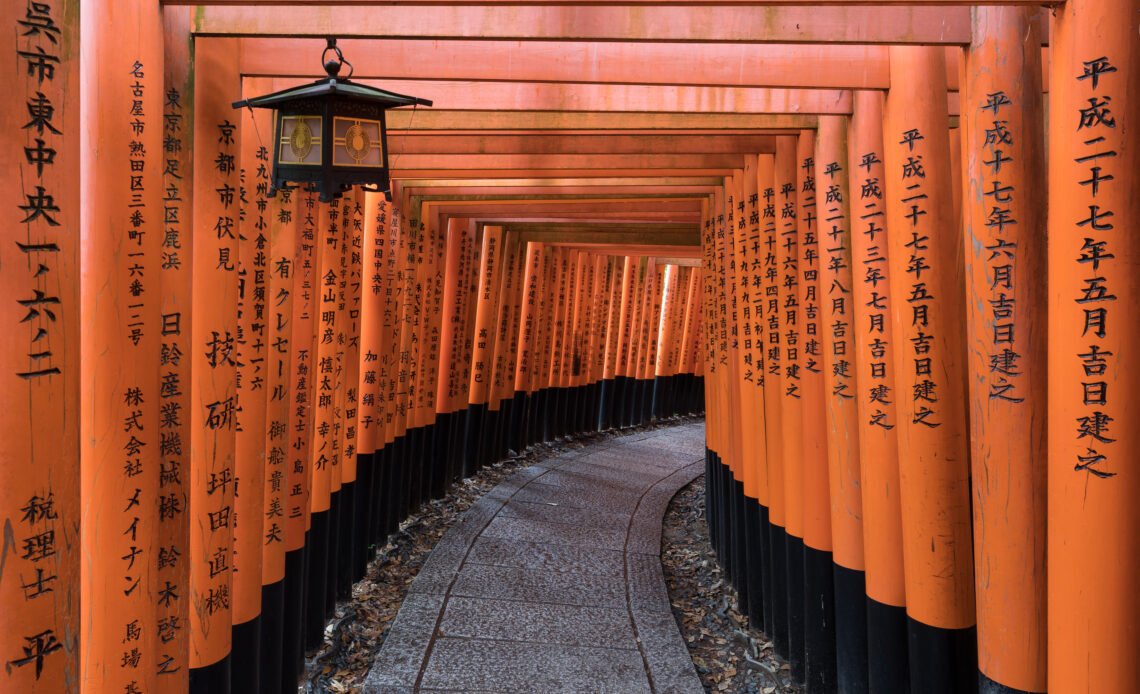
Fushimi Inari Taisha, head shrine of Japan’s roughly 30,000 Inari shrines, is said to date to 711 — tradition holds it predates Kyoto becoming the capital by over 80 years. Its famous Senbon Torii path is a tunnel of vermilion gates, each donated by a business or individual whose name is inked on the back; the main path alone carries around 800 of them, climbing Mount Inari. It’s free and open 24 hours, but go by 8am: crowds thicken fast after mid-morning. Take the JR line or Keihan line back toward central Kyoto and spend the afternoon in Nishiki Market, a narrow covered arcade recognized as an official fish market by the Edo shogunate in 1615 and still nicknamed “Kyoto’s Kitchen” for its roughly 130 food stalls selling yuba (tofu skin), fresh unagi, and tsukemono pickles. Kyoto’s well water, historically some of the cleanest in the city, is part of why a food market took root here in the first place.
Day 3: Kinkaku-ji, Ryoan-ji, and Arashiyama’s bamboo
Kinkaku-ji, the Golden Pavilion, began as shogun Ashikaga Yoshimitsu’s retirement villa in 1397; a disturbed monk burned the original building to the ground in 1950, and the gold-leafed structure visitors photograph today is a 1955 reconstruction. Admission is ¥500. A short bus ride away, Ryoan-ji’s rock garden — fifteen stones arranged so that no vantage point shows all of them at once — is the most famous example of Zen kare-sansui design in Japan. Spend the afternoon in Arashiyama: the bamboo grove near Tenryu-ji is free to walk and busiest before 9am, when the light through the stalks is also best for photos. Tenryu-ji itself was founded in 1339 by shogun Ashikaga Takauji to pray for the soul of Emperor Go-Daigo, with Zen master Muso Soseki as its first abbot; its Sogenchi Pond garden, designed by Soseki, is one of the oldest landscape gardens in Japan and part of the same UNESCO listing as Kinkaku-ji. Finish at Togetsukyo Bridge over the Katsura River, where Arashiyama Yoshimura serves handmade soba from a dining room with floor-to-ceiling glass facing the water and the mountains behind it.
Day 4: Nijo Castle and the Philosopher’s Path
Nijo Castle was built in 1603 as Tokugawa Ieyasu’s Kyoto residence, the seat of the shogunate that would rule Japan for the next two and a half centuries — and, fittingly, the site where the last shogun formally returned power to the emperor in 1867. Its Ninomaru Palace floors are built to creak under footsteps, a defense called uguisubari (“nightingale floors”) meant to warn of intruders; a combined castle-and-palace ticket runs ¥1,300. In the afternoon, walk the Philosopher’s Path, a canal-side trail named for a 20th-century Kyoto University philosopher who used it for his daily walk, up to Ginkaku-ji, the Silver Pavilion — never actually covered in silver, despite the name, after the shogun who commissioned it died before the plan was finished.
Day 5: Slow morning, then one last market crawl
Keep the last day loose. Many ryokan and tea houses around Gion and Arashiyama offer walk-in or reservation-based tea ceremony sessions lasting 45 minutes to an hour, a practical, low-key way to see the choreography behind Kyoto’s biggest cultural export before you leave. Spend what’s left of the day back in Nishiki Market or Pontocho picking up gifts — Kyoto’s tea houses sell matcha by the gram, and several century-old shops near Nishiki still deal exclusively in dried bonito flakes or pickled vegetables, trades that have barely changed since the Edo period.
Practical notes
Fly into Kansai International (KIX) or Osaka Itami, then take a train or limousine bus to Kyoto Station — there’s no airport inside the city. Get an ICOCA IC card on arrival for buses, subways, and trains, or buy the Kyoto City Subway & Bus 1-Day Pass (¥1,100 for adults) if you’re moving around a lot in one day; most of the sights above are also walkable within their own districts. Budget roughly ¥8,000-12,000 a day per person outside lodging once temple admissions, transport, and meals are factored in. Best times to visit are early April for cherry blossoms or, as now, mid-November through mid-December for autumn color — just book accommodation well ahead for either window, since both sell out fast.
This article contains affiliate links, including Klook and Trip.com. We may earn a commission on qualifying bookings — see our Affiliate Disclosure for details.