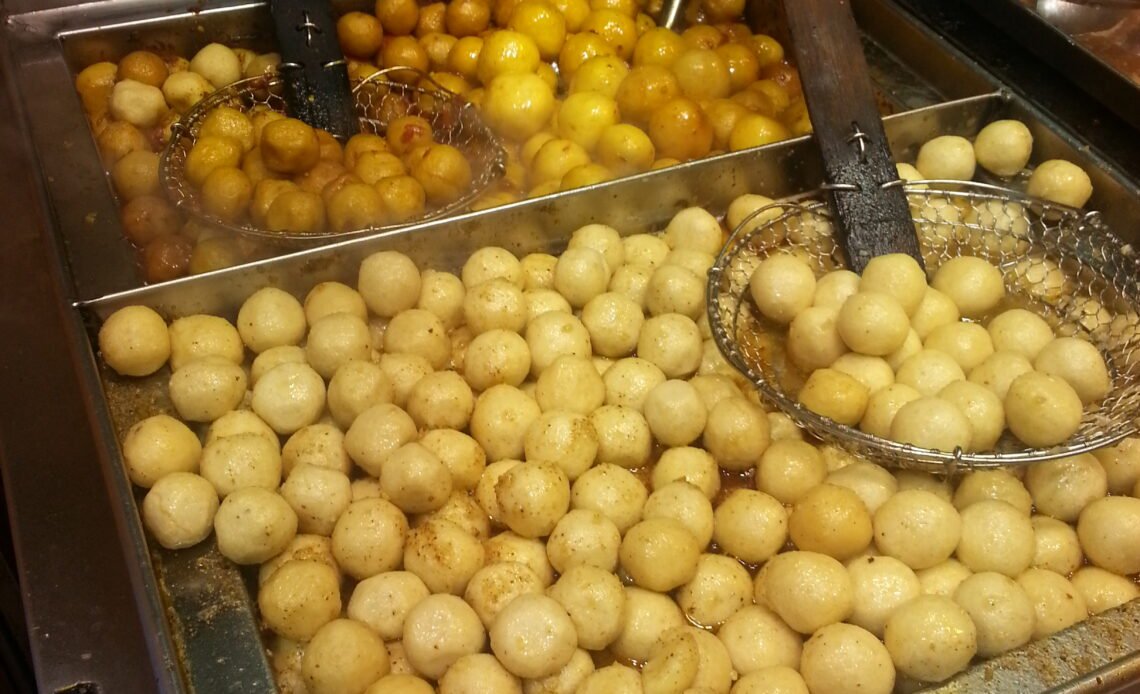
No Hong Kong street food gets fought over quite like the curry fish ball (咖喱魚蛋) — a skewer of golf-ball-sized, deep-fried spheres bobbing in a thick, orange curry sauce, sold from carts and hole-in-the-wall counters on nearly every commercial street in the city. It’s cheap, it’s everywhere, and depending on who’s talking, it’s either a beloved culinary icon or a factory-made snack barely worth the name “fish.” Both things are true at once, which is most of what makes it worth explaining properly.

Two Different Fish Balls, Wearing the Same Name
Hong Kong actually runs on two separate fish balls, and the confusion between them is older than the curry version itself. Fish balls arrived in southern China via Chiu Chow (Teochew) and Fujianese communities, where they’ve been a popular street food since at least the Qing dynasty, made by scraping and pounding fresh fish flesh off the bone into a paste. Those are the pale, “white” fish balls — handmade, higher in actual fish content, usually served in clear broth or fish ball noodle soup. The yellow, deep-fried street-cart version most visitors mean when they say “fish ball” is a different, cheaper product: mass-produced by machine from a paste that commonly runs under 20% real fish meat, colored and firmed up for frying, and built specifically to be a vehicle for the curry sauce rather than a showcase for the fish itself. Kowloon Walled City, long a Chiu Chow stronghold before its 1993 demolition, was once one of the biggest production hubs for Hong Kong’s fish balls — cheap, dense, and semi-legal, exactly the environment that turned fish balls from a Chiu Chow specialty into a city-wide staple.
How the Curry Got There
The curry sauce itself is a 1950s addition, not part of the original Chiu Chow fish ball tradition. In the post-war decades, mobile cooked-food hawkers — “che chai” stalls working off bicycles and pushcarts, the same scene that produced cart noodles — started simmering fish balls in a thick, curry-powder-based sauce to make a cheap snack taste like more than boiled fish paste. Every stall guarded its own sauce recipe to stand out from the next cart over, which is the real reason there’s no single “authentic” curry flavor today: some lean sweet, some lean on chili heat, and the only constant is the deep orange-red color and a sauce thick enough to cling to a skewer. Hong Kong-style curry powder — milder and more turmeric-forward than Indian blends — is the traditional base, though it’s hard to find outside Hong Kong, which is why most non-local recipes substitute Madras curry powder instead.
Why the Texture Actually Bounces
The springy “bounce” (Q彈) that defines a good fish ball isn’t a trick of starch — it’s protein chemistry. Salt dissolves the myosin in fresh fish flesh, and the repeated slapping or throwing of the paste against a bowl develops that dissolved protein into a tight, elastic network, the same basic mechanism behind a well-kneaded dough’s gluten. Keeping everything near-freezing throughout — the fish, the mixing bowl, even the water added to loosen the paste — is just as important: warm paste lets the protein denature before it gets the chance to set that structure, which is why most recipes insist on ice water instead of room-temperature water.
The Recipe
For the fish balls: pulse 1 lb (450g) skinless white fish fillet (dace, grey mullet, or any firm white fish) in a food processor with 2 teaspoons salt, 1 teaspoon sugar, 2 tablespoons cornstarch, and ¼ cup ice-cold water, pulsing in short bursts rather than running continuously, which overheats the paste and makes it rubbery instead of bouncy. Once it comes together, wet your hands and slap the paste against the bowl, or throw it down hard, for about 60 strokes — this is what builds the bounce, not an optional flourish. Shape into 1-inch balls by squeezing the paste through a loosely closed fist and scooping off each ball with a wet spoon, then test one in a bowl of water: a properly aerated ball floats. Deep-fry at 350°F (175°C) for 3-4 minutes until pale gold.
For the curry sauce, sauté 2 minced shallots in oil until soft, then whisk in 1½ tablespoons flour to form a light roux. Add 2 cups chicken stock, ⅓ cup coconut milk, 3 tablespoons curry powder (Madras works as a substitute for Hong Kong-style blends), 1 tablespoon soy sauce, ¼ teaspoon white pepper, and ½ teaspoon sugar. Simmer, stirring, for about 10 minutes until it thickens enough to coat a spoon, then drop in the fried fish balls and simmer another 5 minutes so they soak up the sauce. Serve on a skewer, street-cart style, or over rice with extra sauce spooned on top.
Where the Tradition Is Thinning Out
The handmade side of this story is quietly disappearing. Cheung Chau’s Kam Wing Tai, one of the island’s best-known handmade fishball stalls, closed for good in August 2024, part of a broader decline in small fish ball makers who can’t compete with factory pricing. What’s left is mostly the cheap, mass-produced yellow ball doing curry duty on street corners, and a shrinking number of old-school shops — Sham Shui Po’s Kung Wo Beancurd Factory among the names still cited for doing it the traditional way — still worth seeking out specifically because they haven’t switched over.