Qualcomm closed out its 2026 fiscal year on November 4 with a results release that was less about the quarter itself and more about where the company says its next act is heading — and it buried a one-time accounting windfall almost as big as the headline news.
The numbers, as Qualcomm reported them
Per the company’s own fourth-quarter and fiscal 2026 earnings release, filed with the Securities and Exchange Commission as an 8-K exhibit on November 4, 2026, Qualcomm’s fiscal fourth quarter (the three months ended September 27, 2026) brought in $10.32 billion in GAAP revenue — down 8% from the same quarter a year earlier — and $10.44 billion on a non-GAAP basis, down 7%. GAAP diluted earnings per share for the quarter came to $1.17; non-GAAP diluted EPS was $2.17, which fell within the $2.05–$2.25 range the company had guided to going into the quarter.
For the full fiscal year, Qualcomm reported GAAP revenue of $43.12 billion and non-GAAP revenue of $43.24 billion. Full-year GAAP diluted EPS landed at $12.70, against non-GAAP diluted EPS of $10.54 — a gap wide enough to require an explanation, and the filing supplies one: Qualcomm recorded a $5.7 billion income tax benefit, worth $5.32 per share, from releasing a valuation allowance that the company had originally established back in fiscal Q4 2025. That release was booked earlier in fiscal 2026, in the second quarter, and it’s an accounting entry — not operating cash the business generated this quarter — which is exactly why non-GAAP EPS strips it out and GAAP EPS doesn’t.
The real story: Qualcomm is betting its next chapter is not phones
The release’s actual headline wasn’t the tax item — it was “Renewed Long-term QTL License Agreements with Apple, Huawei and Transsion.” QTL is Qualcomm’s patent-licensing division, the business that collects royalties on cellular technology regardless of whose chips end up in a given phone. Locking in Apple, Huawei, and Transsion (the Shenzhen-based company behind the Tecno, Infinix, and itel phone brands, which ships more handsets across Africa than any other manufacturer) for the long term secures a predictable royalty base at a moment when Qualcomm is publicly trying to make that base matter less to its story.
In the release, CEO Cristiano Amon framed fiscal 2027 — which started on September 28, 2026 — as “the start of our non-handset revenue inflection,” with non-handset revenue projected to grow more than 60% year over year. The release also disclosed a new multi-generational product collaboration with Amazon aimed at AI data centers, without disclosing financial terms, and reiterated a target of $5 billion in data-center revenue for fiscal 2027 — a figure Qualcomm has now repeated across multiple quarters as a marker investors can hold it to.
For context on where that leaves the next quarter: Qualcomm guided fiscal first-quarter 2027 revenue to a range of $10.4 billion to $11.2 billion, split between $9.0–$9.6 billion from its chip business (QCT) and $1.3–$1.5 billion from licensing (QTL), with GAAP diluted EPS guided to $1.03–$1.23 and non-GAAP diluted EPS to $2.15–$2.35. That’s company guidance, not a forecast of our own — Qualcomm’s own stated range for the quarter it’s currently in.
Why the licensing renewals matter beyond this one quarter
Qualcomm’s QTL licensing arm has spent the better part of two decades fighting regulators and customers — including a multi-year legal battle with Apple that only settled in 2019 — over how much phone makers owe for the cellular patents in Qualcomm’s portfolio. Locking in three of the highest-volume handset relationships in the world (an iPhone maker, the dominant Chinese brand that builds around its own in-house modems, and the largest feature-and-budget-phone exporter in Africa) at once removes renewal-related uncertainty from three very different corners of the smartphone market in a single release. It’s also a signal of where Qualcomm wants the market’s attention: not on whether handset royalties will keep flowing — the release suggests they will — but on whether the data-center bet announced alongside them actually shows up in revenue by the time fiscal 2027 closes.
The bottom line
Qualcomm’s fiscal 2026 ended with revenue down modestly year over year, a headline EPS number inflated by a one-time, already-disclosed tax item, and a fourth quarter that landed inside the company’s own guidance range rather than surprising it in either direction. The more consequential news sits one layer down: three renewed licensing deals that secure Qualcomm’s existing cash engine, paired with a reiterated, specific data-center revenue target and a named partner (Amazon) that gives the next few quarters something concrete to check against. None of this is a signal to buy, sell, or hold any security — it’s simply what the company itself disclosed, and what it says it’s planning to do next.
This article is for educational purposes only and does not constitute investment advice. Always do your own research or consult a licensed financial advisor before making investment decisions. See our Financial Disclaimer for more.
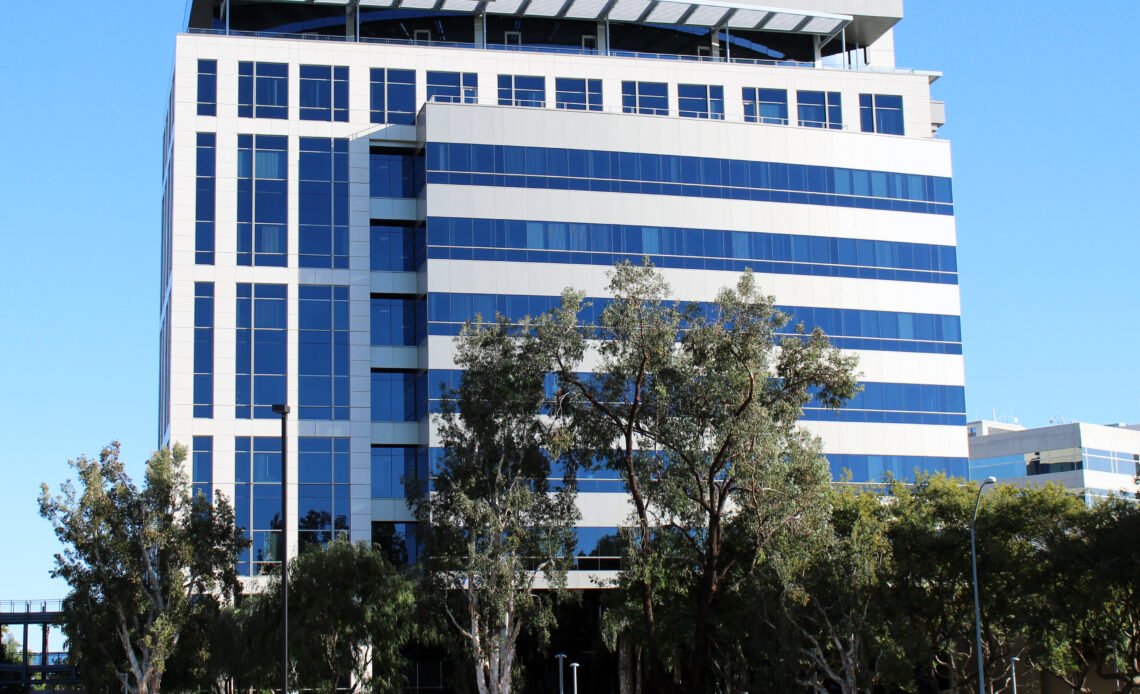
Featured image: Qualcomm headquarters, La Jolla, San Diego. Photo by Coolcaesar via Wikimedia Commons, licensed CC BY-SA 4.0.