Most Paris trips get rationed into a long weekend and a shortlist: Eiffel Tower, Louvre, done. Five days is enough to actually stop rationing — to climb a tower Parisians once hated enough to ban anything like it for decades, eat a hot chocolate thick enough to eat with a spoon, and spend a full day outside the city at a palace that bankrupted a kingdom. This itinerary covers the Right Bank and Left Bank in roughly geographic order, with one honest correction: Centre Pompidou, a fixture of every old Paris list, has been closed since September 2025 for a five-year renovation and won’t reopen until 2030 — it’s dropped here rather than sent you to a shuttered building.

Day 1: Montparnasse and the Left Bank
Start at Tour Montparnasse, built between 1969 and 1973 as the glass-and-steel symbol of a modernizing Paris — and almost immediately despised for blotting the skyline visible from everywhere in the city. The backlash was strong enough that Paris banned buildings over 25 meters in the city center in 1977; that ban lasted until 2015, then was reinstated in 2023 (new construction is now capped around 37 meters) after a second tower, Tour Triangle, reopened the fight. Tour Montparnasse remains the only skyscraper inside the city’s ring road, and its 56th-floor observation deck is still one of the few Paris viewpoints where the Eiffel Tower is actually in the frame rather than underfoot. From there, walk or take the Métro to the Musée d’Orsay, itself a converted Belle Époque train station (Gare d’Orsay, 1900) that stopped running long-distance trains by the 1930s because its platforms were too short for modern trains — it sat half-abandoned until its 1986 rebirth as the world’s deepest collection of Impressionist and Post-Impressionist painting, Monet to Van Gogh. Reserve a timed slot in advance; the museum made online booking mandatory as of March 2026. Spend the evening in the Latin Quarter around Luxembourg Garden, the 17th-century royal garden Marie de’ Medici commissioned to remind herself of her native Florence, now Paris’s most popular free picnic spot.
Day 2: Arc de Triomphe to the Eiffel Tower
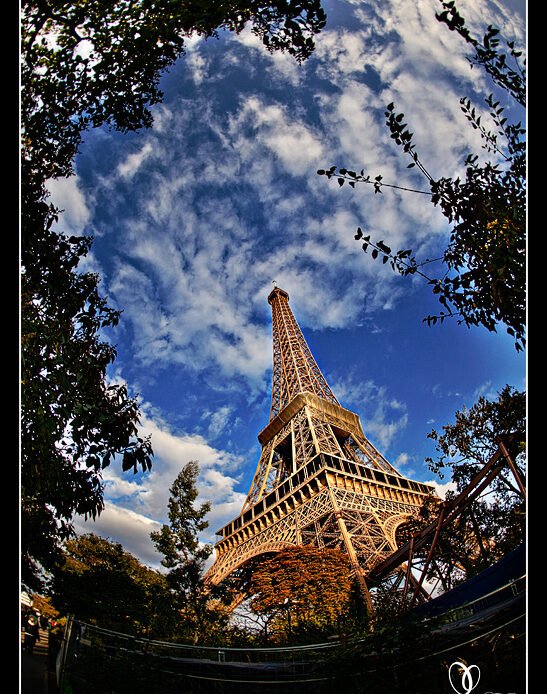
Napoleon commissioned the Arc de Triomphe in 1806 to honor his army, then lost his empire before it was finished in 1836 — the Tomb of the Unknown Soldier has burned an eternal flame beneath it since 1920. Climb to the rooftop (around €16) for the view down twelve converging avenues, then walk the Champs-Élysées toward the Seine. Pont Alexandre III, built for the 1900 Exposition Universelle and named for the Russian tsar who’d allied France against Germany, is the single most ornate bridge in the city — gilded Art Nouveau lamps, winged horses, nymphs holding up the ironwork. Board a Seine cruise from the Pont de l’Alma docks (Bateaux Parisiens runs roughly hourly, about €18–20 for a one-hour loop) to see Notre-Dame, the Louvre, and the Eiffel Tower from the water before dark. Save the Tower itself for evening: Gustave Eiffel’s 1889 World’s Fair centerpiece was a 20-year temporary structure, kept past its demolition date only because the French army found its height useful for radio transmission. Elevator access to the second floor runs about €23.50; the summit adds considerably more, so decide in advance how high you actually want to go.
Day 3: The Louvre, Notre-Dame, and the Marais
Give the Louvre a full morning — it’s a 12th-century fortress turned royal palace turned museum, and non-EU visitors now pay €32 (a 45% hike that took effect in January 2026, part of funding the museum’s ongoing renovation). Lunch at Carette, the tearoom Jean and Madeleine Carette opened on Place du Trocadéro in 1927 and which is still, a century later, one of the better addresses in the city for a proper French macaron. In the afternoon, walk to Notre-Dame: the cathedral reopened in December 2024 after the 2019 fire and five-year restoration, nave entry is free with a recommended timed reservation, and the north tower climb (around €16, booked separately through the cathedral’s own ticketing site) gets you level with the gargoyles for the first time since the fire. Cross to Île Saint-Louis for a scoop at Berthillon if the line allows — the shop that’s been making Paris’s best ice cream since 1954 — then finish in the Marais. With Centre Pompidou dark until 2030, the neighborhood’s own history carries the evening instead: Place des Vosges, Paris’s oldest planned square (1612), sits in what used to be the city’s aristocratic quarter before it became, in the 20th century, home to one of Europe’s most significant Jewish communities — still visible on Rue des Rosiers today.
Day 4: Versailles
Give Versailles the entire day — it’s a 40-minute RER C train from central Paris, but the Estate is genuinely too large to rush. Louis XIV moved the French court here permanently in 1682, partly to escape Paris and partly to keep ambitious nobles too busy with court ritual to plot against him; the Hall of Mirrors, 73 meters of gilt and 357 mirrors, was built to reflect the gardens and the king’s glory in equal measure, and it’s where the treaty ending World War I was signed in 1919. A Passport ticket covering the Palace, gardens, and the Estate of Trianon runs €25 in low season and €35 in high season for non-EU/EEA visitors (€22/€32 for EU residents) — book a timed slot, since the Palace fills by mid-morning. The Trianon estate, a 40-minute walk or short tram ride from the main château, was Marie Antoinette’s retreat from formal court life, complete with a mock peasant hamlet she had built so she could play at rural simplicity a few hundred meters from the most ornate palace in Europe.
Day 5: Rodin, Les Invalides, and Montmartre
Start at the Musée Rodin (€14, including the sculpture garden), set inside the Hôtel Biron, the 18th-century mansion where Auguste Rodin lived and worked his final years in exchange for donating his life’s work to the state — The Thinker sits in the garden exactly as he intended it, as an outdoor piece rather than a museum centerpiece. Les Invalides is a five-minute walk: Louis XIV built it in 1670 as a hospital and retirement home for wounded soldiers, and its golden-domed chapel now holds Napoleon’s tomb, a sarcophagus of red quartzite inside four more coffins, moved here in 1840 nearly two decades after his death on Saint Helena (full Musée de l’Armée access, including the tomb, runs about €17). Walk north for lunch at Le Comptoir de la Gastronomie on Rue Montmartre — a 1894-era delicatessen-turned-bistro near Les Halles still built around foie gras, duck, and house charcuterie — then cross to Rue de Rivoli for Angelina’s signature “l’Africain” hot chocolate (around €9–10), a recipe the tea room has served since 1903 and thick enough that regulars order it with a side of whipped cream just to cut it. Close the trip at Sacré-Cœur in Montmartre: construction began in 1875 as a national penance pledge after France’s 1870-71 defeat by Prussia, took nearly forty years and five architects, and wasn’t consecrated until 1919 — the basilica is free to enter, and the hill it sits on, once a village of windmills and cheap studios for painters who couldn’t afford rent elsewhere in Paris, still has that same slightly-apart feeling after dark.
Practical Notes
If you’re hitting five or more paid sights, the Paris Museum Pass (roughly €105 for 4 days, €125 for 6 days as of early 2026) covers the Louvre, Orsay, Rodin, Les Invalides, Arc de Triomphe, and the Panthéon, though not Versailles or the Eiffel Tower — run your own list against the math before buying. April–June and September–October bring the mildest weather and shorter lines than July–August; book Orsay, Versailles, and Notre-Dame’s tower slots at least a few days ahead regardless of season. Budget roughly €90–130 a day per person outside lodging once you’re paying for the Louvre, Versailles, a Seine cruise, and sit-down meals — the Versailles day alone, with train fare and the Passport ticket, is the most expensive single day of the trip.
