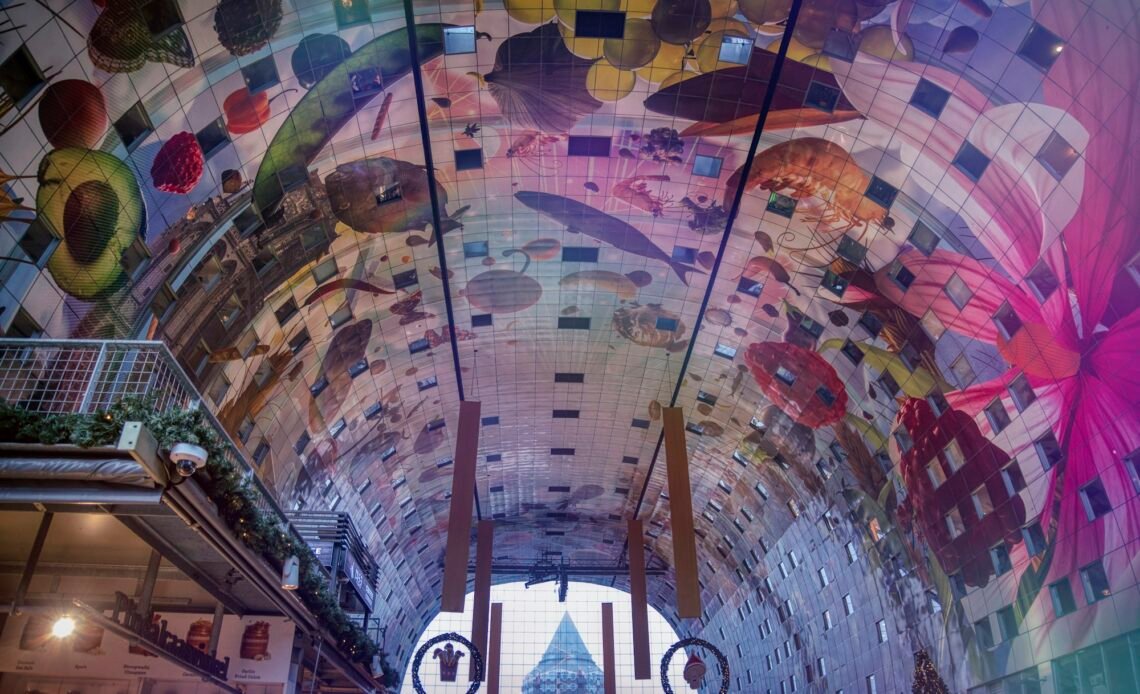
In 2004, Rotterdam had a problem that had nothing to do with architecture: a new Dutch hygiene law was about to ban the open-air sale of meat and fish, and the city’s biggest outdoor market — centuries of stalls spread across the Binnenrotte square — needed a roof, fast. The solution the city picked, from a field of competition entries, was not a warehouse or a shed. It was a 40-meter-high horseshoe arch wrapped in 228 apartments, with an 11,000-square-meter digital mural of fruit, fish, and flowers printed across its entire ceiling. Twelve years later, the Markthal is still the thing most visitors photograph before they’ve bought a single stroopwafel — but it’s also a working market with roughly 100 stalls, and that part of the story gets less attention than the ceiling does.

A Market Built Because the Old One Broke the Law
The Binnenrotte market predates the Markthal by centuries and still runs twice a week on the square right outside it. What changed in the early 2000s was regulation: new Dutch food-safety rules restricting open-air meat and fish sales meant the market’s butchers and fishmongers needed proper cover, not canvas awnings. Rotterdam turned the problem into a 2004 design competition, and architecture firm MVRDV — working with developer Provast and structural engineer Royal HaskoningDHV — won with a pitch nobody else made: instead of a market hall next to a housing block, put the housing over the market, as a single arched structure. Construction ran from 2009 to 2014 at a cost of roughly €178 million. Queen Máxima opened the building on October 1, 2014, with doors to the public at 4:30 p.m. that day — not November, despite that date circulating in some secondhand write-ups since.
Markets under a single roof aren’t new in the Netherlands — Dutch towns have run covered cheese and produce halls for generations — but Rotterdam’s own telling, and several design trade outlets, call the Markthal the country’s first market hall built specifically to house a historic outdoor market’s fresh-food trade, with housing stacked directly on top. Below the apartments, the building holds about 4,600 square meters of market and retail space and roughly 1,600 square meters of restaurants, plus an Albert Heijn supermarket and underground parking for over 1,200 cars. During excavation, builders also found the remains of a 10th-century farmstead roughly seven meters down — part of Rotta, the settlement that gave the city its name, centuries before there was a Rotterdam to flatten and rebuild. A small display near the central stairs, De Tijdtrap, shows what they dug up.
The Ceiling Rotterdam Calls Its Sistine Chapel
The mural overhead is called Horn of Plenty (Hoorn des Overvloeds), by Rotterdam artists Arno Coenen and Iris Roskam, who were selected from nine international candidates. It’s built from a single 1.47-terabyte digital design split across roughly 4,000 perforated aluminum panels, showing vastly enlarged fruit, vegetables, fish, flowers, and insects — a magnified version of exactly what’s for sale on the stalls underneath. At 11,000 square meters, it’s regularly described as the largest artwork of its kind in the world, and locals nicknamed it the “Sistine Chapel of Rotterdam” almost immediately. It’s worth the neck strain: stand near the Albert Heijn end and look straight up the barrel of the arch for the full effect, ideally on a weekday morning before the lunch crowd fills the sightline.
What’s Actually Worth Eating
The Markthal’s stall lineup turns over, but a handful of vendors have been fixtures long enough to count as reliable:
- Bram Ladage (unit 46) — a Rotterdam fries chain that started as a single Binnenrotte market stall in 1967, now with more than 40 locations. The potatoes come from the Hoeksche Waard and are hand-cut on site; order the signature “Brammetje” or a kaassoufflé alongside your patat.
- Cromwijk Kaas (unit 48) — a cheese stall with roots going back to 1968, when Arie Cromwijk opened his first shop nearby; his children Mark and Nathalie Cromwijk now run it, serving an estimated 3,000 to 3,500 customers a week. Look for the aged Noord-Hollandse (48+ and 35+) and the herb-studded boerenkaas.
- Goudstroop (unit 39) — stroopwafels baked fresh on-site rather than shipped in, plus a stroopwafel liqueur and stroopwafel cake for anyone who wants the syrup-and-cinnamon flavor outside the cookie itself.
- Ekmekci (near units 9–12) — Turkish gözleme (grilled stuffed flatbread) and kumpir (loaded baked potato), with dough and salads made in-house daily.
What you won’t find as much of anymore: traditional greengrocers and flower sellers, several of which have been priced out over the past decade as rents climbed and tourist-facing food vendors moved in. MVRDV co-founder Winy Maas said publicly in 2020 that the hall had started to feel more like a “station hall” or “airport hall” than the working market it was designed to be, and urged a course correction back toward fresh produce. It’s a fair complaint to walk in with — the Markthal today leans harder into prepared food and souvenirs than its 2014 pitch promised — but the stalls above are still genuinely good, independently run businesses, not chain outposts dressed up for the camera.
Good to Know
Market stalls run Monday through Thursday and Saturday from 10:00 a.m. to 8:00 p.m., Friday until 9:00 p.m., and Sunday from noon to 6:00 p.m.; the Albert Heijn on the lower level keeps longer hours. Individual restaurants along the outer wall often stay open later than the stalls, so check a specific vendor’s hours before planning a late dinner. Entry to the building, including a look at the ceiling, is free — you only pay for what you eat. Markthal drew about 9.5 million visitors in its opening year and still pulled around 8.5 million in 2024, a volume the city’s original planning estimates — closer to 4 million, mostly locals — never anticipated. It’s an attraction now as much as a market, but underneath the ceiling that made it famous, Rotterdam’s fishmongers, cheesemongers, and fry cooks are still doing the job the 2004 law asked them to move indoors for.
