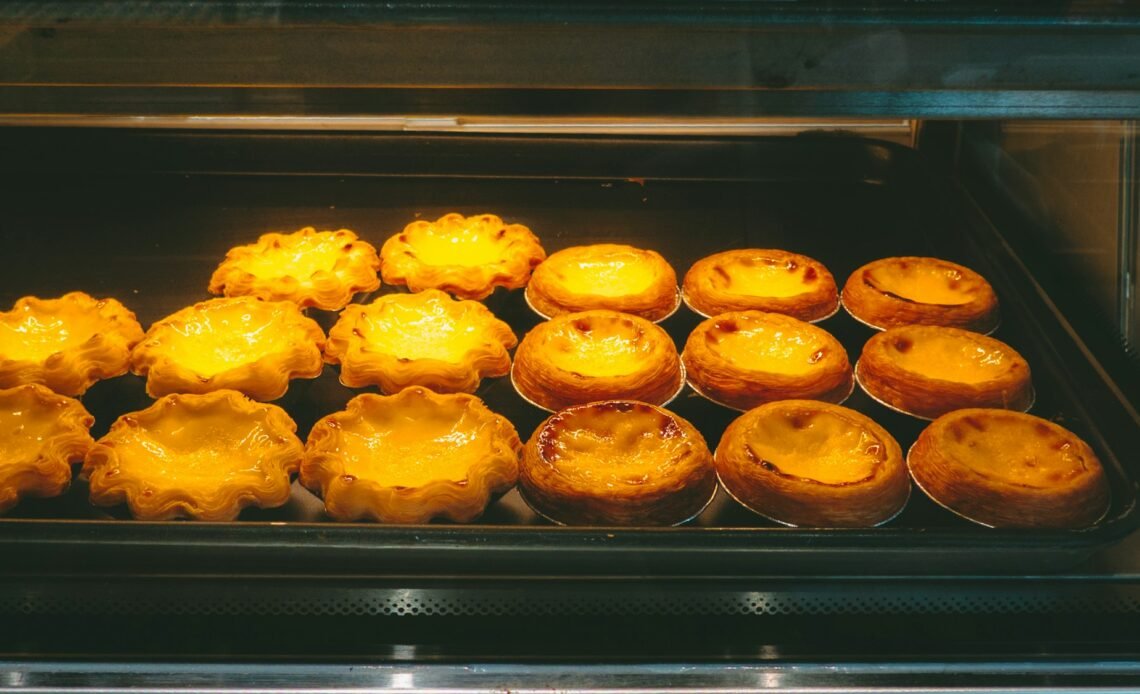
Walk into a Hong Kong bakery case and you’ll usually see two kinds of egg tart side by side: one with a pale, fluted shell and a smooth, matte custard the color of butter; the other with a dark, blistered, almost burnt-looking top set into glossy puff pastry. They look like cousins. They’re the product of two separate kitchens, a 1992 divorce, and a fried chicken chain — and Hong Kong has spent the better part of a century arguing over which one deserves to be called the real daan tat (蛋撻).

A British Tart, Filtered Through Canton
The egg tart’s Hong Kong story doesn’t start in Hong Kong. Food historians trace it to Guangzhou in the 1920s, where Western-style bakeries — a novelty import, staffed by cooks trained in colonial kitchens — began experimenting with custard tarts modeled on the English original rather than anything Portuguese. Several accounts point to Guangzhou’s Jinguang Restaurant as an early seller of the dish around 1927, though, as with most pre-war Cantonese food history, no single birthplace is settled beyond dispute. What is better documented is the route north to south: the tart arrived in Hong Kong via Guangzhou in the 1940s, initially as a refined item on Western-restaurant menus for a wealthier clientele, not a street snack. That changed in the 1960s, when cha chaan tengs — the fast, unpretentious diners serving milk tea and a hybrid Cantonese-Western menu to factory workers and clerks — began baking their own and selling them hot, two or three to an order, for pocket change. That’s also where the Hong Kong tart’s defining trait was set: smaller than its Canton ancestor, built for a single bite-and-a-half rather than a shared plate.
Hong Kong’s version splits into two pastry camps of its own. The classic cha chaan teng shell is a butter-cookie dough — crumbly, slightly sweet, pressed by hand into a fluted tin rather than rolled and layered. Tai Cheong Bakery, which opened on Lyndhurst Terrace in 1954 and became internationally famous after former colonial governor Chris Patten was photographed queuing there in the 1990s, is usually credited with popularizing this cookie-crust style under baker Au Yeung, as an alternative to the flakier puff-pastry shells other bakeries used. Both share the same custard — eggs, sugar, and water, sometimes with a little evaporated milk, strained smooth and baked just until set, with no browning on top. In June 2014, the Hong Kong government formally added egg tart-making technique to its Intangible Cultural Heritage Inventory, codifying what regulars already knew: this was no longer a colonial import, but a local dish with its own lineage.
Macau’s Rival Arrives — And Splits in Two
The dark, caramelized tart beside it has a younger, better-documented origin. In 1989, Andrew Stow, a British pharmacist-turned-baker living in Macau, opened Lord Stow’s Bakery in Coloane Village with his wife, Margaret Wong, after a trip to Portugal left him wanting to recreate the pastel de nata he’d eaten there. Without an authentic recipe, Stow built his own hybrid: Portuguese-style puff pastry wrapped around a richer custard closer to a British filling, baked hot enough to blister and caramelize the top — the scorched-leopard-spot look that still distinguishes the Macau tart from Hong Kong’s. The bakery became a tourist landmark almost immediately, and after Stow and Wong divorced, Wong opened her own competing shop, Margaret’s Café e Nata, in 1992. The two bakeries, a few minutes’ walk apart in Macau, have been rival stops on the same itinerary ever since.
The Fried Chicken Chain That Turned It Into a Craze
The clearest documented “egg tart war” doesn’t involve two bakeries — it involves KFC. In 1999, amid what regional press at the time called egg tart fever, Margaret Wong sold the rights to her recipe to KFC for a lump sum, and “Margaret’s Egg Tarts” appeared on KFC menus across Hong Kong and Taiwan, putting a Macau-style tart into a fast-food chain for the first time. The tarts spread into mainland China through the early 2000s, often sold simply as “Portuguese egg tarts,” and KFC relaunched them in Shanghai in 2003. By 2008 the chain had built a dedicated egg tart factory in eastern China staffed by more than 300 workers; by 2010, KFC was selling an estimated 300 million egg tarts across China in a single year, before eventually closing the factory and shifting production back to individual stores, where tarts are now baked fresh daily. It’s a strange legacy for a pastry born out of a divorce settlement — and a reminder that the cookie-crust version was still being baked fresh every morning in Hong Kong’s cha chaan tengs the whole time, untouched by any of it.
Hong Kong-Style Egg Tarts (Cookie Crust)
This is the cha chaan teng version — a crumbly, slightly sweet shortcrust shell, not the flaky Macau-style puff pastry, and a pale, unblemished custard rather than a caramelized one. Makes about 12 tarts in standard 7cm fluted tart tins.
For the shortcrust pastry
- 110g unsalted butter, softened
- 45g icing sugar, sifted
- 1 large egg yolk
- Pinch of fine salt
- 200g cake flour (or all-purpose flour), plus extra for dusting
For the custard
- 3 large eggs
- 75g caster sugar
- 200ml hot water (not boiling — about 70°C)
- 60g evaporated milk
- ¼ teaspoon vanilla extract (optional)
Method
- Cream the butter and icing sugar until smooth, about 1 minute — don’t overwork it, or the crust puffs unevenly. Beat in the egg yolk and salt, then fold in the flour just until a smooth dough forms. Wrap and chill 30 minutes.
- Divide the dough into 12 pieces (about 22g each). Press each into a tart tin, up the sides to an even 3mm, crimping the top edge to form the classic fluted rim. Chill the shells 15 minutes. Preheat the oven to 200°C (400°F).
- Dissolve the sugar in the hot water and cool to lukewarm. Whisk the eggs and evaporated milk gently — don’t overbeat, or you trap air bubbles that mar the surface. Stir in the sugar water and vanilla, then strain twice through a fine sieve; this is what gives the baked custard its glassy, unbroken surface.
- Pour the custard into the chilled shells, filling each to about 80% capacity.
- Bake at 200°C for 10 minutes, then lower to 160°C (320°F) for 12–15 minutes more, until just set with a slight wobble at the center. Pull the tarts before the surface browns — an unblemished top is the point of the Hong Kong style, unlike the deliberately scorched Macau version.
- Cool in the tins 5–10 minutes before unmolding. Best eaten warm, within a few hours, while the custard is still silken.
Served side by side, the two tarts make the argument for themselves: one restrained, built for a quick bite between noodles and milk tea; the other richer and theatrical, built to be photographed before it’s eaten. Hong Kong has never needed to settle which one wins — there’s a tin of each in every good bakery case.
