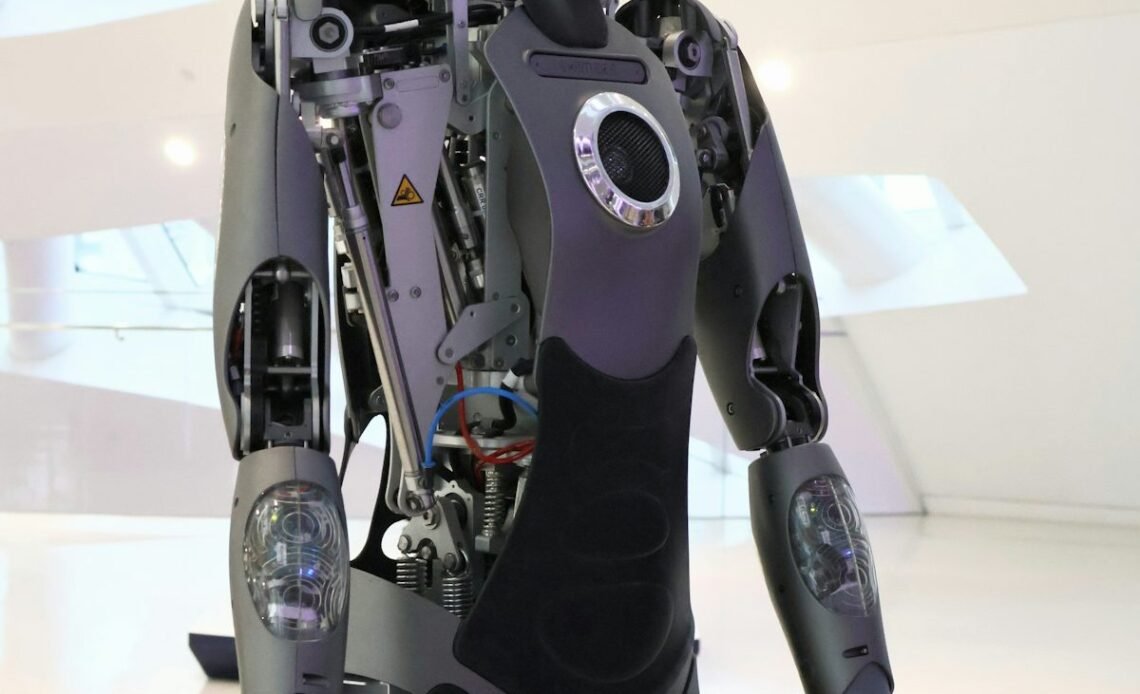
Humanoid robots have spent the last two years as demo-day spectacle — backflips, dance routines, folding laundry on a stage. By November 2026, the industry has mostly moved past that phase, and the gap between the companies actually shipping hardware and the ones still shipping press releases has become the real story. Here’s where five of the best-funded names in the field actually stand, with the setbacks included.

Figure AI: One Robot Off the Line, Every Hour
Figure’s BotQ facility in California is the clearest evidence that humanoid manufacturing has actually started scaling. The company said that by April 2026 it had delivered more than 350 of its third-generation Figure 03 robots and had pushed its build rate from one unit a day to one unit an hour, with first-pass assembly yield above 80% and battery-pack yield at 99.3%. BotQ’s first production lines are sized for roughly 12,000 units a year, with the facility being built out toward 50,000 annually. On the software side, Figure rolled out Helix 02 in February, an upgrade meant to control the whole robot — arms, torso, legs — as one coordinated system rather than stitched-together subroutines. Figure hasn’t gone public with an official count past that April milestone, and later claims of 1,000 units shipped by July circulated only on smaller trade blogs, so treat that specific number as unconfirmed.
Tesla Optimus: Early Production, Not Mass Production
Tesla’s October 21 third-quarter earnings call confirmed that Optimus production has begun on what the company calls its high-volume line in Fremont, producing what Tesla describes as production-quality units. Elon Musk was careful to frame it as early production, saying it would take roughly a year to reach full capacity — and that external, industrial customers won’t receive robots until the end of 2027 even if that timeline holds. Tesla has not published a current output figure; a September report from The Information put weekly output at “several hundred” by August, but Tesla itself hasn’t confirmed that number. It’s a notably more cautious posture than Tesla’s own 2025 projections, when a planned ramp toward 10,000 units reportedly got paused over design problems before this restart. A second factory, in Texas, is under construction with mass production targeted for 2027.
Boston Dynamics’ Atlas: Hyundai’s Big Bet, Still Mostly a Promise
Boston Dynamics unveiled the production version of its all-electric Atlas at CES in January, naming Hyundai Motor Group — which owns more than 80% of Boston Dynamics — and Google DeepMind as the first recipients. Hyundai’s stated ambition is large: roughly 25,000 to 30,000 Atlas units deployed across its U.S. plants by 2028, starting with parts-sequencing work at its Metaplant America facility in Savannah, Georgia, with a Kia plant in Georgia following around 2029. But Hyundai’s own January comments were more conservative than the headline number suggests, describing Atlas as still in testing and years away from full-time deployment. In other words: the hardware is real and the order book is enormous, but as of this fall Atlas is closer to a pilot program than a factory fixture.
Unitree: China’s Low-Cost Flood
While U.S. firms chase six-figure industrial contracts, Hangzhou-based Unitree has taken the opposite approach: volume and price. Its entry-level R1 line starts around $5,900 to $6,800 depending on configuration and region, after the company cut its starting domestic price in June; a dual-arm R1 variant launched in April at 26,900 yuan (roughly $3,900), and Unitree began selling humanoids globally via AliExpress that same month. Its larger H2 platform lists at $29,900, with an H2 Plus variant reaching $100,000, and in May the company unveiled the GD01, a $650,000 rideable “mecha” rather than an autonomous humanoid. Market trackers cited this year estimate Chinese manufacturers now account for roughly 90% of global humanoid robot shipments — a reminder that the “who’s winning” question looks very different depending on whether you’re counting units or headlines.
Agility Robotics: Betting on Wall Street Instead of Another Private Round
Agility Robotics, maker of the warehouse-focused Digit robot, took a different path to capital: on June 24 it agreed to go public through a SPAC merger with Churchill Capital Corp XI at a $2.5 billion pre-money valuation, expected to trade as AGLT once the deal closes. The transaction is structured to deliver more than $600 million in gross proceeds, including roughly $200 million from a PIPE investment led by Foxconn. Agility says it holds more than $300 million in multi-year orders for its next-generation Digit v5 and that its robots have logged over 65,000 operational hours in real warehouse deployments — a smaller, narrower claim than Figure’s or Tesla’s, but one grounded in an actual commercial product rather than a factory-floor pilot.
The Honest Scorecard
Strip away the keynote choreography and November 2026 looks like this: Figure is the furthest along on actual factory throughput, Tesla is finally building real units after a 2025 stumble but still a year from scale, Boston Dynamics has the biggest order book and the least to show for it on the floor today, Unitree has already won on price and volume if not on brand prestige, and Agility is betting public markets will fund the next phase instead of venture investors. None of that is a story about robots replacing workers next quarter — it’s a story about five very different bets on how fast hardware, software, and capital can actually move together, and the answer, so far, is: unevenly.