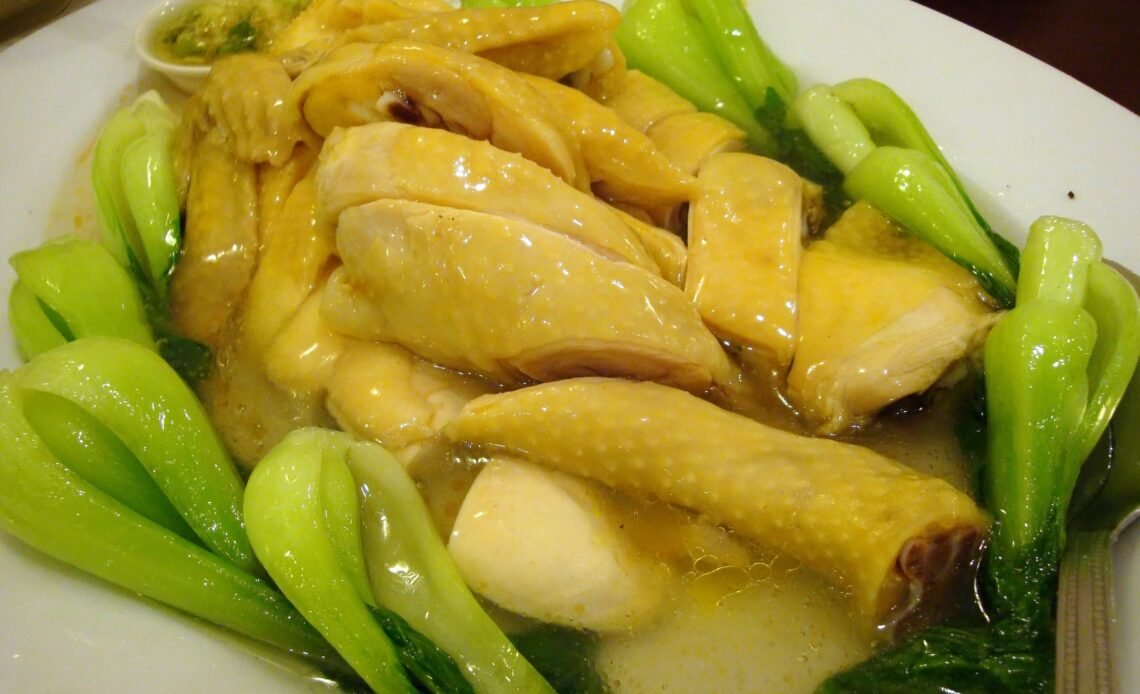
Order 白切雞 — baak chit gai, “white cut chicken” — at a Cantonese restaurant in Hong Kong or Guangzhou, and what lands on the table looks almost suspiciously plain: pale, bone-in pieces of chicken, skin intact, no sauce poured over the top, no char, no glaze. That plainness is the entire point. Among Cantonese cooks, this dish has long worked as an unofficial test — soy sauce chicken and roast goose can forgive a few mistakes, but a bird poached in nothing but water, ginger, and scallion has nowhere to hide an overcooked breast or a flabby, under-rendered piece of skin.
A Dish Older Than the Restaurant That Made It Famous
The earliest reference food historians point to is Yuan Mei’s 1792 recipe collection Suiyuan Shidan (隨園食單), which describes a “white-sliced chicken” cooked in plain water and served cold — a strong sign the technique predates any single restaurant by at least two centuries, though the exact birthplace is genuinely disputed. Some accounts trace a parallel strain to Qingyuan, a city in northern Guangdong known since the Song dynasty for a local black-boned chicken breed, where the clean-poaching method is said to have developed around that bird’s distinctive flavor. What’s better documented is the dish’s 20th-century showcase: Guangzhou’s Qingping Restaurant, which opened in Liwan District in 1964 and by 1981 had developed its own version — “Qingping chicken” — using a clear herbal stock instead of plain water. It was popular enough to be named one of Guangdong’s ten most famous chicken dishes and nicknamed “Guangzhou’s No. 1 chicken,” reportedly selling thousands of birds a day at its peak before the restaurant eventually closed; former cooks carried the recipe to other kitchens around Liwan’s Baohua Road, where versions of it are still served today.
The Technique Is the Whole Dish
The classic method is sometimes called “three dips, three rises” (三浸三提) — the chicken is lowered into just-boiled water, lifted back out, and lowered again, three times, before being left to finish in water that’s been taken off direct heat. The point isn’t theater: a whole chicken dropped into a hard boil and left there cooks unevenly, drying out the breast long before the thigh is done. Dipping and lifting lets heat penetrate gradually and evenly, and pulling the pot off the heat for the final poach keeps the water just below boiling — hot enough to cook the bird through, gentle enough that the meat stays slippery rather than stringy. The finishing move is a plunge straight into an ice bath the moment the chicken comes out, which shocks the skin into a taut, slightly bouncy texture Cantonese menus often advertise outright as 爽滑 (springy-smooth) — a textural compliment that has no easy English equivalent but is the single thing a good version is judged on.
The Recipe
For one whole chicken (about 1.3–1.5kg, ideally a smaller free-range or “yellow” bird rather than a large broiler, since the dish depends on skin-to-meat ratio and flavor more than size): bring a pot of water large enough to fully submerge the bird to a boil with 6 slices of ginger, 3 scallions (roughly smashed), and 2 tablespoons Shaoxing wine. Lower the chicken in breast-down, then lift it out after 30 seconds; repeat two more times — this is the “three dips.” After the third dip, lower the chicken back in fully, bring the water back to a boil, then immediately cut the heat, cover the pot, and let the chicken sit in the residual heat for 35–40 minutes for a 1.3–1.5kg bird (add roughly 5 minutes per extra 200g). Check doneness by piercing the thickest part of the thigh with a chopstick or skewer — the juice should run clear with no trace of blood. Lift the chicken straight into a large bowl of ice water for 10–15 minutes; this both stops the cooking and firms the skin. Drain, pat dry, and chop through the bone into serving pieces, Cantonese-style, with a cleaver.
For the ginger-scallion oil that’s served alongside: finely mince 4 tablespoons ginger and 4 tablespoons scallion (white and light green parts) into a heatproof bowl with ½ teaspoon salt. Heat 4 tablespoons neutral oil (peanut or vegetable) until just short of smoking, then pour it directly over the ginger and scallion — it will crackle and release its aroma immediately. Stir in ½ teaspoon sugar once it’s cooled slightly. Spoon it over the chicken at the table, or serve it on the side as a dip; the reserved poaching liquid, now a light, gingery stock, is traditionally kept to cook rice or make soup rather than thrown out.
There’s no sauce to rescue a badly timed poach and no char to disguise rubbery skin, which is exactly why Cantonese cooks still reach for this dish — bare as it looks on the plate — when they want to know whether someone can actually cook.
