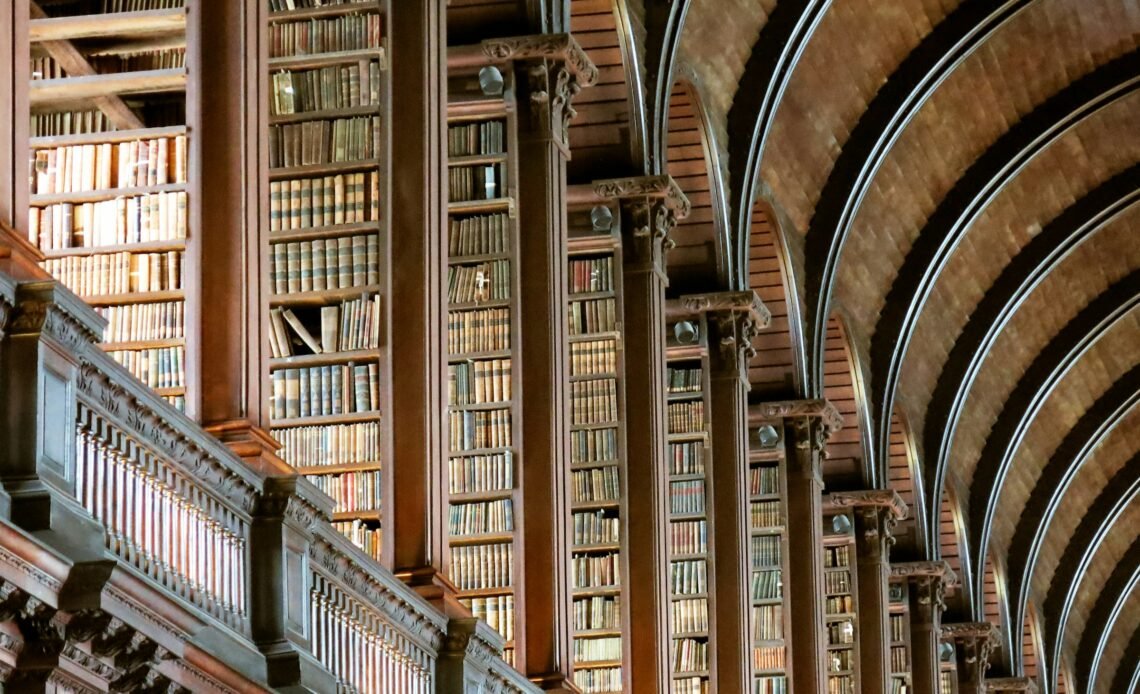
Trinity College Dublin was founded in 1592 by royal charter from Elizabeth I, built on the confiscated grounds of a dissolved Augustinian monastery, and it’s still the anchor most visitors circle back to. Its Old Library holds the Book of Kells, an illuminated gospel manuscript made by Columban monks around the year 800, and the Long Room above it — 65 metres of oak shelving holding roughly 200,000 of the library’s oldest volumes — is routinely called one of the most beautiful rooms in the world. But Dublin’s history doesn’t stop at the college gates: it’s in the colored doors of its Georgian squares, the pub where James Joyce sent his fictional hero for lunch, and a prison yard where fourteen men were shot by firing squad in 1916. This five-day itinerary uses Trinity as a hinge and builds the rest of the city, and two day trips beyond it, around that same thread of real history.


Day 1: Trinity College and Georgian Dublin
Start at Trinity’s Front Square and book a timed slot for the Book of Kells Experience in advance — tickets run from about €19 for the Book of Kells and Old Library together up to roughly €25 for the full Experience, and the cheaper slots do sell out same-day. The Long Room itself is mid-restoration: as part of a €90 million conservation project, the library has already moved most of its roughly 200,000 books off the shelves, leaving only the first four bays stocked, and Trinity says the room stays open to visitors like this until the end of 2027, when the real construction phase begins and the Book of Kells moves temporarily to the restored Printing House nearby. See it now rather than wait. Afterward, walk south into Merrion Square, ringed by Georgian townhouses whose brightly painted front doors are usually explained as a practical fix — nearly identical brick facades needed some way to tell one house from the next before street numbering existed — though a few historians argue it’s simply a byproduct of the Georgian building boom between 1714 and 1830, under the four King Georges the style is named for. Oscar Wilde, born a few streets away on Westland Row in 1854, has a reclining statue in the square’s northwest corner. For lunch, walk to Davy Byrnes on Duke Street, the real pub where James Joyce sent Leopold Bloom for a gorgonzola sandwich and a glass of burgundy in the “Lestrygonians” chapter of Ulysses — it’s been pouring since 1889 and still serves the same sandwich.
Day 2: Dublin Castle, Christ Church, and Temple Bar after dark
Dublin Castle began as a Norman fortress ordered by King John around 1204 and served as the seat of English, then British, rule in Ireland for more than seven centuries, right up until the handover to the new Irish state in January 1922 — the State Apartments and Viking excavations beneath the courtyard are open on a self-guided or guided ticket. Walk ten minutes to Christ Church Cathedral, founded around 1030 by the Hiberno-Norse king Sitric Silkenbeard, whose crypt is one of the largest of any cathedral in Britain or Ireland. In the evening, cross into Temple Bar, whose name almost certainly comes from Sir William Temple, who built a house and gardens along the Liffey here in the early 1600s — not, as the popular myth goes, from a tax dodge, since the earliest map reference to “Temple Bar” dates to 1673, well before that story’s timeline. The Temple Bar pub itself claims one of the largest whiskey collections in the world; for something quieter, the Brazen Head nearby advertises itself as Dublin’s oldest pub, with licensed records tracing hospitality on the site back to 1198.
Day 3: Guinness Storehouse and Kilmainham Gaol
Arthur Guinness signed a 9,000-year lease on the St. James’s Gate brewery site in 1759 at £45 a year — a lease that, technically, still has roughly 8,730 years left on it. The Storehouse built around that history runs dynamic pricing, typically landing between €26 and €37 for standard entry depending on date and time slot, and includes a pint in the rooftop Gravity Bar; book online ahead rather than at the door. In the afternoon, take the tram or a 20-minute walk to Kilmainham Gaol, which opened in 1796 and became the site where fourteen leaders of the 1916 Easter Rising, including Patrick Pearse and James Connolly, were executed by firing squad in the Stonebreakers’ Yard — a turning point that hardened Irish public opinion against British rule. Admission is guided-tour only and booked in timed slots on the official kilmainhamgaolmuseum.ie site (adults around €8); third-party reseller tickets are explicitly not honored, so book direct.
Day 4: Howth, by train
Take the DART from Connolly or Pearse Station — about a 30-35 minute ride — out to Howth, a working fishing harbor turned day-trip village on a headland north of the city. The cliff path loop around Howth Head runs roughly 10km and 3-4 hours if you walk the whole thing, or closer to an hour if you just do the lighthouse stretch above the harbor; go clockwise from the DART station for the better sea views early. Back at the harbor, West Pier’s seafood stalls and sit-down spots like Aqua and Beshoffs serve Howth’s own landed prawns and crab claws, usually the simplest and freshest meal of the trip. Last DART back runs around 11:30pm on weekdays, later on weekends, so there’s no need to rush the walk.
Day 5: Glendalough and the Wicklow Mountains
Glendalough — Gleann Dá Loch, “the valley of two lakes” — has no direct train, so book a day tour or drive; half-day coach trips from Dublin run roughly €33-38 per adult, with longer combined Wicklow-and-Kilkenny tours closer to €65. St. Kevin founded a monastic settlement here in the 6th century, seeking the kind of remote retreat early Irish Christianity prized, and it grew into a center of learning that survived Viking raids for centuries; the 30-metre round tower and the ruined cathedral still stand above the Upper and Lower Lakes. Walk the Green Road between the two lakes for the easiest full view of the valley before heading back to Dublin by early evening.
Practical notes
Buy a Leap Visitor Card for unlimited city transport — Dublin Bus’s own fares list it at €8 for 24 hours, €18 for 72 hours, and €24 for 7 days, covering city buses, the Luas tram, and the DART alike, though the National Transport Authority has flagged an average 15% fare rise from January 2027, so these figures may shift slightly after the new year. Outside lodging, budget roughly €70-100 a day per person once a sit-down meal, a museum ticket, and transport are in: Dublin isn’t a cheap city, and the euro-pound exchange with nearby UK trips makes it easy to underestimate. May-June and September give the mildest weather and shorter queues at Trinity and the Storehouse than peak summer; Trinity closes over the Christmas period, so confirm exact dates on visittrinity.ie before building a late-December trip around it.
This article contains affiliate links, including Klook. We may earn a commission on qualifying bookings — see our Affiliate Disclosure for details.
