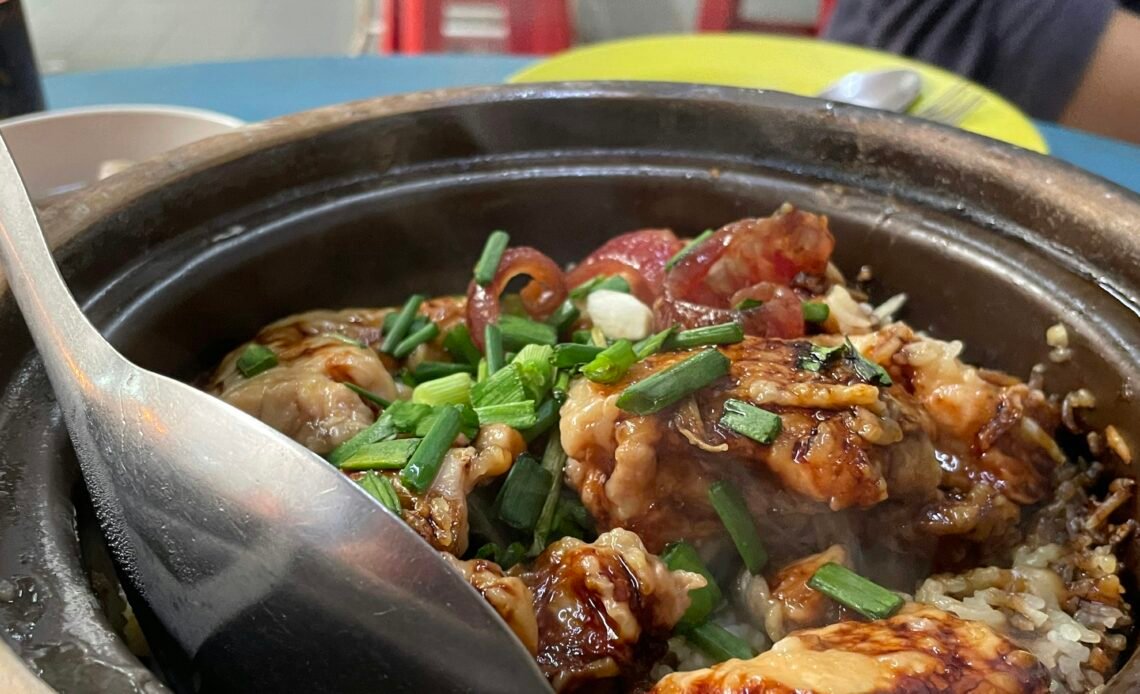
Walk down a side street in Sham Shui Po or Sai Ying Pun on a cold Hong Kong night and you’ll smell claypot rice (煲仔飯, bou zai faan) before you see it — a faint char of toasting rice drifting out of a stall with a row of blackened clay pots lined up over open flame. It’s one of the few Cantonese dishes where the cooking vessel is the whole point: the same unglazed clay pot that goes over the fire comes straight to your table, still bubbling, with a crust of scorched rice clinging to the bottom that most diners consider the best part of the meal.

A Guangzhou Dish Hong Kong Made Its Own
Claypot rice traces back to Guangzhou, where Cantonese home cooks and street vendors used thick-walled clay pots — cheap, heat-retentive, and able to go straight from a charcoal fire to the table — to cook rice and toppings together in one vessel. From there it spread through Hong Kong and into the Cantonese diaspora across Malaysia, Singapore, and Indonesia, which is why you’ll find close cousins of it as far south as Kuala Lumpur, often under names like bo zai fan or clay pot chicken rice. In Hong Kong specifically, the dish became a cold-weather fixture of open-air cooked-food stalls — famously clustered around old North Point and Temple Street — where rows of pots sat over charcoal braziers and diners ordered by pointing at a topping list rather than a menu. Kwan Kee, a Sai Ying Pun institution now recognized in the Michelin Guide’s Hong Kong selection, is one of the few surviving stalls still cooking over real charcoal rather than gas, which locals say changes the smell and texture of the crust.
The Crust Is the Entire Point
The layer of scorched rice at the bottom of the pot — fan jiu (飯焦) — is the dish’s answer to Korean dolsot bibimbap’s crispy bottom, Persian tahdig, or Spanish paella’s socarrat: the product of starch and residual sugar catching against hot clay a few degrees past where most rice would simply finish cooking. Traditional stalls build it by starting the rice on high heat until the water visibly drops below the surface of the grains, then dropping to a low flame, laying toppings directly on top of the half-cooked rice, and letting the pot sit undisturbed so the bottom layer continues toasting while the top steams through from the residual heat trapped by the clay. Lifting the lid too early lets steam escape and the crust never fully forms — most recipes that fail at home fail here, not in the seasoning.
Building the Pot
Rinse 2 cups of jasmine rice until the water runs mostly clear, then soak for 20 minutes and drain — this shortens the cooking time enough that the top layer finishes before the bottom burns. Add the rice to a seasoned clay pot (a Dutch oven or heavy-bottomed pot works if you don’t own one) with 2½ cups of water or light chicken stock. Bring to a boil uncovered over high heat; once you see the water level drop just below the surface of the rice, about 4 to 5 minutes, lay 2 sliced Chinese sausages (lap cheong) and, if using, a few thin slices of cured pork belly (lap yuk) and 4 to 5 rehydrated dried shiitake mushrooms directly on top. Cover, drop to the lowest flame your stove allows, and cook undisturbed for 15 minutes. Turn off the heat and let the pot sit covered for another 10 minutes — this is what finishes the crust without scorching it. While it rests, whisk together 1 tablespoon oyster sauce, 1½ teaspoons dark soy sauce, 1 teaspoon light soy sauce, 1 teaspoon sugar, and 1 teaspoon sesame oil; drizzle this over the rice right before serving, along with sliced scallion, so the sauce seasons the dish at the table rather than steaming away in the pot.
What Actually Goes On Top
Lap cheong and lap yuk — both air-dried, slightly sweet cured meats traditionally made in the colder months, which is part of why claypot rice reads as a winter dish — are the baseline combination, but stalls build entire menus around swapping the topping: sliced chicken marinated in ginger and soy, frog legs (a Pearl River Delta specialty), salted fish with diced pork, or simply a fried egg cracked over the rice in the last few minutes. Whatever goes on top, the rule stays the same — it’s a topping for the rice and its crust, not the dish’s main event. Order it in Hong Kong today and it almost always arrives in the clay pot itself, sauce stirred in tableside, with the server warning you the bottom is still hot enough to keep cooking for another minute or two after it reaches you.
