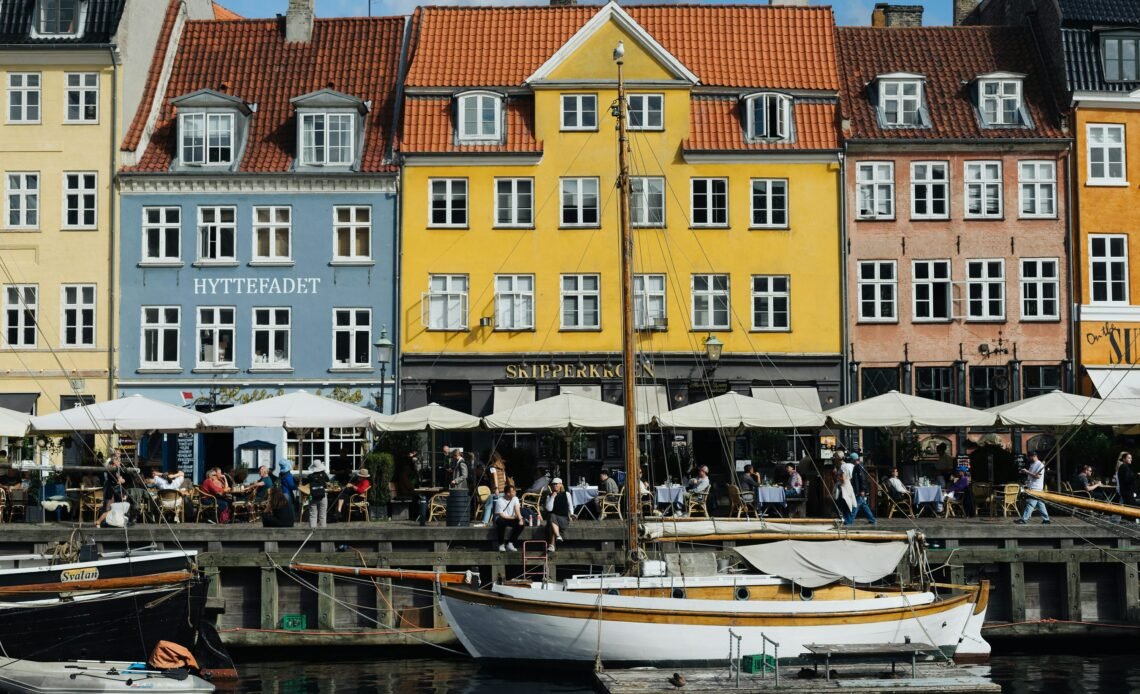
Copenhagen rewards a slower trip than most people give it. It’s easy to treat it as a one- or two-day stopover between Scandinavia’s bigger names, but the city holds a Renaissance castle built for a king who never stopped building, a self-governing neighborhood that’s outlasted three decades of attempts to close it, a restaurant form — smørrebrød — that got codified into its modern shape at a single lunch counter in 1877, and a half-day train ride to one of Europe’s great modern art collections. Four days is enough to actually see how the pieces fit together, with real prices and real history attached to every stop.

Day 1: Kongens Nytorv, Nyhavn, and the Harbor
Start at Kongens Nytorv (King’s New Square), laid out in 1670 under Christian V as Copenhagen’s grandest square, flanked today by the Royal Danish Theatre and the Hotel d’Angleterre. From there it’s a two-minute walk to Nyhavn, the 17th-century harbor where Hans Christian Andersen lived at three different addresses (Nos. 20, 67, and 18) over 18 years — the colorful gabled houses lining the canal are the most-photographed stretch of the city for good reason. For lunch, Det Lille Apotek on Store Kannikestræde claims the title of Copenhagen’s oldest restaurant, tracing back to 1720 when the building operated as a pharmacy (hence “The Little Pharmacy”); its old-school Danish menu runs to a creamy paprika-and-pineapple dish called Apoteker Stew. In the afternoon, walk the harbor front to the Royal Danish Library’s “Black Diamond” (Den Sorte Diamant) — the angular black-granite-and-glass 1999 extension that now holds the national library’s rare manuscripts — then cross the water at Cirkelbroen, the Circle Bridge that artist Olafur Eliasson built from five staggered circular platforms rigged like old ship masts. It opened in 2015, funded by the Nordea Foundation as a gift to the city, and its zigzag path is deliberate: Eliasson designed it to slow pedestrians down rather than send them straight across. From there it’s a short walk into Christianshavn for an evening at Freetown Christiania, the self-governing commune residents founded in 1971 on a former military barracks; entry is free and the area is open to walk through, though it remains a residential neighborhood, so stick to daylight-hours sightseeing and skip the open-air cannabis stalls on the old Pusher Street, which Danish police still periodically raid.
Day 2: Royal Copenhagen and the Round Tower
Spend the morning at Rosenborg Castle, the Dutch Renaissance pleasure palace King Christian IV built between 1606 and 1634 as a summer retreat just outside the old city walls — the walls have long since been absorbed into downtown, and the surrounding King’s Garden (Kongens Have) is Copenhagen’s oldest public park. The castle holds the Danish Crown Jewels and Christian IV’s own collection of swords and amber; winter hours (through December 23) run Tuesday–Sunday, 10am–4pm, closed Monday, with adult admission around 140 DKK online. Walk 10 minutes to Rundetaarn (the Round Tower) next: built in 1642 as part of the Trinitatis Church complex, its 7.5-turn spiral ramp — wide enough that legend holds Tsar Peter the Great once rode a horse to the top — leads to Europe’s oldest functioning observatory, still used by the University of Copenhagen’s astronomy club on clear nights. Adult entry runs 60 DKK as of the tower’s most recent price increase; grab a lunch snack right outside at DØP, a certified-organic hot dog stand on the pedestrian street Købmagergade (classic pork sausage in sourdough with organic remoulade, around 60 DKK) that’s placed on Opinionated About Dining’s global cheap-eats list multiple years running. In the afternoon, cross to Slotsholmen for the Christiansborg Palace Tower — at 106 meters the tallest tower in the city, and free to enter since it opened to the public in 2014; the entrance is through the King’s Gate directly beneath it. For dinner, book Schønnemann on Hauser Plads, open since 1877 and widely credited (alongside Restaurant Davidsen) with turning smørrebrød from a working-class lunch into a sit-down restaurant dish, served the same way today: rye bread from its own kitchen, white-aproned staff, and snaps poured from a glass-fronted cabinet.
Day 3: Frederiksstaden and the Waterfront
Breakfast at Hart Bageri, the sourdough bakery Richard Hart — former head baker at San Francisco’s Tartine — opened with Noma’s René Redzepi in 2018; the cardamom bun, built from leftover croissant dough, is the thing to order, and the chain has since grown to roughly ten locations around the city (Hart himself relocated to Mexico City in 2023, so don’t expect to see him behind the counter). Walk to Amalienborg Palace, the Danish royal family’s winter residence since 1794, for the Changing of the Royal Life Guard: the guard marches from its barracks starting at 11:50am and the ceremony runs at noon daily on the palace square, with a band or drum corps joining on Fridays. Next door, Frederik’s Church — better known as the Marble Church for its dome, modeled on St. Peter’s Basilica and finally finished in 1894 after more than a century of stalled construction — is free to enter. Walk the waterfront 15 minutes to see the Little Mermaid statue, which brewer and Carlsberg heir Carl Jacobsen commissioned from sculptor Edvard Eriksen after watching a 1909 Royal Danish Theatre ballet of the Hans Christian Andersen tale; it was unveiled in 1913 and the statue’s bronze body is reportedly modeled on Eriksen’s wife, since the ballerina who inspired the commission declined to pose nude. The nearby Gefion Fountain, funded by Jacobsen and sculpted by Anders Bundgaard between 1897 and 1908, depicts the Norse goddess Gefion plowing the island of Zealand out of Sweden overnight. Back in the center, La Glace — Copenhagen’s oldest patisserie, open since 1870 and still in its original building — is the stop for cake; its “Sports Cake” (Sportskage), layered with macaroon, cream, and caramelized sugar, has been the house signature for generations, now run by sixth-generation owners. Finish at Designmuseum Danmark for an hour with Danish design history (Arne Jacobsen chairs, Royal Copenhagen porcelain, and rotating contemporary shows), then book dinner at Madklubben Steak near Kultorvet, where a three-course steak menu runs around 300 DKK and four courses around 350 DKK.
Day 4: Louisiana Museum of Modern Art
Take the regional train from Copenhagen Central Station to Humlebæk (about 35–40 minutes), then walk 10–15 minutes to the Louisiana Museum of Modern Art, founded in 1958 by Knud W. Jensen on the grounds of a 19th-century villa originally named by its first owner for his three wives, all named Louise. Architects Jørgen Bo and Vilhelm Wohlert designed the museum to thread through the existing landscape rather than replace it, so the galleries open directly onto a sculpture garden overlooking the Øresund strait toward Sweden, dotted with works by Alexander Calder, Henry Moore, and Jean Arp. As of this trip, the museum’s major special exhibition is a career survey of British artist Tracey Emin, running October 8, 2026 through April 18, 2027 — check louisiana.dk for current ticket pricing and any date changes before you go, since special exhibitions are sometimes ticketed separately from general admission. Head back to Copenhagen by early evening; if there’s time before a last dinner, Reffen, the city’s largest street-food market on the Refshaleøen peninsula, is a lower-key way to close out the trip than a sit-down reservation.
Practical Notes
May–September gives the longest daylight and the best odds of good weather, but also the highest hotel rates and the Round Tower’s extended summer hours; shoulder months (April, October) trade a few degrees of warmth for thinner crowds. On transit and sightseeing costs: reported prices for the Copenhagen Card’s 72-hour “Discover” tier (covering 80+ attractions plus public transit in the Capital Region) range from roughly 1,039–1,050 DKK across sources that updated for 2026, against an estimated pay-as-you-go total near 1,364 DKK for a similar itinerary — check copenhagencard.com directly before buying, since even official-looking comparison sites disagree on the exact figures. Budget roughly 400–600 DKK per person per day outside lodging and the sit-down dinners, which run higher: expect 300–1,200 DKK depending on which Madklubben concept and night of the week you book. Copenhagen’s city bikes and the Metro (which runs 24 hours) make a car entirely unnecessary for this itinerary.
