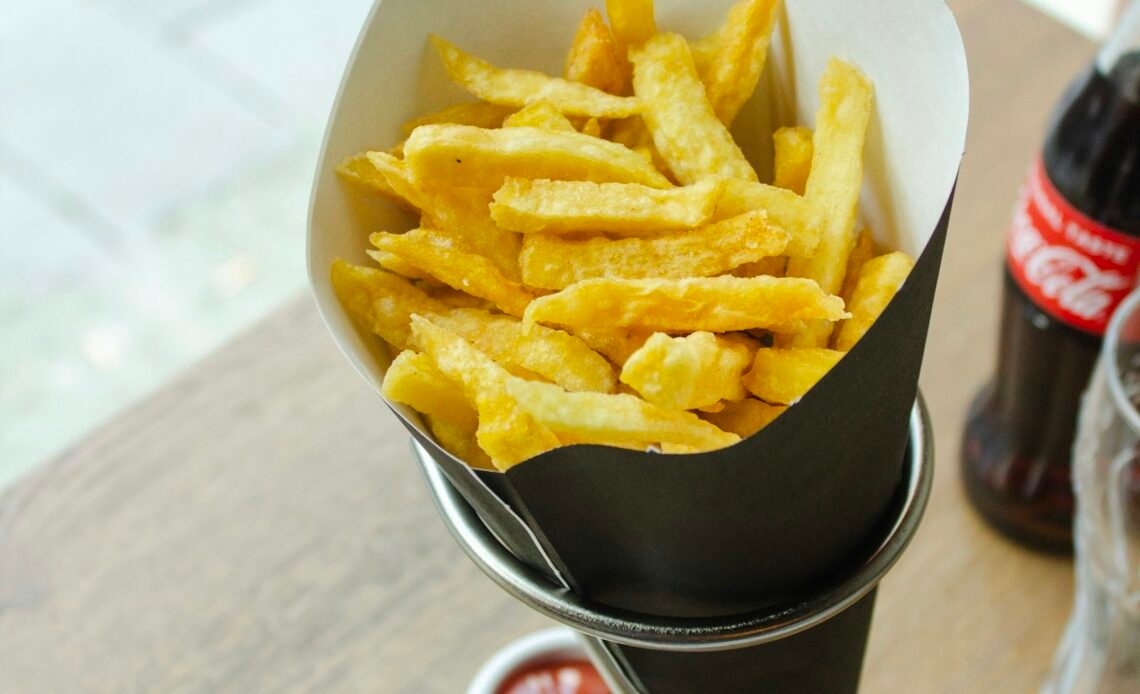
Belgium has a word the French don’t: fritkot, the freestanding kiosk where frites are fried, sauced, and handed over in a paper cone within minutes of your order. At Place Jourdan in Etterbeek, one of Brussels’ European Quarter squares, that kiosk is Maison Antoine — open since 1948, still run by descendants of the couple who started it, and still cited by locals as the city’s reference point for what a frituur should be. The fries themselves follow a method that’s genuinely different from the ones sold at most fast-food counters: fried twice, in beef fat more often than not, from a potato variety bred specifically for the job.
Maison Antoine opened in 1948, when Antoine Desmet and his wife — tired of the itinerant life of fairground vendors — set up a permanent frying stand on Place Jourdan instead of following the fair circuit from town to town. The original operation was entirely manual: potatoes peeled and cut by hand, with only mayonnaise and mustard on offer as toppings. The stand has since mechanized its prep, but the Desmet family has kept it in-house through a third generation, and the pavilion that replaced the original kiosk after a square redevelopment still draws a queue that regulars describe as moving fast even at its longest. There’s no seating at the kiosk itself — you order at the window and eat standing, though several of the cafés ringing the square will let you bring your cone inside if you buy a drink.
The stand’s most-repeated anecdote dates to 2016, when a Brexit-related EU summit stretched into the night a short walk away: then-German Chancellor Angela Merkel sent an order to Maison Antoine for 45 cones of fries for her delegation, with around 40 sauce requests — the owners said most asked for mayonnaise, with a handful opting for Andalouse. It’s the kind of detail that circulates in food writing about the place precisely because it’s so ordinary a way to treat a head-of-state order: the same cone, the same counter, the same sauce list as everyone else in line.
Why the fries taste different
Belgian frites start with Bintje, a floury potato variety developed in the Netherlands in 1904 and now grown widely across Belgium and northern France specifically because its starch content and shape hold up through a two-stage fry without turning mushy or collapsing. Cut into batons roughly a centimeter thick, the potatoes go through a first fry at a relatively low temperature — commonly cited around 140°C (284°F) — just long enough to cook the interior through without browning the surface. The fries then rest, and go back into the fryer at a much hotter temperature, typically 175–190°C (350–375°F), for a short, aggressive second fry that produces the shattering, cracked crust (what French-language sources call craquelure) around a soft, steam-cooked center. A single fry at high heat, which is how most fast-food and home fries are made, can’t reproduce that contrast — you get either a soggy fry or a burnt one.
The fat matters too, and it’s a genuine point of debate inside Belgium, not just a marketing claim. Traditional frituurs fry in rendered beef fat — beef tallow — which has a higher smoke point than most vegetable oils and, fans argue, gives the fries a deeper, savorier flavor that oil-fried versions lack. Maison Antoine fries in beef fat. But tallow is more expensive and harder to source consistently than vegetable oil, and plenty of newer frituurs and chains across the country have switched to peanut or sunflower oil, or a blend — which is part of why asking a Belgian where to get fries “done properly” reliably starts an argument about which fat is authentic and which is a shortcut.
What to order, and what it costs
A standard cone of double-fried frites at Maison Antoine runs around €3.50. The move beyond a plain cone is the mitraillette — a baguette stuffed with a meat of your choice (usually a merguez sausage or a meatball, boulet) along with a full portion of fries and sauce, for roughly €7. The sauce counter is the other reason people name Maison Antoine specifically rather than just “a frituur”: the stand offers upward of 25 to 30 options, made fresh, well past plain mayonnaise. Andalouse — a tomato-and-pepper mayonnaise — and samouraï, a spicier mayo-based sauce with harissa or chili, sit alongside curry, Provençale, and pili-pili on a chalkboard list that changes slightly by season. The default pairing most locals order is simple: mayonnaise, which is what the majority of Merkel’s 2016 order came down to as well.
Maison Antoine is open daily from 11:30 a.m. to 1 a.m., and until 2 a.m. on Fridays and Saturdays — hours built around a European Quarter clientele that includes lunchtime EU staffers and a late-night bar crowd spilling out of Place Jourdan’s cafés. It’s at Place Jourdan 1, 1040 Etterbeek, a roughly 20-minute walk or a short metro ride (Schuman or Maelbeek stations) from Brussels’ city center. There’s no reservation system and no table service — you queue, you order by the cone or the sandwich, and you eat it the way it was designed to be eaten: hot, out of paper, standing up.

