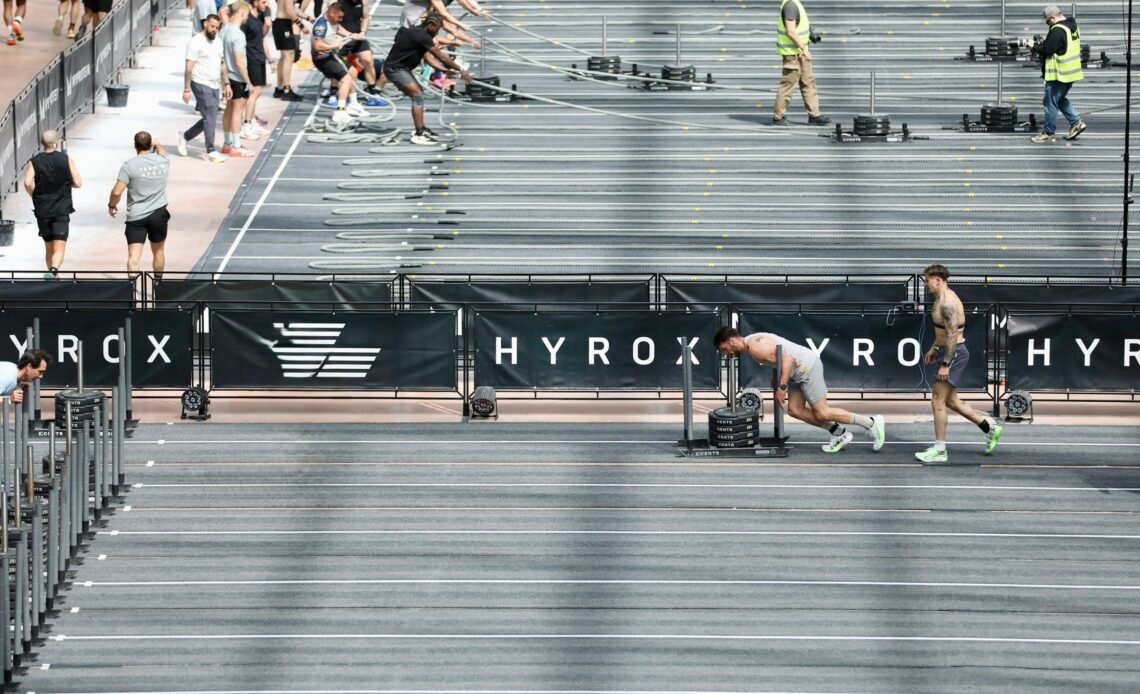
Nine years ago, a German former gym-chain executive and a two-time Olympic field hockey gold medalist put 650 people through a race nobody had run before: eight 1-kilometer runs, broken up by eight functional-fitness stations, in a fixed order, at every venue, forever. That race is HYROX, and this season it’s on pace to pull in somewhere between 1.3 and 1.5 million participants worldwide — with HYROX itself projecting more than 2 million for the 2026/27 season across 107 race weekends in 95 cities. A Hong Kong edition this month drew roughly 19,500 athletes from 60 countries, nearly double the previous year’s field. Here’s what the race actually involves, who built it, and what it costs to try.

The same eight stations, every city, every time
HYROX’s entire pitch is standardization. Every race, anywhere in the world, is the identical format: a 1,000-meter run, then a station, repeated eight times. The stations, in fixed order, are a 1,000-meter SkiErg, a 50-meter sled push, a 50-meter sled pull, 80 meters of burpee broad jumps, a 1,000-meter row, a 200-meter farmers carry, 100 meters of sandbag lunges, and 100 wall balls to finish. The Pro division loads five of those eight stations heavier than the Open division, but the course itself never changes — which is the point. A finish time in Hong Kong is directly comparable to a finish time in Houston, something CrossFit-style competitions, with their constantly varied workouts, were never built to offer.
Who built it
HYROX was founded in 2017 by Christian Toetzke, a former gym-industry executive, and Moritz Fürste, a German field hockey player who won Olympic gold at Beijing 2008 and London 2012 and bronze at Rio 2016. That pedigree matters to the brand’s pitch: Fürste has talked publicly about wanting HYROX to eventually reach the Olympics itself, and the race’s growth curve — from 650 athletes at its first event to a projected 2 million-plus entries next season — is the case he and Toetzke keep making for it. About 70% of entrants each season are first-time HYROX competitors, according to race-data firm Infront, which is the detail that separates it from a niche competitor circuit: most of the people lining up have never done this specific race before.
A real business, not just a workout trend
HYROX stopped being a side project a while ago. In September 2026, Toetzke and Fürste bought back majority control (51%) of the company in a deal that left private-equity firm L Catterton and media investor WndrCo holding the remaining 49% — reporting on the deal’s value varies, with estimates ranging from roughly €600 million to as high as €1 billion, alongside a projected 2026 revenue near $270 million. PUMA has been HYROX’s global footwear and apparel partner through the brand’s growth years and extended that deal through 2030, putting its Deviate Nitro Elite HYROX shoe squarely into the race’s marketing. None of those numbers are small for a format that, less than a decade ago, didn’t exist.
What it costs, and the training tradeoff worth knowing
Entry pricing isn’t global or fixed — HYROX uses dynamic pricing that rises as a city’s race fills, and fees vary sharply by region. Recent listings put UK entries around £110, Shanghai’s race at 799 yuan for a solo Open entry (roughly $112) and 1,999 yuan for a four-person relay, and US city races commonly landing between $95 and $150 per division depending on how early someone registers. Doubles and relay formats generally cost less per person than solo Open entries. The honest advice is to check the specific city’s page on hyrox.com close to registration, since the same division can cost noticeably more a few weeks before race day than it did months out.
On the training side, exercise-science reviews of “concurrent training” — mixing heavy strength work with sustained cardio, which is exactly what HYROX demands — have found a real interference effect: pushing both hard at once blunts maximum strength and power gains more than training either alone, particularly when running volume is high. Hypertrophy (muscle size) is affected less. HYROX’s own station mix, which leans on rowing, skiing, and sled work rather than pure distance running, likely softens that interference somewhat compared to a program built around long runs plus heavy lifting — but it doesn’t erase it. Anyone training specifically to set a personal best in both a HYROX race and a one-rep max lift is working against real physiology, not just a scheduling problem.
Why it’s spreading this fast
HYROX’s growth isn’t being driven by elite athletes — it’s the 70% first-timers, the gyms running HYROX-style training clubs to prep members for race day, and a format simple enough to explain in one sentence: run a kilometer, do a station, repeat eight times, see your time next to everyone else’s on the same course. Whether that’s genuinely a new sport on an Olympic trajectory or a very well-marketed fitness-industry moment, the participation numbers and the money now behind it say it isn’t slowing down in the next season.
