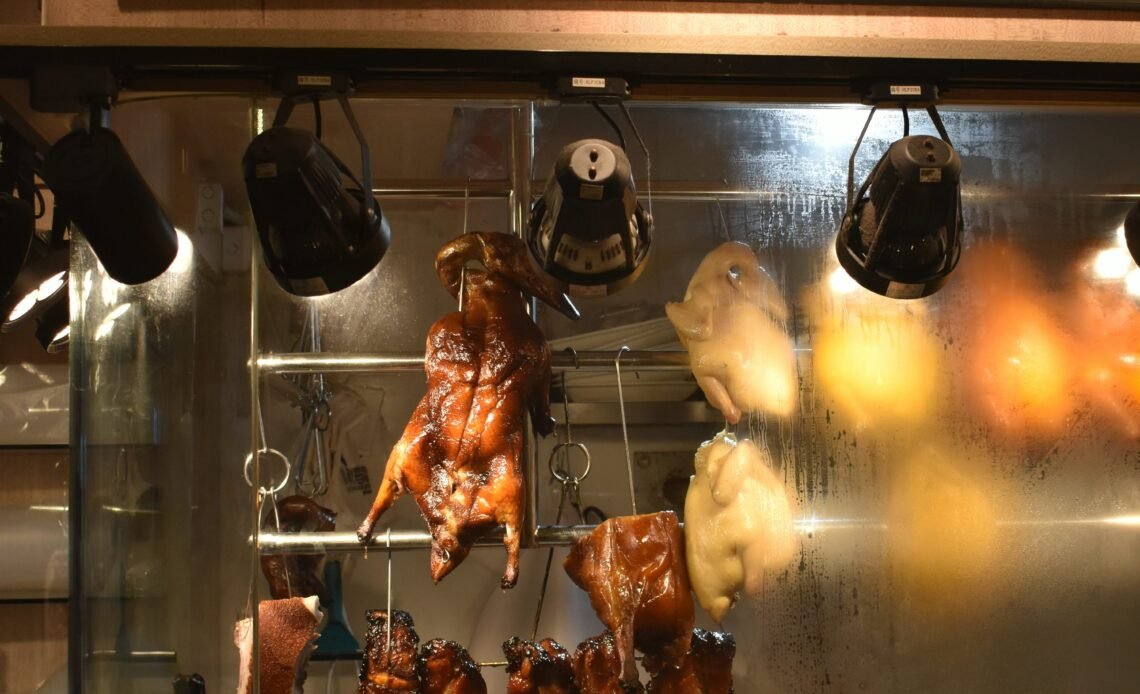
Cooking is TRARORO’s newest section — a print companion to the Cooking852 podcast, built around Cantonese and Hong Kong food: real recipes, real technique, real kitchen history. There’s no better dish to start with than char siu (叉燒), the lacquered red-edged roast pork that hangs in siu mei shop windows across Hong Kong and gave the whole category of Cantonese roast meats its name.

Why It’s Called “Fork Roasted”
Char siu literally means “fork roasted” (叉 cha, fork; 燒 siu, roast) — a description of the original method, where strips of marinated pork were skewered on long forks and suspended directly over a charcoal pit, a technique documented in Guangdong kitchens going back to at least the Qing dynasty. It belongs to siu mei, the broader family of Cantonese roasted meats that also includes siu yuk (crispy roast pork belly) and roast goose, all traditionally cooked in open, wood- or charcoal-fired ovens rather than sealed Western-style ones. The signature reddish color most people associate with char siu today is a relatively recent addition — traditionally it came from red yeast rice (hung curd), though most modern kitchens, home and commercial alike, use red food coloring instead, which is a cosmetic choice rather than a flavor one.
The Marinade That Actually Matters
Cut about 2 to 2.5 lbs of pork shoulder — not loin, which is leaner and dries out under high heat — into strips roughly 2 to 3 inches wide and 1 to 1¼ inches thick, keeping the thickness even so they cook uniformly. Whisk together ¼ cup soy sauce, ¼ cup Shaoxing wine, ¼ cup hoisin sauce, ¼ cup oyster sauce, ¼ cup sugar, 2 tablespoons molasses, 2 teaspoons grated garlic, 1 teaspoon five-spice powder, and ¾ teaspoon salt. Set half the marinade aside untouched by raw meat — that reserved half becomes the base for the glaze later. Marinate the pork in the rest, refrigerated, for at least several hours and ideally overnight; this isn’t a quick-marinade dish, since the sugar and soy need real time to penetrate strips this thick.
The Glaze Is the Whole Point
Maltose (麥芽糖) is what gives proper char siu its glassy, lacquered shine — a thick, mild, barley-malt sugar syrup that behaves completely differently from honey, which works as a substitute but sets looser and less glossy. Warm the jar slightly and oil your spoon before scooping, since maltose is dense enough to fight you otherwise. Combine 2 tablespoons maltose with the reserved marinade in a small pan and simmer over medium heat for about 3 minutes, until it coats the back of a spoon. Roast the pork on a rack at 450°F (230°C) with a water-filled tray underneath to catch drips and prevent smoking, brushing with glaze every 5 minutes through two rounds, until the internal temperature hits 140–150°F. Finish under the broiler, glazing again before each 3-to-4-minute pass, until the surface is glossy with charred edges and the center reaches 150–155°F. Let it rest 10 to 15 minutes before slicing against the grain — skipping the rest is the single most common reason home versions come out drier than the shop version.
How It’s Actually Eaten
In Hong Kong, char siu rarely stands alone — it’s sliced over rice with a drizzle of its own pan drippings, folded into wonton noodle soup, or stuffed into char siu bao. The five-spice blend underneath the glaze typically leans on star anise, fennel seed, cinnamon, cloves, and Sichuan peppercorn, which is why good char siu tastes layered rather than simply sweet. It’s also one of the few roast meats that reheats well: a few minutes under a broiler brings the glaze back to life without drying out the meat, which is more than can be said for most leftover pork.
