Osaka’s winter light season has grown into a sprawl of more than twenty separate illumination programs spread across the city, but the one that actually started it is still the one worth planning a trip around: OSAKA Hikari no Renaissance, the projection-mapping centerpiece of the “Osaka Hikari no Kyoen” (Osaka Light Festival) umbrella. For 2026, the show runs for fifteen nights at Nakanoshima, the river-bound island at the heart of the city, from Friday, December 11 through Friday, December 25 — confirmed directly on the event’s official site, hikari-kyoen.com, and cross-checked against the City of Osaka’s own press release announcing the 2026 dates.
A Light Show on the Face of a 108-Year-Old Landmark
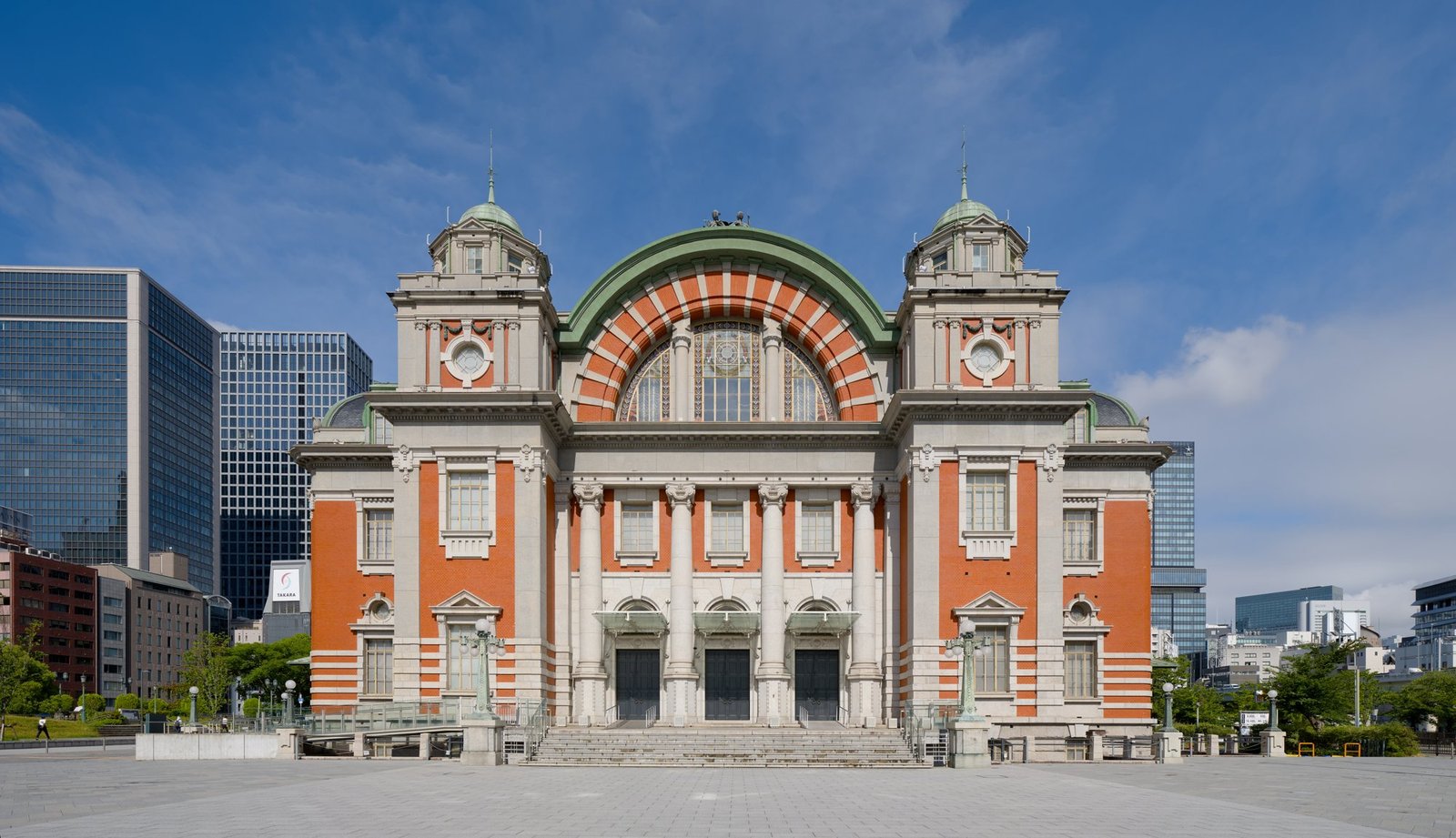
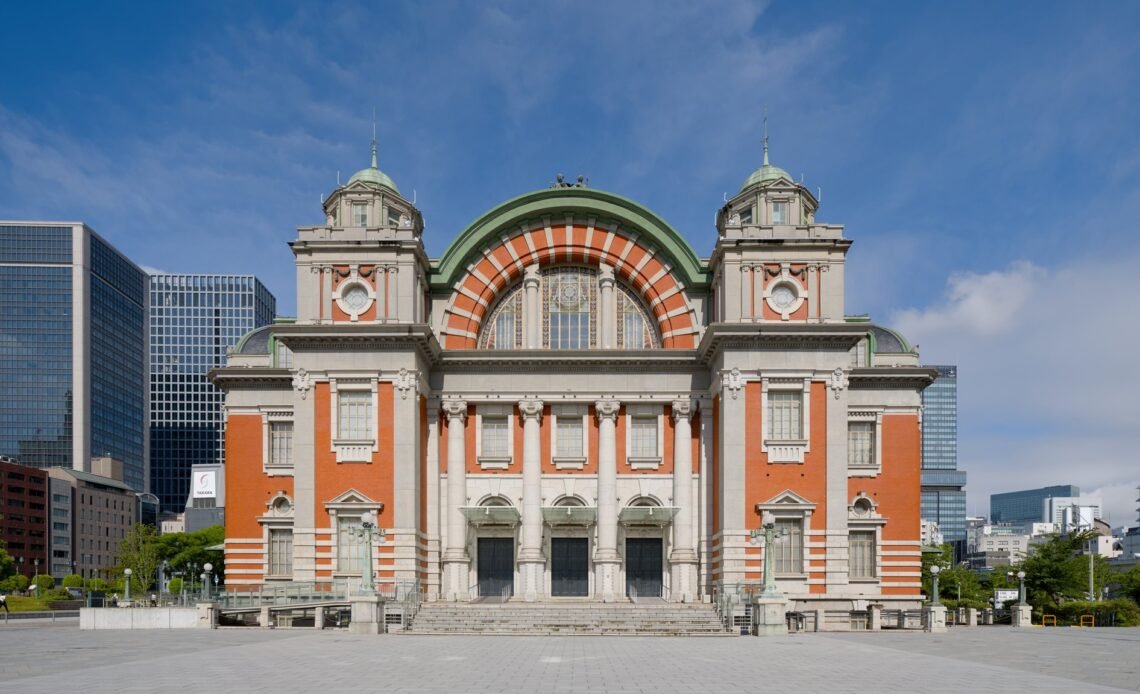
The main event is a nightly projection-mapping display on the east facade of the Osaka City Central Public Hall, a red-brick, bronze-domed Neo-Renaissance building on Nakanoshima that has anchored this stretch of the Dojima and Tosabori rivers since 1918. Its backstory is as deliberate as the architecture: stockbroker Einosuke Iwamoto donated one million yen — an enormous sum at the time — to the city to build it, then died in 1916, two years before it opened. The design itself came out of one of Japan’s first open architectural competitions, won by Tatsuno Kingo (the architect behind Tokyo Station) and Yasushi Kataoka. When the hall opened in November 1918, roughly 100,000 people visited in its first four days. It was designated a national Important Cultural Property in December 2002, the first public hall in western Japan to receive that status — which makes projecting light art onto it every December a small, running act of civic theater: turning a protected 20th-century landmark into a canvas without touching a brick of it.
The festival itself dates back to 2003, making 2026 roughly its 24th year — old enough that Osaka now treats it as a fixture of the city’s identity rather than a one-off tourism push. It runs alongside a second, longer-running core program, the Midosuji Illumination, which strings lights down Midosuji Avenue — Osaka’s ceremonial boulevard, widened from a roughly 6-meter street to about 44 meters and reopened in May 1937, a scale almost unheard-of in prewar Japanese urban planning — from November 3 through December 31 this year. Together, the two form the spine of “Osaka Hikari no Kyoen,” with more than twenty satellite illumination programs now scattered across the wider Kansai region feeding off the same seasonal pull.
What’s Actually Showing This Year
Per the official program, the public hall’s projection-mapping show runs nightly for the full December 11–25 window, with showtimes repeating on a loop through the evening — content and exact run-times vary by program, per the event organizers, so checking the official site on the day is worth it if you’re building a night around it. The piece transforms the hall’s ornate facade — its arched windows, stone balustrades, and bronze dome — into a shifting canvas, a different register of spectacle than the simpler string-light displays found along Midosuji. Nakanoshima Park, which wraps the public hall, also hosts smaller area programs and seasonal lighting as part of the wider festival footprint, so the walk from the public hall along the river tends to turn up more than the single headline show.
Getting There, Cost, and Timing
Viewing the projection-mapping show is free, with no reservation required — you simply show up within the nightly viewing window. The closest station is Keihan’s Naniwabashi, about a one-minute walk from the public hall; Osaka Metro Midosuji Line and the Keihan Main Line both stop a short walk away at Yodoyabashi and Kitahama, making Nakanoshima one of the easier festival sites in Osaka to reach without a car. Because the public hall sits roughly midway between Osaka’s two main downtown hubs — Umeda to the north and Namba to the south — it’s realistic to pair an evening here with dinner or a Dotonbori walk the same night, rather than treating it as a separate trip.
For anyone visiting Osaka specifically for the season, the two-week overlap with the tail end of the Midosuji Illumination (which runs through December 31) means a single December visit can realistically catch both core programs: the ceremonial boulevard lit end to end, and the more intimate, art-driven show at the public hall two kilometers away on Nakanoshima. Given how far Osaka’s light season has expanded — past editions have added programs as far out as Rinku Town and Senboku, well outside the city center — Nakanoshima and Midosuji remain the two stops worth prioritizing if time is limited.
Official info: hikari-kyoen.com.