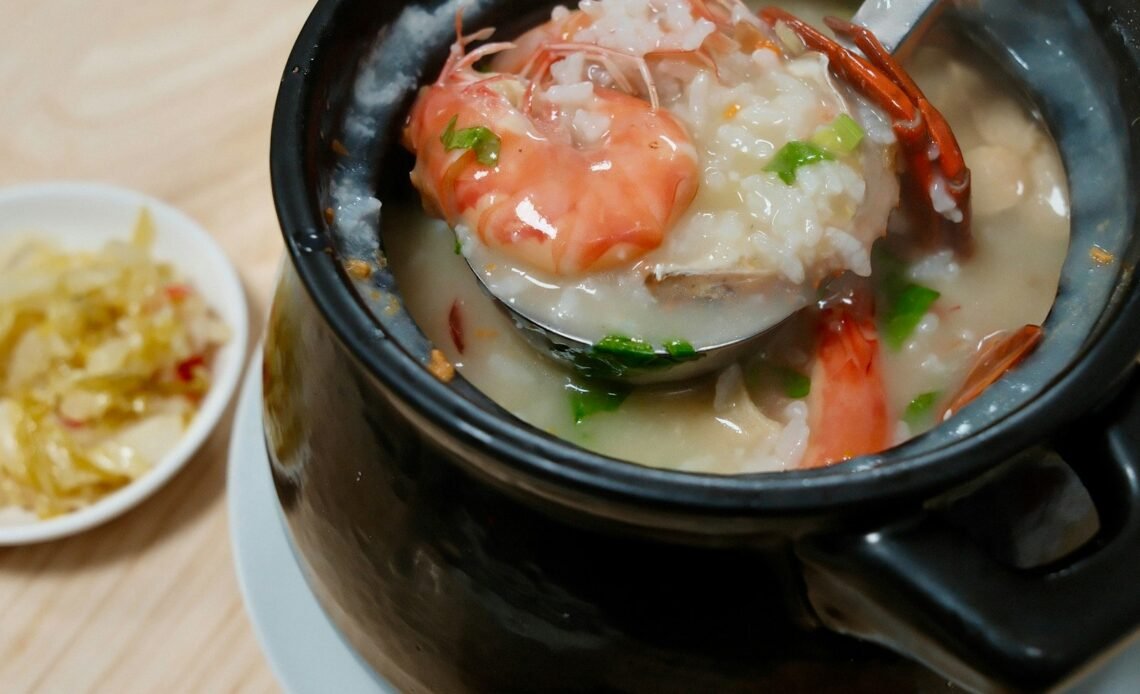
Long before congee was a breakfast staple or a hangover cure, it was a business model. In Qing-dynasty Guangzhou, boat-dwelling Tanka families paddled sampans along Lychee Bay and the nearby Liwan Lake, ladling out bowls of rice porridge loaded with fresh fish and river shrimp to anyone who flagged them down from the bank. The dish took the name of the boats that sold it — teng jai jook (艇仔粥), “sampan congee” — and it’s the ancestor of the version Hong Kong eats today, even if almost nobody still serves it from a boat.

Why It Started on the Water
Sampan congee’s original bowl was simple: rice porridge, sliced raw fish, and shrimp, poached for seconds in the hot gruel right at the point of sale, since a moving boat kitchen had no room for much else. As the dish moved onshore into Guangzhou’s restaurants and then into Hong Kong through 20th-century migration, cooks padded it out with peanuts, pork offal, century egg, and jellyfish — the loaded, kitchen-sink congee you’ll find on some Hong Kong menus today still carries the sampan name even though the cook never left dry land. Hong Kong’s own sampan culture peaked in the 1950s, when Tanka families genuinely lived aboard small boats in harbors like Aberdeen; it declined as larger vessels and rising repair costs pushed that way of life ashore. The congee outlived the boats.
The Everyday Version: Jook, Not Congee
In Cantonese kitchens the dish is jook (粥) — the same character read as zhōu in Mandarin — and the bowl most Hong Kong households and cha chaan tengs actually make most days isn’t the loaded sampan version but pei daan sau yuk jook (皮蛋瘦肉粥), century egg and lean pork congee. It’s the plain-clothes workhorse of the category: cheap, fast enough for a weeknight, and the clearest way to see Cantonese congee technique without other ingredients competing for attention.
The Ratio That Actually Matters
Cantonese congee is cooked loose and long enough that the grains break down almost entirely into the liquid, which is what separates it from the firmer, grain-intact rice porridges found elsewhere in China and Southeast Asia. Professional ratios run anywhere from 1:8 to 1:12 rice to water depending on how thick a cook wants the final bowl; 1:10 is a reliable middle ground for a congee that’s thick enough to coat a spoon but still pours. Rinse 1 cup (about 200g) of jasmine rice until the water runs close to clear, then soak it in water for 30 minutes — this shortens the cooking time and gives a smoother break-down than cooking from fully dry rice.
Century Egg and Pork Congee (皮蛋瘦肉粥), Serves 4
Combine the soaked rice with 10 cups (2.4L) water or unsalted chicken stock and 3 thin slices of ginger in a heavy pot. Bring to a boil, then drop to the lowest simmer that still shows small bubbles — a rolling boil here just splatters starch everywhere without cooking anything faster. Cook uncovered for 60 to 90 minutes, stirring every 10 minutes or so to keep the bottom from catching, until the rice has broken down into a loose, creamy porridge with no distinct grains left.
While the congee cooks, peel 2 preserved (century) eggs and cut them into small cubes. Thinly slice 200g of lean pork loin against the grain and toss it with ½ teaspoon salt, ½ teaspoon sugar, 1 teaspoon cornstarch, 1 teaspoon sesame oil, and a pinch of white pepper; let it sit while the rice cooks. Stir half the century egg into the congee about 15 minutes before it’s done — it melts in and deepens both the color and the savory base. Once the congee has reached its final consistency, raise the heat slightly and stir in the marinated pork, cooking just until the slices turn opaque, about 1 to 2 minutes. Overcooked pork slices go rubbery fast, so pull the pot off heat the moment they’re done rather than leaving it simmering.
Season with salt and white pepper to taste, then ladle into bowls and top with the remaining century egg cubes, a drizzle of sesame oil, shredded ginger, and sliced scallion. A side of youtiao (fried dough stick), torn into pieces and dropped in for the last minute for crunch, is the classic cha chaan teng finish.
What Changes, What Doesn’t
Swap the pork and century egg for shredded chicken, fish fillet, or just peanuts and preserved vegetables, and you’re back toward the sampan version’s original spirit — a base congee built to carry whatever’s on hand. What doesn’t change is the technique underneath: a long, low simmer that breaks the rice down rather than just cooking it through, and raw proteins added late so they poach in the time it takes to walk a bowl to a table. That’s the real inheritance from the boats on Lychee Bay — not the fish and shrimp specifically, but the idea of a porridge built to be finished to order, one bowl at a time.
