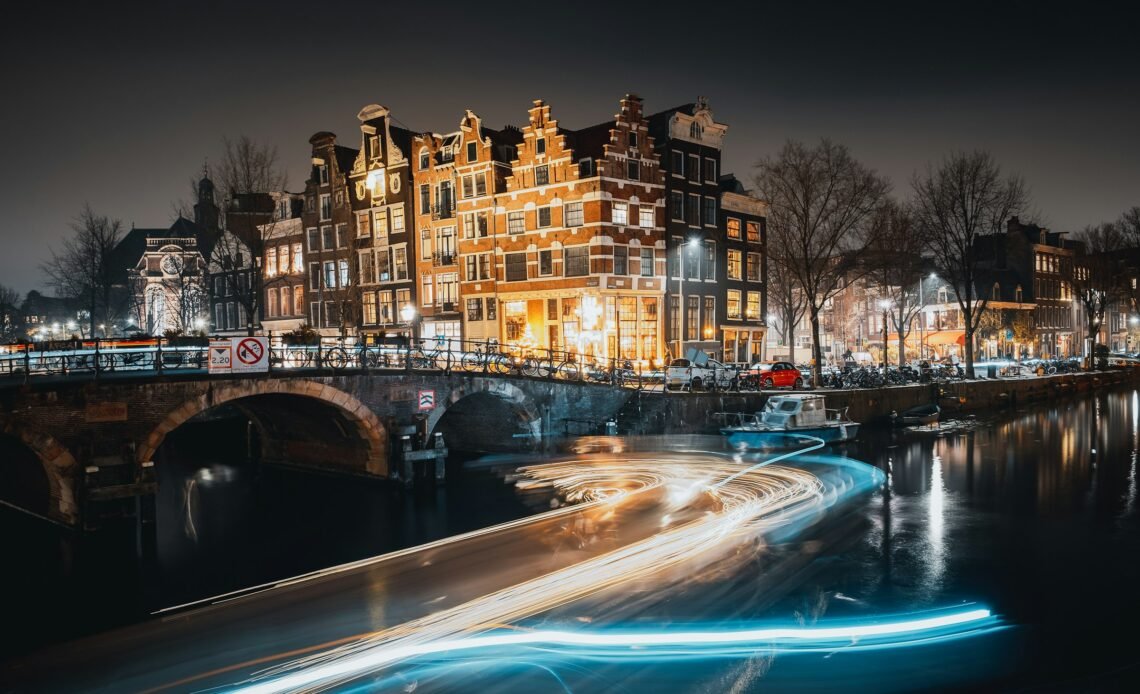
Amsterdam’s nightlife reputation is older than the stag parties that currently drive it. The city’s oldest red-light alleys trace back to a 14th-century harbor district where sailors, merchants, and dockworkers drank and gambled within sight of the Oudekerksplein — centuries before anyone coined the phrase “red light.” The jenever that still gets poured at 17th-century tasting houses is the direct ancestor of gin, invented here as a juniper-flavored medicine before it became the drink of the Dutch Golden Age. And the narrow canal houses you’ll duck into for a nightcap are narrow for a reason: Amsterdam once taxed buildings by the width of their street-facing facade, so merchants built tall, deep, and barely wide enough for a staircase. This is a three-day itinerary built around going out after dark — but the real story of Amsterdam nightlife is four centuries of trade, taxation, and tolerance that got there first.

Day 1: De Wallen and the oldest bars in the city
Spend the afternoon in the Centrum before the neighborhood changes character after dark. De Wallen — Amsterdam’s oldest quarter, named for the medieval canal walls that once ringed it — grew up around the Oudekerksplein as a port district where taverns and trade sat side by side; the window prostitution that gives the area its modern reputation was formally tolerated and later regulated here long before most of Europe debated the question at all. Before the crowds arrive, visit Museum Our Lord in the Attic (Oudezijds Voorburgwal 40), a 17th-century canal house that hid a full working Catholic church across its top three floors during a period when public Catholic worship was banned in officially Protestant Amsterdam; adult admission runs about €18, and the steep original staircases mean it’s worth budgeting a full hour. For dinner, eat in the Nieuwmarkt, then walk the district itself before 10pm, when it’s at its most atmospheric and least rowdy — photographing the windows or the workers is illegal and enforced with real fines, so keep the camera in your bag.
After that, go find the jenever. Proeflokaal Wynand Fockink, tucked down the alley at Pijlsteeg 31 since 1679, is a tasting house in the original Dutch sense — no seats, no bar stools, just a wooden counter where you drink your pour standing up, the traditional way, bending at the waist to sip from a filled-to-the-brim glass without lifting it first. A few minutes’ walk away, In ‘t Aepjen (Zeedijk 1) pours from inside one of only two surviving wooden-fronted houses left in the city, dating to around 1550; sailors once settled bar tabs here with monkeys brought back from the East Indies, which is where the “In the Monkeys” name actually comes from. Both are classic Amsterdam brown cafés — nicknamed for walls stained by centuries of pipe and cigarette smoke — rather than clubs, and that’s the point on night one.
Day 2: The Jordaan by day, Leidseplein by night
Spend the morning walking the Jordaan and the Grachtengordel, the 17th-century canal ring UNESCO inscribed as a World Heritage Site in 2010. The neighborhood’s famously narrow, deep houses are a direct result of a historical property tax levied on canal-frontage width rather than depth — the wealthiest merchants built modestly at the street and lavishly backward, which is also why so many facades lean slightly forward today: hoist beams at the top let furniture be pulled up outside because the staircases inside were never built wide enough. Stop at Café ‘t Smalle (Egelantiersgracht 12), a jenever distillery turned brown café since the 1780s, for an afternoon drink on its canal-side terrace, then browse the Noordermarkt before the shops close.
At night, head to Leidseplein for Amsterdam’s two most historically significant live venues, which sit next door to each other. Paradiso occupies a former 19th-century church on Weteringschans and has booked everything from The Rolling Stones to techno residencies since opening as a music venue in 1968; Melkweg, in a converted dairy building next door, runs multiple rooms covering electronic, hip-hop, and indie on any given night. Check both venues’ own calendars before you go — lineups change nightly and popular shows do sell out — and expect doors anywhere from 8pm for concerts to well past 11pm for club nights.
Day 3: De Pijp, then the techno rooms
Spend the day at Albert Cuypmarkt, the Netherlands’ largest daily street market, running through the De Pijp neighborhood since 1905 — look for a stroopwafel made fresh on the griddle rather than packaged. If you want altitude over the canals, A’DAM Lookout’s rotating platform and swing (adult tickets from roughly €17.50) sits across the IJ from Centraal Station and is less crowded after dark than during the day.
For the last night, Amsterdam’s techno scene runs through Radion in Amsterdam-West and Shelter in the Overhoeks tower near Centraal, both known for deep, selector-driven lineups rather than mainstream EDM; both sell timed tickets online rather than at the door. If cannabis tourism is part of your trip, know that the city’s long-threatened ban on tourists buying from coffeeshops has been proposed, shelved, and revived repeatedly since 2023 and had not taken effect as of late 2026 — all of Amsterdam’s roughly 165 licensed coffeeshops remained open to visitors 18 and older with valid passport ID, though none serve alcohol and most don’t take cards, so bring cash. Close the night with fries from a late-opening frituur near Rembrandtplein, which keeps serving well past 1am on weekends.
Practical notes
A GVB 24-hour public transit pass runs about €10, with multi-day options up to €27.50 for 96 hours — trams and the night bus network cover the areas in this itinerary well, so there’s little reason to drive. Budget roughly €60-90 a day per person outside lodging and club cover once you’ve covered museum admissions, bar tabs, and a sit-down dinner or two. Spring and early autumn bring milder weather and shorter museum lines than peak summer, though nightlife runs year-round regardless of season. Police can and do issue on-the-spot fines for public drinking, street smoking, and photographing sex workers in De Wallen — the rules are enforced, not decorative, so treat the neighborhood’s history with the same respect you’d give any other 700-year-old part of the city, because that’s exactly what it is.
