Right now, through roughly November 21, the maples lining the Nashigawa River at Lake Kawaguchiko are at their reddest — a peak window Japan’s foliage trackers pinned at November 13-21, 2026, with color building toward Mt. Fuji’s other famous viewing points through early December. The town calls it the Fuji Kawaguchiko Autumn Leaves Festival, running November 7-29 this year, and the single best reason to go isn’t just the mountain. It’s a 150-meter stretch of maples that exists because a river flooded roughly a century ago, and the people who lived along it planted trees instead of walls.


The Corridor a Flood Built
According to Mt. Fuji’s official tourism site, the Momiji Corridor — sometimes called the Maple Corridor — began during the Taisho era (1912-1926), after repeated flooding of the Nashigawa River damaged the farmland and homes along its banks. Rather than just rebuild embankments, local residents planted maple trees along the river to help hold the soil. A century later, those same trees — now somewhere between 60 mature specimens lining the riverbank itself and several hundred counted across the wider festival grounds along Momiji Street, depending on which stretch you measure — form one of the most photographed autumn corridors in Japan, with a canopy that turns the water beneath it a deep red by mid-November. It’s a rare case of flood-control infrastructure that became a tourist landmark: the trees were never planted for the view, and the view is the whole reason people now fly here.
At night during the festival, the corridor is lit from sunset until around 9 p.m., and admission to walk it is free — though the town has started charging for the car park near the venue, a recent change worth budgeting for. The closest bus stop is Itchiku Kubota Art Museum, about a five-minute walk from the corridor, with the Kawaguchiko Natural Living Center stop as an alternative.
A War Memorial Built for Peace, Not Postcards
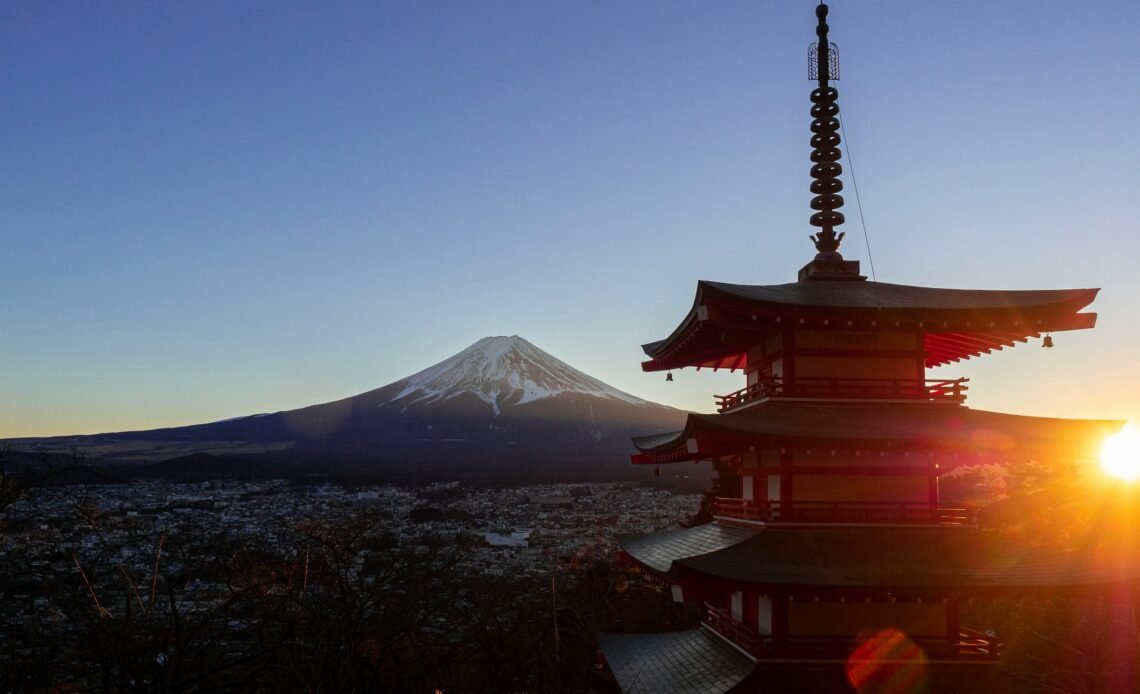
Twenty minutes away by car in Fujiyoshida, Arakurayama Sengen Park holds the image everyone has seen without necessarily knowing its story: the five-story Chureito Pagoda, framed against Mt. Fuji, often with cherry blossoms or maple leaves in the foreground depending on the season. The pagoda wasn’t built as a photo backdrop — it went up in 1963 as a peace memorial, honoring Fujiyoshida residents who died in conflicts stretching from the mid-19th century through the Second World War. It sits roughly 400 steps up the hillside above the Arakura Sengen Shrine, and while the park is best known for its spring cherry blossoms, its maples hold color into late November, often later than the Momiji Corridor below — which makes it a natural second stop on the same trip rather than a separate visit.
For a different angle on the same mountain without the climb, Oishi Park on the lake’s north shore gives an open, low vantage point across the water to Fuji — a better bet if you’re short on time or traveling with people who can’t manage 400 steps.
Building the Day
The pagoda rewards morning light, before the steps and the viewing deck fill up — aim to be climbing by 8 or 9 a.m. Spend the early afternoon at Oishi Park or around the lake’s north shore, where there are several lakeside cafés if you want a slow lunch with the mountain in view. Save the Momiji Corridor for late afternoon into evening: arrive before sunset to see the color in daylight, then stay as the light-up comes on. That timing matters more than it looks like it should, because getting back has a catch.
Getting There — and the One Thing to Plan Around
From Tokyo, the direct option is the Fuji Excursion limited express from Shinjuku Station to Kawaguchiko Station — about one hour 50 minutes each way, with one-way adult fares around ¥4,200. It runs a handful of times a day, so book your return before you go, not after.
Here’s the catch: the local Red Line sightseeing bus that connects the station to the sights stops running around 5:45 p.m. — well before the corridor’s light-up ends at 9 p.m. — and the last comfortable Fuji Excursion departure back toward Shinjuku leaves Kawaguchiko in the late afternoon, not after dark. If you want to see the illumination properly, either plan a taxi back to your lodging afterward or just stay the night around the lake — there’s a reason most people treat this as an overnight trip rather than a single long day from Tokyo. Pack for cold: November evenings at this elevation, with Fuji often still carrying snow above you, run considerably colder than central Tokyo after dark.
Forecasts shift with the weather even this close to the date, so check an official source like the Japan Meteorological Corporation’s koyo tracker or the Fujikawaguchiko tourism site before you lock in travel days — but as of this week, the color is as good as it’s going to get.
