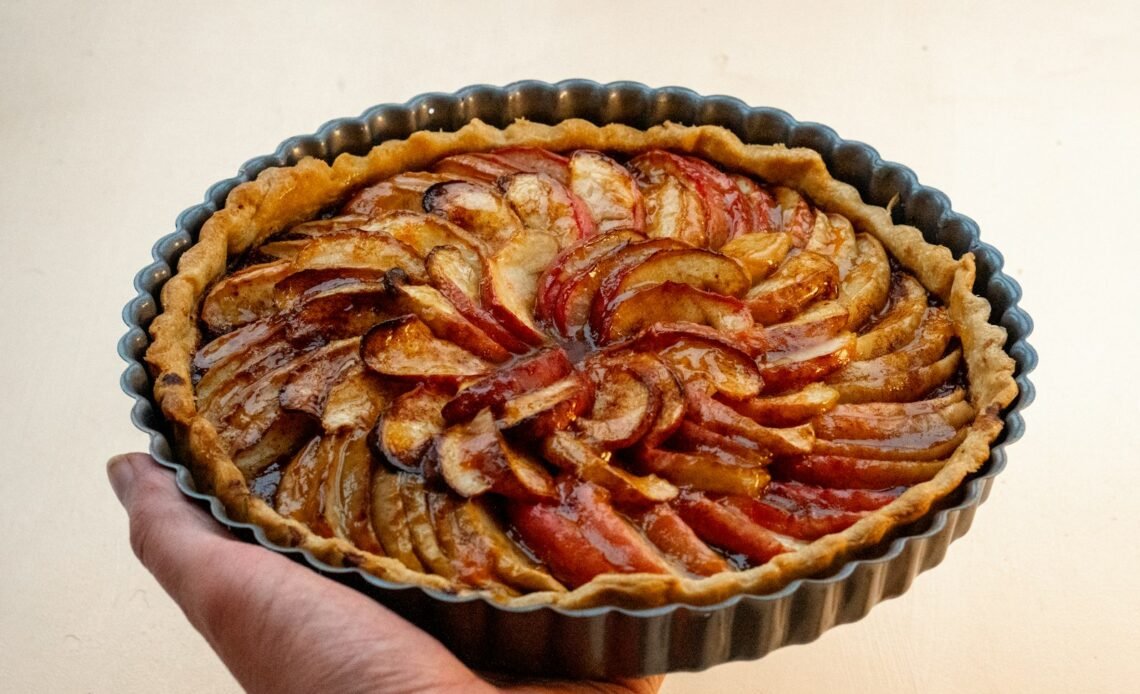
Ask a Rotterdammer where to get apple pie and nearly all of them point to the same corner: Meent 88, where a 1952 insurance-company office building now runs a grand café under the name of the architect who designed it. Dudok has served warm appeltaart with whipped cream for more than three decades, and locals and guidebooks alike call it the city’s most famous slice — not because it’s the fanciest dessert in Rotterdam, but because it’s the one that hasn’t changed while everything around it did.

A Pie That’s Older Than the Netherlands’ Independence
Dutch cooks were writing down apple pie recipes before most of Europe had settled on the idea at all. The earliest known Dutch version appears in Een notabel boecxken van cokeryen, a cookbook printed in Brussels in 1514 — more than two centuries before the “American” apple pie most people picture today even existed as a recipe. That timeline matters because it explains why appeltaart tastes and looks nothing like its American cousin: it isn’t a thin double-crust pie, it’s a tall, cake-like tart, usually 6 to 8 centimeters deep, built from a dense, slightly sweet shortcrust that’s closer to a cookie dough than American pie pastry. The filling leans on cinnamon, sometimes a pinch of nutmeg or cardamom, and raisins or currants often soaked in rum — a combination that points straight back to the spice trade the Dutch East India Company ran through Amsterdam’s harbor for two centuries. The lattice top, woven in strips rather than cut as vents, is the detail most people register first and the one that’s hardest to fake with a store-bought crust.
The pie most people now picture as “the” Dutch style — tall, lattice-topped, heavy on the spice — got standardized relatively recently by Amsterdam bakery Winkel 43 on Noordermarkt, whose version became famous enough in the late 20th century to set the template other cafés now bake to. Rotterdam’s take, at Dudok, follows that same shape but earns its own reputation through consistency rather than invention: it’s the slice Rotterdam families order on a Sunday afternoon, not a tourist photo opportunity dressed up for Instagram.
The Building Has Its Own Story
Dudok’s café occupies the ground floor of a building that has nothing to do with food. Architect Willem Marinus Dudok designed the structure at Meent 88, on the corner of Westewagenstraat, for the insurance company De Nederlanden van 1845, with construction running from roughly 1951 to 1952 and interior work by Herman Kossmann and Jaap Dijkman. It’s a slab of postwar Rotterdam reconstruction architecture — the city had been flattened by the German bombing of May 1940, and buildings like this one were part of the deliberate, modernist rebuild that gave Rotterdam its reputation as the Netherlands’ most architecturally experimental city, decades before the Markthal or the Cube Houses made that reputation global. The insurance company moved out in 1980, the building briefly held government offices and, improbably, a carpet shop, and it wasn’t until 1991 that it reopened as Grand Café Dudok — named for the architect, not any family recipe. The building is now a protected municipal monument, which is part of why the café still looks like it belongs to 1952 rather than 1991: soaring ceilings, oversized windows, and the kind of scale that was built for insurance clerks, not brunch crowds, but works for both.
What to Actually Order
Order it the way regulars do: warm, with a side of whipped cream (slagroom), not cold off a refrigerated counter. Dudok’s own 2024 menu lists the warm Dudok Original Appeltaart, served with vanilla ice cream and whipped cream, at €9.25; a plain slice of the Original or the vegan version runs €5.50 each, with whipped cream added for a small surcharge. The café’s in-house patisserie also sells whole 20-centimeter pies to take home — the same recipe shows up packaged at Albert Heijn supermarkets nationwide for around €14, which tells you something about how far beyond Meent 88 this specific pie has traveled. (As with any café menu, treat these as the last verified prices rather than gospel — ask for the current card when you sit down.) A second, smaller Dudok Patisserie counter operates inside Rotterdam Centraal station, useful if you’re passing through on a train rather than staying for the full café experience.
Beyond the pie, Dudok runs as a full grand café — breakfast, lunch, and dinner — with a menu that also covers sandwiches, salads, and a rotating list of other cake slices (red velvet, carrot-walnut, lemon meringue, forest-fruit cheesecake). But the appeltaart is the one dish the café is actually known for outside Rotterdam, and it’s the one worth planning a stop around if you’re only passing through the city for a day.
Good to Know
Dudok sits at Meent 88, 3011 JP Rotterdam, a short walk from both Rotterdam Centraal and the Markthal — easy to combine with a market visit on the same afternoon. The café generally opens by 8 or 9 a.m. and stays open through dinner service; hours have varied across different listings, so it’s worth a quick check of the café’s own page before you go rather than trusting any single third-party directory. Seating spreads across the ground floor and a terrace that fills quickly on weekends, so arriving outside the Saturday lunch rush improves your odds of a table. And if you can’t make it to Meent 88 at all, the Albert Heijn version is a reasonable stand-in — just know you’re eating the commercial descendant of the café slice, not the warm, à la minute version regulars actually order.
