On October 28, Anthropic quietly added 20 new partners to a program most people have never heard of: AI for Science, which hands free Claude credits to researchers instead of charging them like everyone else. No model launch, no press conference — just six funders, six institutions, and six research projects added to a list that started in May 2025. The partner names are the interesting part: a complete wiring map of a fruit fly’s brain, a genetic database spanning over 800,000 people, and a climate model built by Columbia physicists are all now running on subsidized Claude access.

What AI for Science Actually Gives Away
Anthropic’s AI for Science program doesn’t sell Claude to researchers — it gives it to them. The company provides free Claude API credits to what it calls “high-impact scientific projects,” plus a discounted Team plan for individual scientists who want Claude in their daily workflow. Since the program started, Anthropic says it has backed hundreds of projects spanning biology, medicine, physics, chemistry, climate science, and mathematics. The October 28 update added 20 more partners in one batch: funders like the Alfred P. Sloan Foundation (founded 1934), the Simons Foundation, Schmidt Sciences, and the U.S. National Science Foundation — a $9 billion federal agency that alone accounts for roughly a quarter of all federal basic-research funding at American universities — plus institutions including the Wellcome Sanger Institute, the Francis Crick Institute in London, EMBL, and San Francisco’s Gladstone Institutes.
The Fruit Fly Brain and the 800,000-Person Genome Database
The most concrete project on the list is FlyWire, a Princeton-led consortium that published the first complete wiring map of an adult fruit fly’s brain in Nature in October 2024 — roughly 139,000 neurons and more than 50 million synapses, built by having a computer program automatically trace individual neurons through electron-microscope images originally captured at the Howard Hughes Medical Institute’s Janelia Research Campus. It’s the most complete connectome of an adult animal assembled to date, and FlyWire’s team now gets Claude credits to keep extending that analysis. On the genomics side, the Broad Institute’s gnomAD database — which pools DNA data from over 800,000 people to help researchers figure out which genetic variants actually cause rare disease, rather than just occurring harmlessly — joins the program too. So does AstroPath, a Johns Hopkins cancer-research project with an unusual trick: it borrows calibration methods originally developed for astronomical sky surveys to image tumor samples cell by cell. Columbia’s LEAP center, an NSF-funded effort combining machine learning with physics-based climate models, and Tau Ceti, a community-built library of formally verified mathematics written in the Lean proof language, join a sixth project, the Centre for Population Genomics — a Garvan Institute and Murdoch Children’s Research Institute program working to include Australia’s multicultural communities in genomic research — to round out the six named research initiatives.
Letting AI Agents Touch Lab Equipment
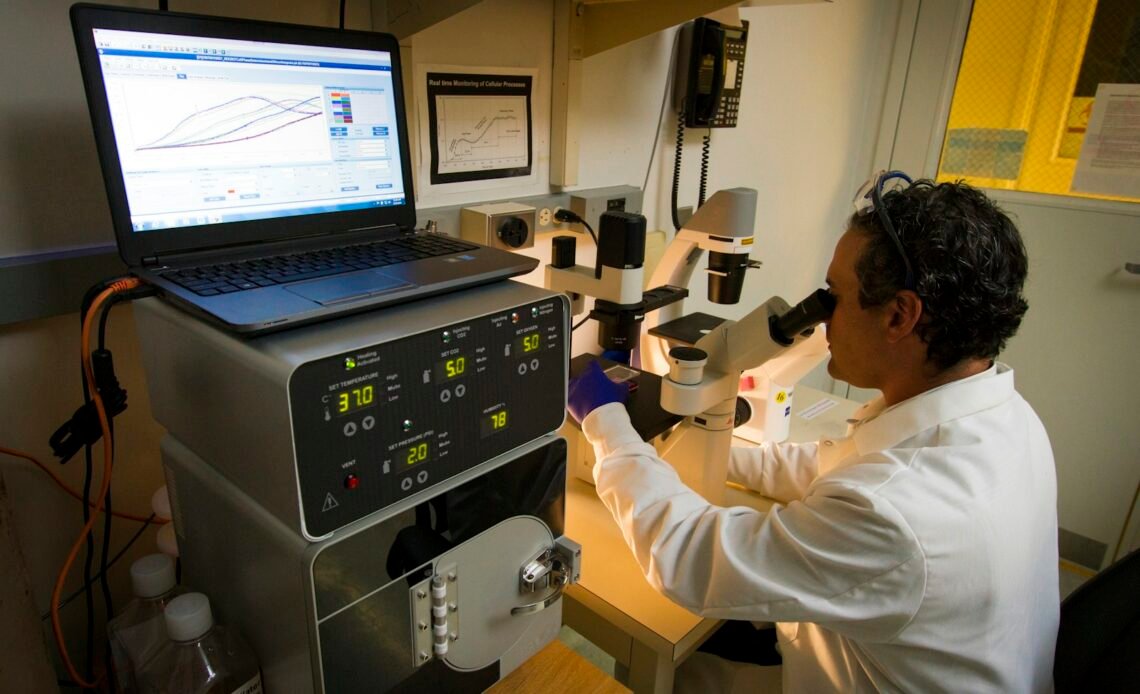
Two of the collaborations go a step beyond funding. Anthropic says it co-developed a “Model Hardware Standard” with HHMI’s Janelia Research Campus — a shared specification meant to let AI agents safely operate physical lab instruments, now in research preview. That’s a meaningfully different ask than having Claude summarize a paper or write analysis code: it means giving a model some degree of control over real microscopes, sequencers, or sample handlers, with whatever safety rails the standard builds in. Separately, the Allen Institute is using Claude to build teams of AI agents that comb through its large open biological datasets — work Anthropic claims can compress months of manual analysis into hours, though that’s Anthropic’s own framing rather than an independently audited benchmark.
Why a Credits Program, Not a Product Launch
None of this shows up in a keynote because it isn’t really a product story — it’s a customer-acquisition story aimed at an unusually prestigious, unusually low-revenue customer base. Academic labs rarely have the budget to pay full API prices, but they produce the kind of public, citable results (a Nature paper, a widely-used open database) that double as credibility for whichever AI company’s logo sits in the acknowledgments section. Google and OpenAI run comparable academic-credit programs for the same reason. Anthropic says many of these 20 new collaborations are still early-stage, and that it plans to keep adding partners globally rather than treating this as a one-time announcement — which means the more interesting test is whether any of these specific projects, the fly connectome extensions or the rare-disease variant hunts, produce a result over the next year that the researchers themselves credit back to having Claude in the loop.
