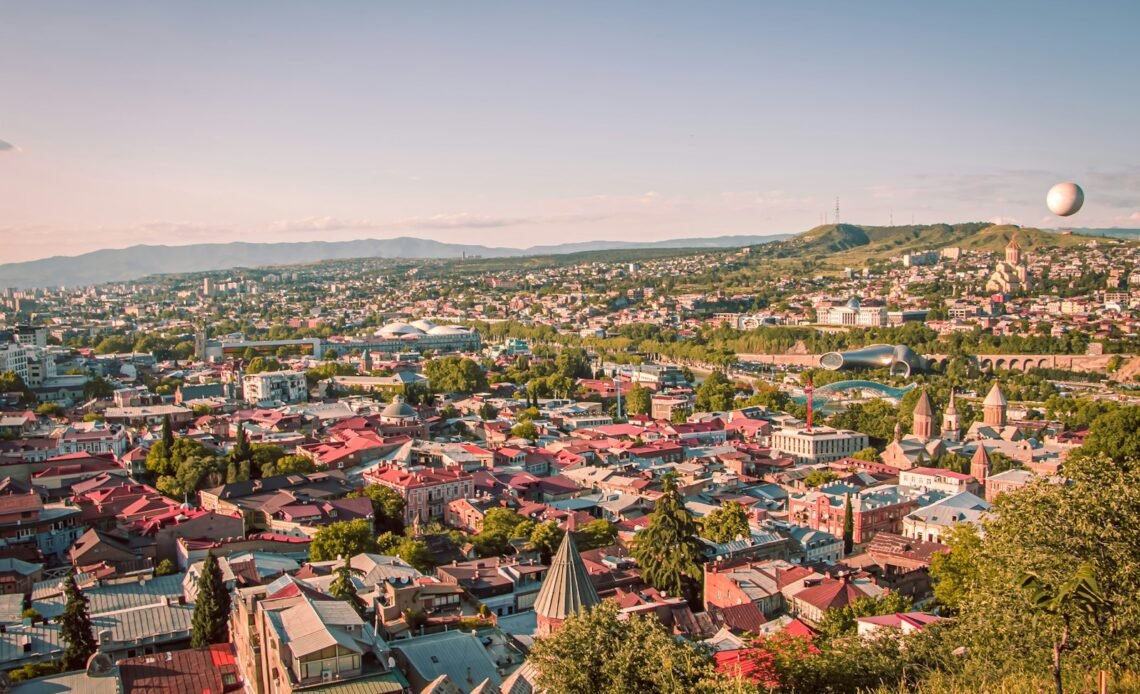
Georgia’s capital has spent the last couple of years quietly climbing every “underrated Europe” list going — and after five days there, it’s easy to see why. Tbilisi packs sulfur bathhouses, a cable-car fortress, a 1,600-year-old former capital next door, and one of the world’s oldest wine cultures into a trip that still costs a fraction of Paris or Rome. Here’s how to actually spend five days there.

Day 1: Old Tbilisi, on Foot
Start in Abanotubani, the sulfur bathhouse district, where domed brick bathhouses still pipe in naturally hot mineral water — a soak here is the local cure for jet lag. Walk across the Bridge of Peace into the Old Town, then take the cable car up to Narikala Fortress for the best rooftop view of the city before wandering down through the Botanical Garden below it. End the day at Meidan Bazaar for khachapuri (Georgia’s cheese-stuffed bread) and churchkhela (walnut-and-grape-juice candy).
Day 2: Cathedrals, Wine, and the Dry Bridge
Holy Trinity Cathedral (Sameba) is the sight nearly every local guide puts first — it’s one of the tallest Orthodox cathedrals in the world and visible from much of the city. From there, walk down to Metekhi Church on its cliffside perch over the Mtkvari River for the classic postcard view back toward Old Town. Spend the afternoon at the Georgian National Museum of Wine for a tasting flight of qvevri wine, fermented in buried clay vessels using an 8,000-year-old method UNESCO recognizes as intangible cultural heritage — then browse the Dry Bridge flea market for Soviet-era trinkets and hand-woven textiles.
Day 3: Mtskheta, Georgia’s Former Capital
Twenty minutes outside Tbilisi sits Mtskheta, Georgia’s ancient capital and the spiritual center of the country. Svetitskhoveli Cathedral, believed to hold a relic of Christ’s robe, anchors the town, while Jvari Monastery on the hilltop above — the same spot Pushkin wrote about — gives a sweeping view down over the confluence of the Mtkvari and Aragvi rivers. It’s an easy half-day trip by marshrutka (shared minibus) or a short taxi ride, leaving the afternoon free back in the city.
Day 4: Kakheti Wine Country and Sighnaghi
Georgia is widely credited as the birthplace of wine, and Kakheti is where that history still runs the local economy. Base the day around Sighnaghi, the hilltop “City of Love” known for its 18th-century defensive walls and 24-hour wedding registry, then book a family-run cellar visit for a qvevri tasting and a hands-on Georgian cooking class — khinkali (soup dumplings) and churchkhela-making are common options. It’s roughly a 90-minute drive from Tbilisi each way, so this works best as a full-day excursion with a driver or small-group tour.
Day 5: The Mountains, or a Slow Morning at Fabrika
For a last big day, the drive toward Kazbegi via the Georgian Military Highway through Gudauri climbs to Gergeti Trinity Church, perched at 2,170 meters with Mount Kazbek behind it — budget 3 to 4 hours of driving each way, so it’s a full day. If an early flight rules that out, swap it for a slower finish: Lisi Lake for a walk outside the city center, then Fabrika, a former Soviet sewing factory turned hostel-and-courtyard complex, for coffee and last-minute souvenir shopping from local designers.
Practical Notes
Spring (April–June) and fall (September–October) bring the most comfortable weather for walking the Old Town and day-tripping into the mountains. Getting around is cheap and easy with the Bolt app for city rides and marshrutky for longer hops; a realistic daily budget, including meals and a cellar tasting, runs $40–$60 per person outside of lodging. Many nationalities get visa-free entry for up to a year, but check requirements for your passport before booking, and grab a local eSIM on arrival — connectivity is solid even out toward Kazbegi.