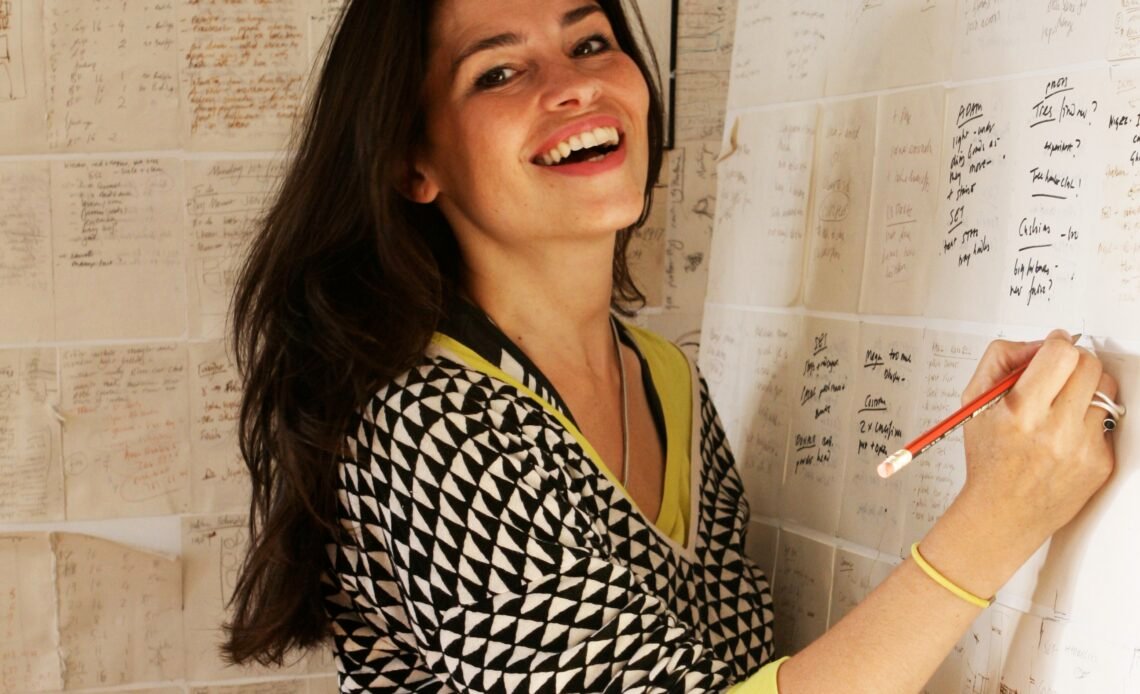
For two decades, Es Devlin has built the architecture that pop culture performs inside — the spherical portal Beyoncé walked through on the Renaissance tour, the monolith behind her Formation stadium dates, the scenic design for the 2012 London Olympics closing ceremony and the 2016 Rio opening ceremony, a Tony Award for “The Lehman Trilogy,” a Super Bowl LVI halftime show built around Dr. Dre, Snoop Dogg, Eminem, Mary J. Blige and Kendrick Lamar. What the British artist had never had, until this month, was a museum show of her own on Australian soil. “The Turning” opened November 7 as one of five inaugural exhibitions inside Powerhouse Parramatta, the $915 million museum that just gave Western Sydney its first major cultural institution — and the opening festival built around it runs through Sunday, November 29.

The Designer Behind the Stages You Already Know
Devlin, 55, trained in English literature at Bristol before a foundation course at Central Saint Martins pulled her toward theatre design, then the Motley Theatre Design Course sharpened it into a profession. She made her National Theatre debut designing Harold Pinter’s “Betrayal” in 1998, and started building concert stages for the band Wire in 2003. Kanye West called in 2005 for his “Touch the Sky” tour, and that relationship opened the door to the stadium-scale work she’s known for now: Adele’s “Live in London” and “One Night Only” at Griffith Observatory, U2, The Weeknd, Lorde, the UK Pavilion at Expo 2020 Dubai, and the Brit Awards statuette she co-designed with Yinka Ilori in 2021. She holds an OBE from 2015 and was made a CBE in 2022 “for services to design.” Her theatre work — “Chimerica,” “The Nether,” “Hamlet,” “Dear England” — has picked up multiple Olivier Awards along the way. For a designer whose work has been seen by billions of people through a handful of the biggest stages on Earth, a gallery show is a genuinely different exercise: nobody is singing, and nothing moves unless the visitor moves it.
Inside “The Turning”
“The Turning” is a suite of five large-scale installations spanning sculpture, film and language rather than a single centerpiece object. The anchor piece, reported under the working title “Forest of Us,” is a mirror maze that draws a direct visual parallel between the branching bronchial structures inside human lungs and the branching structure of trees — the same fractal logic repeated at two different scales, one inside the body and one outside it. The other four works extend that same preoccupation with reflection, memory and collective identity, built to be walked through and participated in rather than viewed from a fixed seat, with ambient sound running through the rooms. It’s Devlin’s first major exhibition in Australia, and notably, it’s a solo museum commission rather than a commercial brief — nobody hired her to sell a tour or an album here; Powerhouse hired her to make a room that thinks about looking at yourself.
A $915 Million Building Designed to Hold It
The museum itself is the other half of the story. Powerhouse Parramatta was designed by Nicolas Moreau of the Paris firm Moreau Kusunoki, working with Steven Toia of the Australian practice Genton, and it’s built around an exposed steel exoskeleton — 12,000 tonnes of structural steel moved to the building’s exterior so the roughly 18,000 square meters of exhibition space inside stay column-free, with ceilings reaching up to 18 meters in places. Moreau has described the result as “a dissolving lattice exoskeleton” that moves the structure to the exterior; Toia has framed the design around Parramatta’s history “as a place of meeting and exchange.” The building is engineered for a 100-year lifespan, and more than 50 local designers contributed to the interior fit-out. Powerhouse’s exhibitions curator, Gemma Savio, summed up the ambition of the opening program in four words: “We can create worlds.”
Four Other Debuts, One Very Western Sydney Bet
Devlin’s show is one of five the museum chose to open with, and the spread says a lot about what Powerhouse wants to be. “The Mall,” curated with OMA/AMO, traces the cultural history of the shopping center through objects including Steve Jobs’ own pair of Levi’s 501 jeans and the archive of Victor Gruen, the urban planner usually credited with inventing the modern mall. “Task Eternal,” designed by the Beijing firm Open Architecture, follows humanity’s pursuit of flight through more than 850 objects, among them a historic Qantas Avro 504k, Leonardo da Vinci’s flying-machine sketches on loan from Milan’s Biblioteca Ambrosiana, and one of the largest NASA moon rocks ever collected during the Apollo missions. “Overflow” is a First Nations-led exhibition built around Water Country principles, developed with seven Aboriginal organizations and brought to screen by Kamilaroi filmmaker Ivan Sen. And “The Dark,” aimed at children between four and 12, was built by theater-makers Kip Williams, Elizabeth Gadsby and Marg Horwell around a bedroom, a crystal tunnel and a forest. Together the five shows draw on more than 3,000 objects, over 1,600 of them pulled from the existing Powerhouse Collection that used to live across the harbor at the museum’s original Ultimo site.
Why the Timing Matters
Powerhouse Parramatta’s 23-day opening festival — 179 events, free entry to the museum itself, roughly two-thirds of the festival program also free — closes out this weekend, with Devlin appearing in conversation with Gus Casely-Hayford, director of the V&A East in London, as one of the festival’s marquee ticketed talks. More than 26,000 people reportedly came through on opening weekend alone. What happens to “The Turning” once the festival wraps hasn’t been spelled out in Powerhouse’s own materials — the museum has framed its five opening exhibitions as part of an ongoing program rather than a time-limited event, which tracks with a building explicitly engineered to still be standing in 2126. For Devlin, whose résumé is built almost entirely out of things that exist for one night, one tour, one ceremony and then get struck, that permanence is arguably the stranger creative brief. The woman who designs rooms that vanish after the encore just built one that isn’t going anywhere.