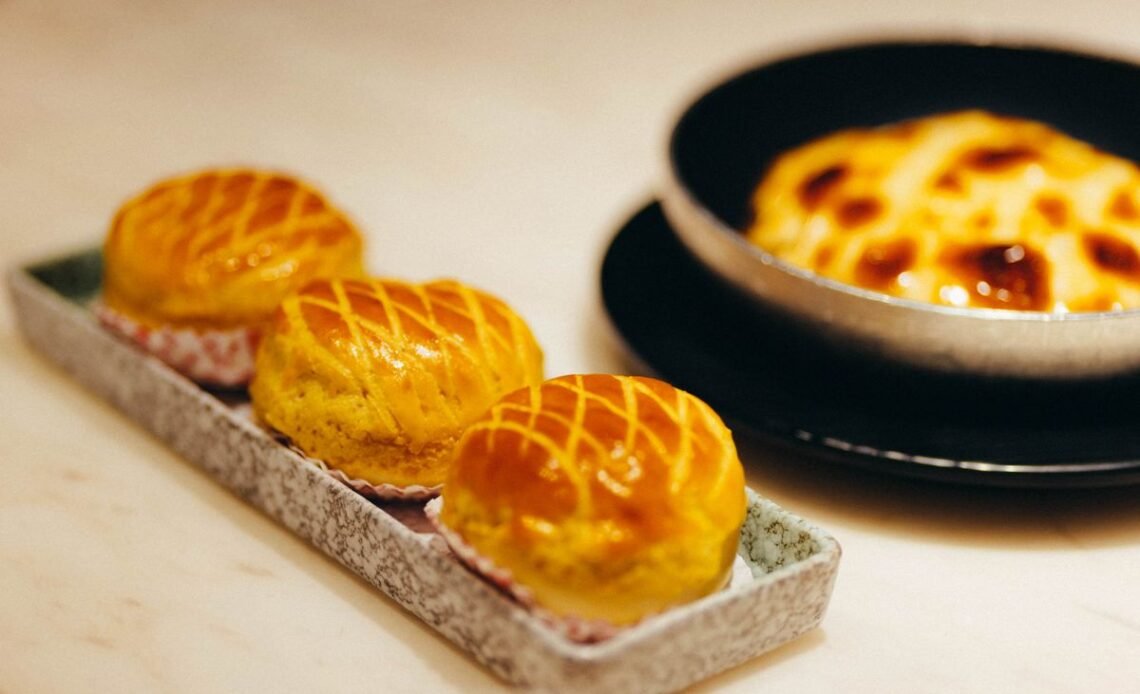
There is no pineapple in a pineapple bun. There never has been. The bolo bao (菠蘿包) gets its name from the crackled, golden, diamond-scored crust baked onto the top of a soft milk bun — a crust that resembles the skin of a pineapple and nothing else about the fruit, not the flavor, not the fragrance, not a single shred of it. It’s one of Hong Kong’s most recognizable foods, and also one of its most honestly misnamed.

A Bun With a Disputed Birth Certificate
Food historians don’t agree on who invented it, but they agree on roughly when: the earliest documented record of the bolo bao traces to Hong Kong in 1942, during the Japanese occupation, with Tai Tung Bakery in Yuen Long — still baking them today — among the bakeries credited with making it early and often. Beyond that, the trail splits. One theory points to a Japanese sweet-bun precursor that Hong Kong bakers adapted and scored differently. A second, more contested theory ties it to Mexican sweet breads — a cousin of the concha, possibly filtered through Chinese-Mexican bakers and the wave of Cantonese migration through the Americas in the early 20th century. Neither claim has settled the argument, and most serious food writers now treat the bolo bao as a dish that was built, piece by piece, out of several borrowed ideas rather than invented whole by one person in one place.
What’s not disputed is where it found its permanent home: the cha chaan teng, the hybrid Cantonese-Western diners that multiplied across Hong Kong after the Second World War to feed a city that wanted Western-style convenience food on a Cantonese budget and schedule. The bolo bao became cha chaan teng furniture — stacked in baskets by the register, eaten with milk tea, assumed rather than ordered. In June 2014, the Hong Kong government made that cultural weight official, adding the pineapple bun to the city’s intangible cultural heritage list alongside dishes like wonton noodles and claypot rice.
Bolo Bao vs. Bolo Yau — the One-Word Difference That Matters
Order it plain and it’s a bolo bao. Ask for butter and it becomes a bolo yau (菠蘿油) — yau meaning oil, the Cantonese shorthand for the thick, cold slab of butter wedged into a hot, split-open bun so it melts slowly against the warm crumb instead of disappearing into it. The pairing is the whole point: a crackled, slightly sweet crust, a soft interior, and a cold fat contrast that never fully dissolves before the last bite. Kam Wah Cafe, a family-run cha chaan teng on Bute Street near Prince Edward MTR station and open since 1973, is one of the city’s most cited bolo yau destinations — known for cutting a pat of butter roughly as thick as a finger and for lines that form well before the morning rush. A 2025 price guide put its plain bun at around HK$8 and the buttered version near HK$13, though cha chaan teng menus shift often enough that it’s worth checking the board on arrival rather than assuming last year’s price holds.
The Recipe
A proper bolo bao is two doughs baked as one: a soft, enriched milk-bread base, and a separate cookie-like topping that cracks into the signature lattice as it bakes. Makes 12 buns.
For the bun dough: Start with a tangzhong — whisk 20g bread flour into 75g water in a small saucepan and cook over low heat, stirring constantly, until it thickens into a smooth paste (it should hold a trail when you drag the whisk through it). Cool to room temperature. Combine the tangzhong with 490g bread flour, 60g sugar, 3g (about ½ teaspoon) salt, 7g instant yeast, 1 large egg, and 160ml warm whole milk. Mix and knead — by hand for about 15 minutes, or 8-10 minutes in a stand mixer — until a shaggy dough forms, then work in 50g softened unsalted butter a little at a time until the dough turns smooth, elastic, and slightly tacky. Proof covered in a warm spot for 60-90 minutes, until doubled. Divide into 12 pieces (roughly 75-80g each), shape into tight balls, and proof again for 30-40 minutes.
For the topping: Cream 60g softened unsalted butter with 140g sugar until pale, then beat in 1 egg yolk, a splash (about 1 teaspoon) of milk, and a few drops of vanilla. Sift in 150g all-purpose flour with ¼ teaspoon baking powder and a pinch each of baking soda and salt, and fold just until it comes together into a soft, cookie-like dough. Chill it for 20-30 minutes — it should be firm enough to shape but not hard. Divide into 12 pieces (about 27-29g each), roll each into a ball, then flatten into a disc slightly wider than one of the proofed buns.
To finish: Drape one topping disc over each risen bun, pressing gently at the edges so it drapes rather than cracks early. Using the back of a knife, score a shallow diamond or crosshatch grid across the top — this is what splits the crust into the pineapple-skin pattern as it bakes, not a glaze or stencil. Brush with a light egg wash and bake at 180°C (350°F) for 15-18 minutes, until deep golden and the lattice has visibly cracked open. Let the buns cool just until they can be handled, then split one open and push in a cold, finger-thick slab of unsalted butter if you want the real cha chaan teng experience rather than the bakery-counter one.
Served warm, split, and loaded with cold butter, the bolo bao is still one of the clearest arguments in Hong Kong food for why a dish doesn’t need a tidy origin story, or even an accurate name, to become essential.
