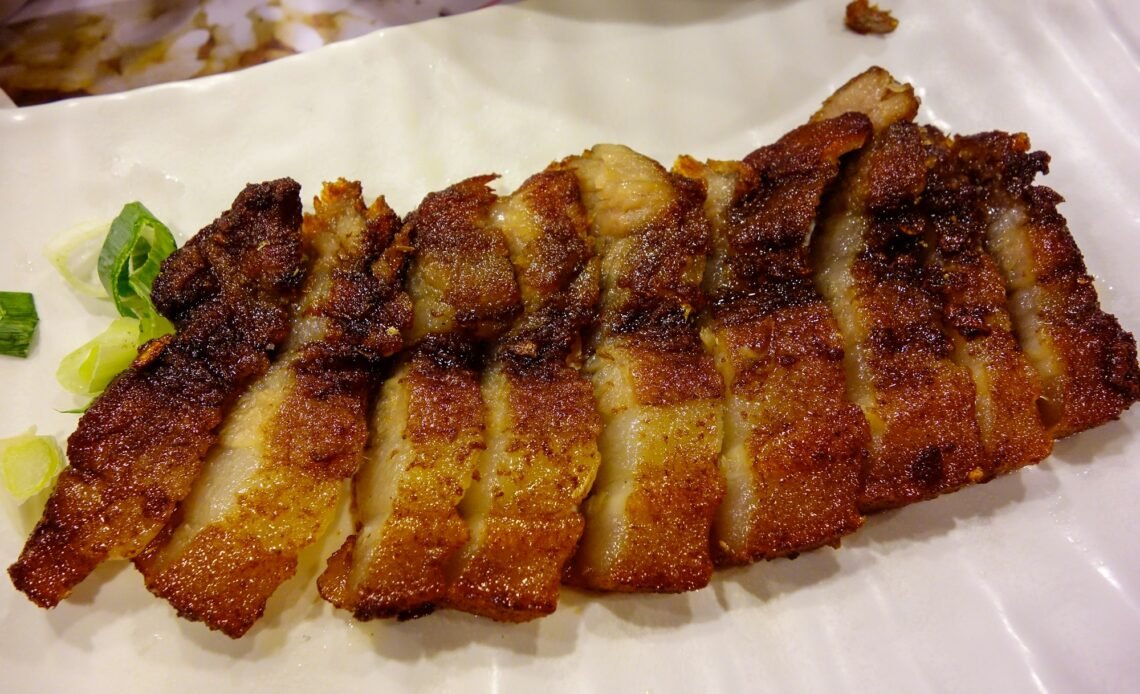
Walk past any siu mei shop window in Hong Kong and char siu’s red-glazed strips usually get the attention. But look one hook over and you’ll find siu yuk (燒肉) — crispy roast pork belly, pale meat under a sheet of blistered, amber-brown skin that shatters instead of chews. Where char siu is about the glaze, siu yuk is about the opposite problem entirely: getting bone-dry, crackling skin and juicy meat out of the same piece of fat-marbled belly at the same time, in the same oven.

One Family of Roasts, Two Completely Different Jobs
Siu yuk belongs to siu mei (燒味), the same family of Cantonese roasted meats as char siu and roast goose, a tradition Cantonese cooks trace back to marinated barbecue practices in Guangdong believed to date to the Tang and Song dynasties, and one that scattered worldwide after the fall of the Qing dynasty in 1911, when Cantonese emigrants carried the technique to Hong Kong, Southeast Asia, Australia and North America. But within that family, siu yuk is the odd one out. Char siu is a marinating-and-glazing exercise — flavor built in layers, finished glossy. Siu yuk has almost no marinade to speak of. The seasoning goes entirely into the meat side; the skin gets nothing but salt, air, and heat. It’s a more unforgiving dish precisely because there’s nowhere for a cook to hide a mistake behind a glaze.
Why the Skin Won’t Cooperate
Commercial siu mei shops traditionally hung the belly vertically on hooks inside tall, cylindrical ovens — descendants of open wood- or charcoal-fired pits, later replaced in most shops by gas-fired “Apollo” ovens — so the fat rendered and dripped away instead of pooling under the skin and turning it rubbery. Home cooks are chasing the same physics in a box oven, and the entire dish turns on one unglamorous step: drying. Pierce only the skin (never deep enough to hit the meat) in a tight grid with a skewer or needle, rub coarse salt over it as an exfoliant, and then leave the belly uncovered in the fridge for several hours to overnight. Skip that drying window and the skin steams instead of crackles, no matter how hot the oven runs later.
The Recipe
Use a 2 to 2.5 lb piece of skin-on pork belly, ideally one with thinner skin, which blisters into lighter, crisper crackling than a thick hide does. Pat the meat side dry and score it lightly, then rub in a mix of 1 teaspoon five-spice powder, 1 teaspoon salt, ½ teaspoon white pepper, ½ teaspoon sugar, 2 teaspoons ground bean sauce (or regular soybean paste), and 1 clove garlic, grated — keeping every bit of this rub on the meat and fat side only. Flip it skin-up, pierce the skin all over in a tight grid, and rub 1 to 1½ tablespoons coarse salt directly into the punctures. Set it uncovered on a rack in the fridge, skin exposed to the air, for at least 4 hours and preferably overnight.
To cook, brush the excess salt off the skin and roast meat-side configuration seam-down on a rack over a water-filled tray at 325°F (165°C) for about 60 to 75 minutes, until the meat is tender and the internal temperature reads around 145°F. Then crank the oven to its highest broil setting, or 475–500°F (245–260°C), and roast skin-up for a final 15 to 25 minutes, watching closely rather than walking away — this is the step that actually makes the crackling, and it goes from blistered to burnt in the space of a couple of minutes. Pull it the moment the skin is uniformly bubbled and deep amber, then rest 10 minutes before chopping through the crackling with a heavy cleaver, which is the only way to cut it cleanly without the skin shattering off the meat.
How It’s Actually Served
In Hong Kong, siu yuk is sold by weight off the same chopping block as char siu and roast goose, usually ordered as a mixed “two-meat” or “three-meat” plate (雙拼飯 / 三拼飯) over rice, with a dip of straight white sugar or a sharp vinegar-chili sauce on the side to cut through the fat — sugar in particular isn’t a novelty garnish there, it’s the traditional counterpoint to how rich the skin and fat layer actually is. A good piece should have three distinct textures in one bite: shattering skin, a thin band of rendered fat underneath it, and moist, well-seasoned meat below that — which is also exactly why siu mei shops are judged, cut for cut, on how evenly a single belly hits all three.
