On August 6, Club Pilates announced it had crossed 1,500 studios operating or under development worldwide, widening its lead as the largest Pilates franchise on the planet. That’s not a round number picked for a press release — it’s roughly 500 more locations than the brand had when it hit 1,000 studios in Portland, Oregon, just a few years earlier. The story behind how a single San Diego studio turned into the industry’s dominant franchise says as much about Pilates’ mainstream moment as any single boutique’s buzz.
From One Studio to the Industry’s Biggest Name
Club Pilates traces back to December 2, 2007, when instructor Allison Beardsley opened a single studio in San Diego after years of teaching mat Pilates full-time — by her own account, around 30 hours a week. Her pitch was simple but, at the time, unusual: reformer Pilates, the machine-based version long associated with dancers, physical therapy patients, and pricey private sessions, should be taught in small groups at a price regular gymgoers could actually justify. Beardsley still holds a minority stake in the brand today, even though Club Pilates’ own site doesn’t name a founder — the credit comes from local San Diego press and her own interviews rather than corporate copy.
The growth engine arrived a few years later. Serial boutique-fitness operator Anthony Geisler acquired Club Pilates in 2015, after previously building and selling LA Boxing to UFC Gym. When Geisler formed the holding company Xponential Fitness in 2017, Club Pilates became its first and, for years, its flagship brand — the one that funded the roll-up of CycleBar, Pure Barre, StretchLab, Rumble, and the rest of Xponential’s now-roughly-dozen-brand portfolio. Xponential took the holding company public in 2021, and Club Pilates has stayed its single largest revenue driver ever since.
What Actually Happens in a Club Pilates Class
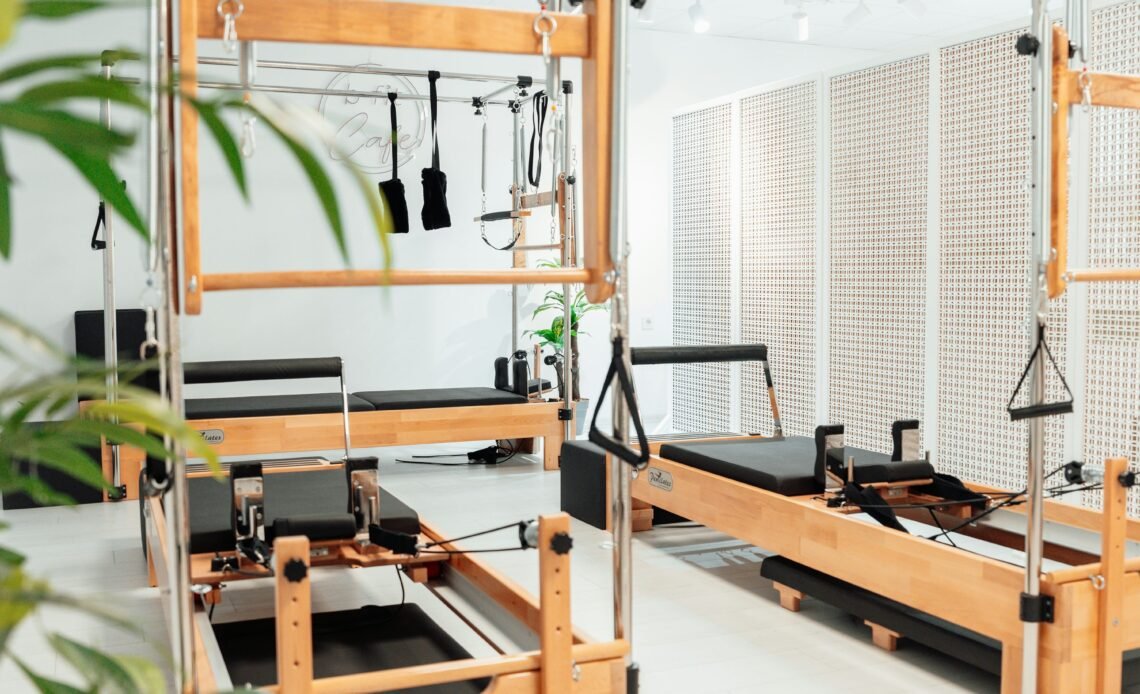
The format is the part that scaled. Classes run in small groups, with each studio’s reformer floor typically capped at around a dozen machines per session — enough for an instructor to actually correct form, unlike a packed group-fitness room. Club Pilates teaches nine distinct class formats across four skill levels, from pure beginner reformer fundamentals up through formats that layer in standing toning work, light cardio intervals, or TRX-style suspension training on top of the reformer base. The pitch to a first-timer is that there’s a real, structured on-ramp — you’re not thrown into an advanced class next to members who’ve been coming for years, the way you might be at an unbranded studio with a single flowing format.
That structure is also what franchising requires: a format has to be teachable the same way in a strip mall outside Phoenix as it is in a converted storefront in Brooklyn, by instructors trained through the brand’s own teacher-training pipeline rather than independently certified Pilates instructors hired one at a time. It’s a trade-off purists sometimes grumble about, but it’s also the exact reason Club Pilates could get to 1,500 locations while boutique single-studio operators stayed, by definition, single studios.
What It Actually Costs
Pricing is set locally by individual franchisees, so there’s no single national number, but industry pricing trackers put the typical range at roughly $79–$169 a month for a 4-class package, $139–$305 a month for 8 classes, and $189–$397 a month for unlimited access, with drop-in single classes running about $25–$52 depending on market. That’s meaningfully more than a big-box gym membership, but it’s also a fraction of what a private reformer session with an independent instructor costs in most major cities — often $80–$120 for a single one-on-one hour. The group format is, functionally, the thing that made reformer Pilates affordable at scale in the first place.
Why This Is Happening Now
Club Pilates isn’t expanding in a vacuum. Boutique reformer studios broadly have become one of the fastest-growing corners of the fitness industry over the past two years, and Pilates-specific apparel, accessories, and at-home reformer sales have followed the same curve. What the 1,500-studio milestone adds to that picture isn’t a new trend — it’s evidence of which business model actually won the land grab. Independent studios can out-niche a franchise on vibe and instructor talent; they generally can’t out-build one on real estate, training pipelines, or capital. Xponential’s other acquisitions have shown the same pattern across barre, cycling, and stretching — the format gets popularized by independent studios first, then consolidated by whichever franchisor moves fastest once demand is proven.
For anyone shopping around a first reformer class this month, the practical takeaway is less about brand loyalty and more about what actually suits a beginner: a structured, four-level curriculum and a capped class size are genuinely useful if you’ve never touched a reformer before, whichever studio happens to offer them nearby. Just go in knowing the $25–$50 drop-in rate is standard for the format — not a markup specific to one brand.

