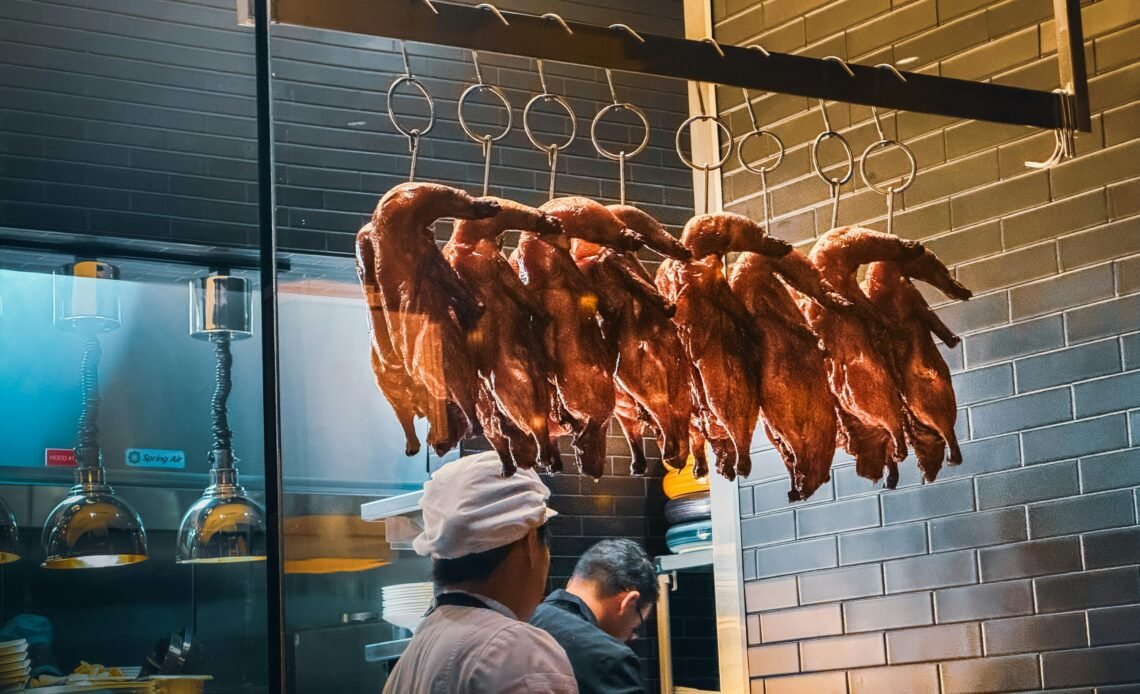
Char siu gets the fame, but ask anyone in Hong Kong which siu mei dish actually matters and the answer is often roast goose — siu ngo (燒鵝), the mahogany-skinned bird that turned a street stall near the old Macau ferry pier into a name Fortune magazine once put on a list with Maxim’s in Paris and the Four Seasons in New York.

From a Ferry-Pier Stall to Fortune’s Top 15
Yung Kee, Hong Kong’s best-known roast goose name, started in 1942 as a street stall near the old Hong Kong–Macau Ferry Terminal, built by Kam Shui Fai on a bird most other cooks at the time treated as a cheaper stand-in for duck. It didn’t stay a stand-in for long. By 1968, Fortune magazine had named Yung Kee one of the world’s top 15 restaurants — the only Chinese restaurant on that particular list — and the restaurant, now at 32-40 Wellington Street in Central, is still trading on that reputation 84 years later; a Standard report earlier this year marked its 82-year-plus run by noting it had just added a line of softer “care food” dishes for diners who struggle with the usual bone-in cuts. Regulars have long carried boxes of the goose onto outbound flights, which is how it picked up the nickname “Flying Roast Goose.”
Why So Few Kitchens Still Use Charcoal
The texture everyone’s chasing — skin that shatters before the fat underneath even registers — traditionally came from roasting over charcoal, which browns faster and drier than gas. Hong Kong stopped issuing new charcoal-roasting licenses years ago, so the handful of restaurants still doing it, Yung Kee among them, are working with licenses that predate the freeze; nobody new can simply open a charcoal oven today. That’s part of why Kam’s Roast Goose in Wan Chai — opened in 2015 by Hardy Kam with chef Wong Kwan Sang, who spent four decades at Yung Kee before leaving to help start it — roasts on gas instead, and why Yat Lok in Central, roasting goose since 1957 and holding a Michelin star for it, is counted as one of the city’s last charcoal houses still working the old way.
The Technique: It’s Mostly About Air, Not Just Fire
What actually separates a good siu ngo from a dry or rubbery one happens before the bird ever sees heat. The cavity gets packed with a thick paste of five-spice powder, Shaoxing wine, grated garlic, salt, and a mix of light and dark soy sauce, then the opening is sewn or pinned shut so that paste essentially steams the meat from the inside while the skin roasts dry on the outside — two different cooking processes happening in the same bird at once. Before roasting, the skin is dipped briefly in a maltose-and-vinegar bath (roughly one part maltose to three or four parts vinegar, warmed until it loosens enough to coat), then the goose is hung and air-dried, uncovered, for several hours or overnight. Skip the drying step and the skin steams instead of crackling, no matter how good the oven is. During roasting, the skin is basted with more of that maltose mixture every 20 to 30 minutes, which is what builds the shiny, almost lacquered mahogany color rather than a flat brown. A whole bird typically takes close to two hours total — low enough heat at first to render fat without scorching, then a hotter finish to set the skin — and gets rested at least 15-20 minutes before a cook breaks it down bone-in with a cleaver, the same way char siu gets sliced against the grain rather than cut however’s convenient.
A Dish That Still Finds New Forms
Roast goose hasn’t stayed frozen in siu mei-shop windows. Earlier this year, Tim Ho Wan — the Michelin-starred dim sum chain that made its name on a HK$68 pork bun — partnered with Yung Kee on a limited baked roasted goose bun, deboned Yung Kee goose folded into Tim Ho Wan’s signature baked pastry and sold for HK$68 for three pieces at Tim Ho Wan branches through the summer. It’s a reminder that in Hong Kong, a 1942 recipe and a mass-market bakery chain aren’t really operating in different worlds — they’re drawing from the same siu mei tradition, just at different price points and different speeds.
Where to Actually Order It
For the classic charcoal version, Yung Kee (32-40 Wellington Street, Central) and Yat Lok (34-38 Stanley Street, Central) are the two names locals point to first — Yat Lok’s Michelin recognition has held for years running a far smaller menu than Yung Kee’s full restaurant. For a gas-roasted but widely praised alternative, Kam’s Roast Goose (226 Hennessy Road, Wan Chai) draws lines at lunch specifically because of the Yung Kee pedigree in its kitchen. However the heat gets there, the test is the same one Hong Kong diners have used for 80-odd years: the skin should crackle first, the fat should render out rather than pool, and the meat underneath should still taste like it was seasoned from the inside out.
