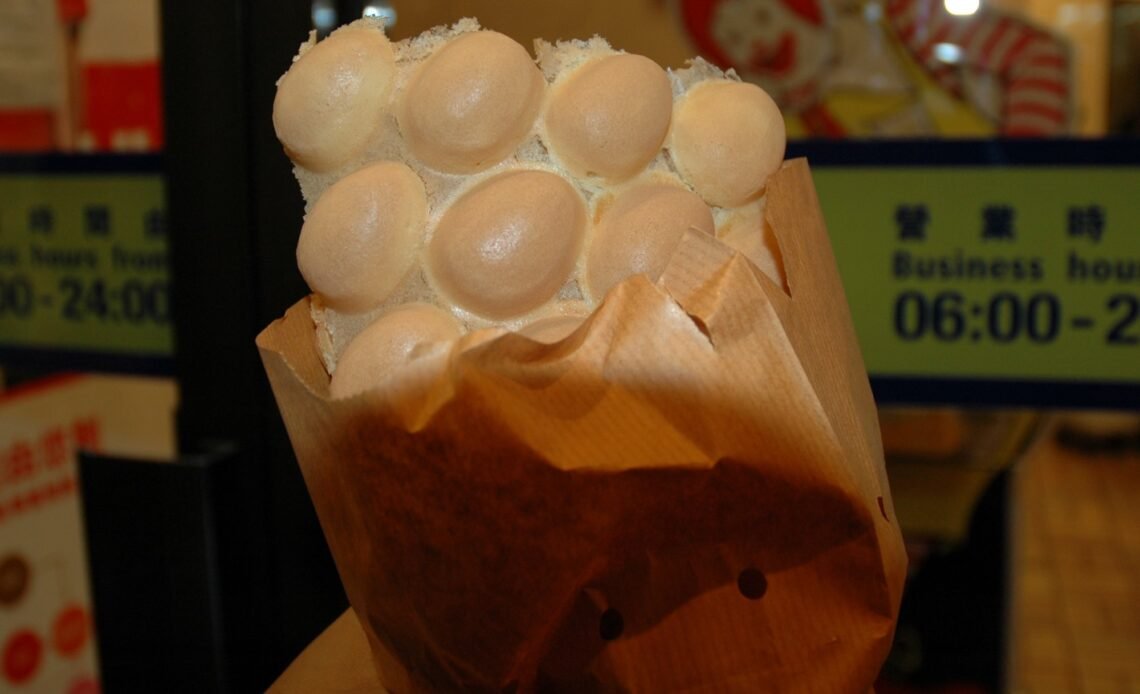
Walk down almost any market street in Hong Kong after dark and you’ll hear it before you see it: the clap of a hinged iron mold snapping shut, then the hiss as batter spreads into forty small hollows and starts to set. What comes out a few minutes later is gai daan jai (雞蛋仔) — “little chicken eggs” — a sheet of golden, honeycomb-bubbled waffle that visitors now call a bubble waffle or eggette, torn apart hot and eaten plain, straight from a paper bag. It’s one of the few Hong Kong street snacks with no fixed birthplace, no agreed inventor, and no single shop that can credibly claim to have started it — which hasn’t stopped it from becoming, by one local TV ranking, the single most popular street food in the city.

A Snack With No Verified Inventor
Food historians and Hong Kong’s own Cantonese-language press generally agree on the decade — the 1950s — and disagree on almost everything else. The oldest and most-repeated account holds that neighborhood grocers, rather than throw out eggs that had cracked or chipped in transit, worked the damaged stock into a cheap, egg-heavy batter and cooked it in a two-sided iron griddle pierced with small round cells, giving the waffle both its golden color and its name. A second, less flattering version claims the opposite problem: eggs were a luxury item in postwar Hong Kong, so some vendors shaped an eggless batter into an egg-shaped mold to sell the illusion of a richer snack, with the real article arriving only once eggs became affordable again. A third thread, traced to Hong Kong and Macau newspaper reporting, credits a hawker named Mr. Cheung with pushing a cart of a related snack called daan kau jai (蛋球仔) — a larger, round predecessor typically broken into about 30 pieces per batch — as early as 1944, before the smaller, flatter gai daan jai format took over. None of the three stories has documentary proof strong enough to settle the question, and no surviving shop has produced a receipt, a lease, or a first-generation owner able to confirm which came first.
What’s better documented is how the snack was sold: from mobile carts and fixed kiosks running coal-fired griddles, the same cooked-food-hawker scene that produced cart noodles and curry fish balls, before migrating onto electric griddles as fire licensing tightened in later decades. By the 2010s a Hong Kong TVB survey of the city’s most popular street snacks ranked gai daan jai first overall, ahead of fish balls and stinky tofu. Lee Keung Kee, a plain-fronted stall on King’s Road in North Point that has stuck to the classic egg-and-sugar version for decades, made Michelin’s Hong Kong street food list in 2015 and has since opened branches in Tsim Sha Tsui, Causeway Bay, and Mong Kok — not proof of who invented the dish, but as close as the city has to a reference point for what an unadorned one should taste like.
The Batter That Makes the Bubbles
Makes about 2 waffles, roughly 20-25cm across each. Sift together 150g (about 1¼ cups) all-purpose flour, 30g tapioca starch (cornstarch works as a substitute, though tapioca gives a slightly chewier bite), 15g custard powder, 1½ teaspoons baking powder, and a pinch of salt. In a separate bowl, whisk 2 large eggs with 100g (½ cup) sugar until the sugar mostly dissolves, then whisk in 90ml evaporated milk, 60ml water, 1 teaspoon vanilla extract, and 30ml neutral oil. Pour the wet mixture into the dry ingredients in two additions, whisking after each until the batter is completely smooth with no visible lumps of flour — this is the step most home attempts skip, and lumps here show up as dense, under-bubbled patches in the finished waffle. Cover the bowl and refrigerate for at least 1 hour, or up to 24, so the baking powder’s gas release slows down and the batter relaxes; pull it out about 20 minutes before cooking so it isn’t ice-cold.
Heat an egg waffle iron (the hinged, honeycomb-celled type, available online, or an electric version set to around 180-200°C) on both sides until a drop of batter sizzles immediately on contact. Brush both plates lightly with oil, then pour in just enough batter to fill the cells to about 80 percent — overfilling is the most common reason the two halves won’t seal and the finished waffle tears apart at the seam. Close the mold, clamp the handle, and immediately flip the whole iron over so the batter settles evenly into both sets of cells before it sets. Cook for 2½ to 3 minutes per side over moderate heat, flipping once more halfway through, until the waffle is deep gold and pulls away from the plates cleanly. Expect to sacrifice the first one: griddle irons cook unevenly until the metal is fully seasoned with heat, and the first waffle is almost always pale or sticks. Tear the finished waffle into its individual bubble clusters while it’s still warm and eat it plain, the way it’s sold on the street — the custard powder and evaporated milk are there to make additional toppings beside the point.
Why the Shape, Not the Flavor, Is the Point
What separates gai daan jai from an ordinary waffle isn’t the batter — plenty of other Cantonese snacks use a similarly sweet, egg-and-milk mix — it’s the mold. Each hemispherical cell cooks the batter on a curved shell, crisping the outside of every bubble within about ninety seconds while the center stays soft and custardy, a contrast a flat griddle can’t produce. That’s also why the dish travels well as an object even when the story behind it doesn’t: electric countertop irons now turn out a reasonable version in a rented apartment in London or Toronto, which is largely how “bubble waffles” spread into North American and European dessert shops over the past decade, usually dressed up with soft-serve or chocolate drizzle in ways the original cart version never was. In Hong Kong itself, flavor variants like pandan or black sesame exist mostly at newer specialty shops; the kiosk version, wrapped in waxed paper and eaten walking, is still almost always the plain egg one, bubbles slightly collapsed by the time you reach the bottom of the bag — which is exactly when it’s supposed to be eaten.