Seville doesn’t ease you into its history — it hands it to you at street level. The Giralda, the bell tower that anchors the skyline, started life in 1198 as the minaret of an Almohad mosque, modeled on the Koutoubia in Marrakesh; when Christian forces took the city in 1248, they kept the tower and built one of the world’s largest Gothic cathedrals around it rather than tear it down. That habit of building on top of what came before, instead of erasing it, is the real throughline of this city: a Roman veterans’ colony a few miles upriver, a Moorish palace still in royal use eight centuries later, a flamenco tradition born in a gitano river-bank neighborhood. Five days is enough to walk through most of it, with one day spent entirely outside the city limits.


Day 1: Santa Cruz, the Cathedral, and the Real Alcázar
Start early at Seville Cathedral, built from around 1403 over the demolished Almohad mosque and finished in 1506 — by floor area, the largest Gothic cathedral in the world. Admission, including the Giralda climb and adjoining Church of El Salvador, runs €13 online or €14 at the door (effective since January 2026); hours run Monday-Saturday 10:45am-6pm, Sunday 2:30-7pm. Book online rather than queue. Climb the Giralda’s ramps — wide enough for two horsemen abreast, since the original muezzin reportedly rode rather than walked up — for the city’s best rooftop view. Five minutes away, the Real Alcázar is a working royal palace since the 1300s, the oldest in Europe still used by a head of state; Spain’s royal family keeps rooms in its upper floors. General admission is €15.50, with an optional €5.50 add-on for the Cuarto Real Alto apartments; winter hours run 9:30am-5pm. Its Mudéjar Palace, built for Pedro I from 1364 by Granada craftsmen, borrows so directly from the Alhambra’s horseshoe arches that HBO filmed it as the Water Gardens of Dorne in Game of Thrones. Spend the afternoon lost in the whitewashed Barrio Santa Cruz, the old Jewish quarter, and end at Las Teresas, a tapas bar running since 1870, hams hanging over the counter, known for its papas aliñás (dressed potato salad).
Day 2: Triana, flamenco’s real home
Cross the Puente de Triana to the west bank, historically the city’s sailor, potter, and gitano quarter, and flamenco’s spiritual home — the soleá, one of flamenco’s foundational palos (musical forms), ties specifically to Triana’s old corrales, the communal courtyards where Romani families lived packed together. Visit Centro Cerámica Triana, built into a surviving 19th-century tile factory, to see why so many Seville facades are covered in azulejos — Triana supplied most of them, a trade tracing to Moorish-era kilns along the riverbank. Walk Calle Betis along the water for the view back to the Torre del Oro, and eat lunch at one of its terrace spots. In the evening, book a show at Casa de la Memoria, a nonprofit venue in the former stables of the Palacio de Lebrija that runs nightly without a bar or kitchen to distract — standard admission €18, €15 for students and residents. End the night at the Metropol Parasol, the “Setas de Sevilla” (Seville’s mushrooms) — wooden waffle-canopies completed in 2011 by German architect Jürgen Mayer H., built over a square that sat as a parking lot after the old municipal market was demolished in 1973. The basement Antiquarium preserves Roman and Moorish ruins found during construction; the rooftop walkway gives a sunset view over the old city.
Day 3: Plaza de España, María Luisa Park, and Casa de Pilatos
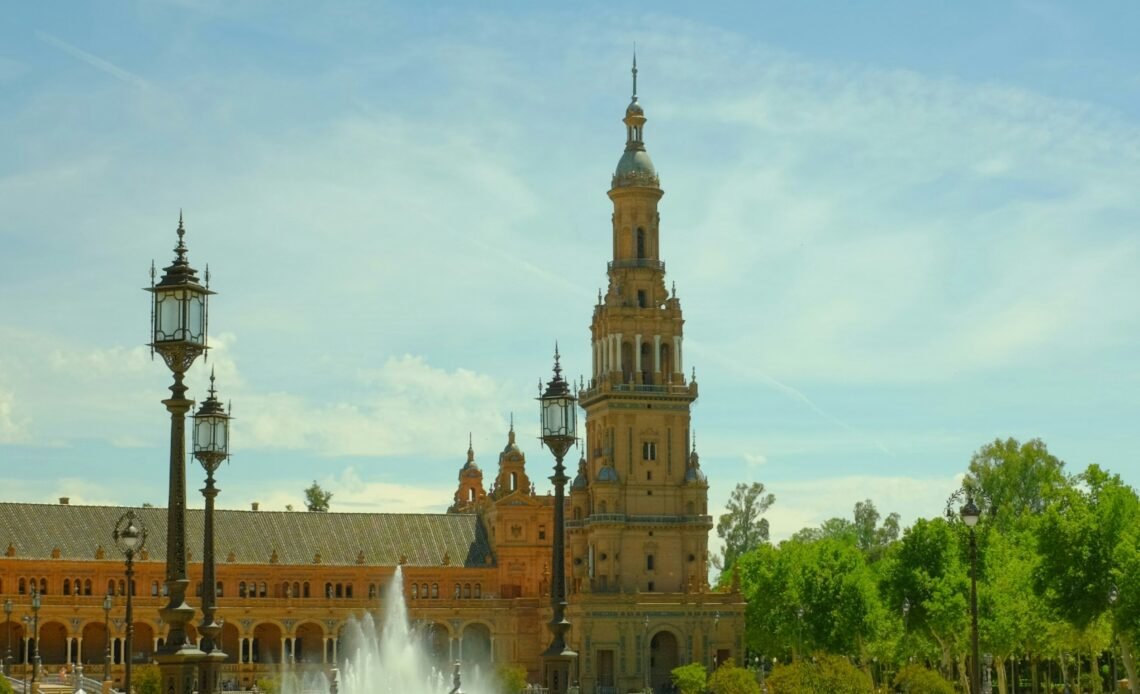
Plaza de España, the semicircular brick-and-tile building pictured above, was architect Aníbal González’s centerpiece for the 1929 Ibero-American Exposition — Art Deco crossed with neo-Mudéjar, a tiled alcove for each Spanish province lining the curve. González died weeks before the fair opened; the plaza underwent a €9 million restoration from 2007-2010 to bring it closer to his original design. It borders María Luisa Park, the exposition’s former fairground turned public garden, worth an hour under its orange trees. From there, head to Casa de Pilatos, a 16th-century noble palace blending Mudéjar, Gothic, and early Renaissance styles, named for an owner whose pilgrimage to Jerusalem led him to loosely model its proportions on Pontius Pilate’s house. Ground-floor admission runs about €12; the upper floor, still privately owned by the Dukes of Medinaceli, needs a separate guided tour. Spend the evening tapas-hopping through Arenal or Alfalfa — order espinacas con garbanzos (spinach and chickpeas, rooted in Moorish-Jewish cooking) and solomillo al whisky (pork loin in whisky sauce).
Day 4: Day trip to Córdoba
The high-speed AVE from Santa Justa station to Córdoba takes as little as 41-45 minutes, with frequent departures and one-way fares typically €14-€30 depending on how far ahead you book. The draw is the Mezquita-Catedral, begun in 785 under Abd al-Rahman I as the great mosque of Islamic Córdoba’s caliphate and expanded over two centuries into one of the largest mosques ever built, its prayer hall held up by over 850 reused Roman and Visigothic columns. After the 1236 Christian reconquest, rather than demolish it, a full Gothic-Renaissance cathedral nave was built straight up through the middle of the hypostyle hall in the 1500s — a juxtaposition Charles V reportedly regretted once he saw it finished, saying the builders had destroyed something unique to build something found anywhere. General admission runs around €13-15; high-season hours are Monday-Saturday 10am-7pm, Sundays reserved for worship before opening to visitors at 8:30-11:30am and 3-7pm. Save an hour for the Judería, Córdoba’s old Jewish quarter, before the train back.
Day 5: Itálica, the Roman city under a village
Itálica, a half-hour outside Seville near the village of Santiponce, was founded in 206 BC by Scipio Africanus to settle wounded veterans after the Battle of Ilipa — among the first Roman towns built outside Italy. It produced two emperors: Trajan was born here, and Hadrian, whose family had emigrated from Italica generations earlier, is widely believed to have been too; Hadrian expanded the city and funded its amphitheater, which once seated around 25,000 and is recognizable today as the “Dragonpit” from Game of Thrones’ seventh season. Admission is free for EU citizens and residents, €1.50 for everyone else — one of the cheapest major Roman sites in Europe, largely because so much of ancient Italica still lies unexcavated beneath the modern village on top of it. A regional bus runs from Seville’s Plaza de Armas station (confirm the current line at ctas.es); the ride is roughly 20-25 minutes. Back by early afternoon, close the trip along the Guadalquivir past the 13th-century Torre del Oro, an Almohad river defense named, depending on the legend, for golden tiles that once covered it or for the gold later shipped through here from the Americas.
Practical notes
Go in spring (March-May) or early autumn (late September-October): summer regularly hits 38°C (100°F), while spring brings orange blossom and, if dates align, the Feria de Abril and Semana Santa processions. Winter is mild (16-18°C) and quieter, which is what late November offers. The old town is compact enough to walk entirely on foot; for longer hops, the MetroCentro tram and city buses run about €1.40 a ride, and Sevici’s bike-share docks are everywhere. Budget roughly €60-90 a day per person outside lodging once meals, tickets, and transport are factored in — tapas-hopping keeps costs down more than any sit-down restaurant will.
This article contains affiliate links, including Klook and Trip.com. We may earn a commission on qualifying bookings — see our Affiliate Disclosure for details.