Walk into any of Hong Kong’s three-Michelin-starred Cantonese kitchens this week and ask how they make lo bak go (蘿蔔糕) — the dense, pan-fried radish cake piled into steamer baskets at every Lunar New Year market from Sham Shui Po to Mong Kok — and you’ll get three different answers from three chefs who have nothing left to prove. T’ang Court’s Kwong Wai Kwong builds his on a 7:3 ratio of radish to rice flour. Lung King Heen’s Chan Yan Tak goes to 8:1, cut with water chestnut flour. Rùn’s Hung Chi Kwong, working at the other extreme, uses equal parts radish and flour. None of them is wrong, and the disagreement is the whole story: this is a dish built from four ingredients that most home cooks already have, and getting it right is apparently hard enough to keep three Michelin kitchens from settling on the same ratio.

A Cake Named After the Wrong Vegetable
“Turnip cake” is the standard English name and it’s a mistranslation that stuck. Lo bak go is made from daikon, a white radish, not a turnip — the mix-up likely comes from how close daai tau choi (turnip) and lo bak (radish) sound in Cantonese. The cake itself is plain rice-flour-and-water batter built up with cured, dried, and preserved bits — dried shrimp, dried shiitake, Chinese sausage, sometimes dried scallop — that go back at least to Qing-dynasty Guangzhou, where thick clay-pot teahouse snacks like this one anchored the yum cha tradition that later spread south into Hong Kong. The name itself is doing double duty: lo bak, radish, is close enough in sound to carry a “good fortune” association for diners who eat it at Lunar New Year, and go, cake, is a homophone for the word meaning “to rise” or “advance” — the same pun that makes nian gao a new-year food elsewhere in China. A cake that rises in the steamer, eaten for a year that’s supposed to rise with it, made from a vegetable that isn’t the one in its English name.
Three Michelin Kitchens, Three Ratios
What separates those three chefs isn’t taste so much as what each is solving for. Kwong’s 7:3 radish-to-flour mix leans toward the vegetable, adding more flour only if the batter runs watery, and he now prefers to serve it steamed rather than fried, for a softer bite. Chan goes further toward radish at 8:1, but braces the structure with water chestnut flour instead of more rice flour, and folds in chopped South African abalone for chew — a luxury move that has nothing to do with the cake’s teahouse origins and everything to do with cooking for a three-star dining room. Hung, at the opposite end with his 1:1 ratio, hydrates the extra starch with the soaking liquid from dried shrimp and conpoy instead of plain water, so the cake carries more umami despite having proportionally less radish. He told the Michelin Guide he tried sea urchin (too soft to hold its place) and salted fish with mullet roe sauce (too strong) before deciding the classic version didn’t need fixing. Kwong’s summary of the whole exercise applies to all three: “The simpler the dish looks, the more difficult it is to nail it.”
The Recipe
Makes one 8-inch round cake, about 8-10 servings as a side. Peel and coarsely grate 1kg (about 2.2 lb) daikon radish. Cook it in a wide pot over medium heat with no added water, stirring occasionally, for 10-15 minutes, until it turns translucent and releases most of its liquid — strain and reserve that liquid; you want about 400ml total once topped up with plain water. Meanwhile, soak 20g dried shrimp and 4 dried shiitake mushrooms separately in hot water for 20 minutes, then drain and dice both finely; dice 2 Chinese sausages (lap cheong) as well. In a dry wok or skillet, render the sausage over medium heat for 2 minutes to release its fat, then add the shrimp and shiitake and stir-fry another 2-3 minutes until fragrant. Set two-thirds of this mixture aside for the batter and reserve the rest for topping.
Whisk 200g (about 1¾ cups) white rice flour and 30g (about 3 tablespoons) wheat starch or cornstarch into the reserved 400ml of radish liquid until smooth, with no lumps. Combine this slurry with the cooked radish, the two-thirds portion of fried sausage and shrimp, 1 teaspoon sugar, ½ teaspoon white pepper, and salt to taste. Pour into a well-oiled 8-inch round or square cake pan, smooth the top, and scatter the reserved sausage-and-shrimp mixture and a handful of chopped scallion over the surface. Cover loosely with foil to keep condensation from dripping onto the cake, set the pan in a steamer over vigorously boiling water, and steam for 45-55 minutes, until a skewer inserted in the center comes out clean.
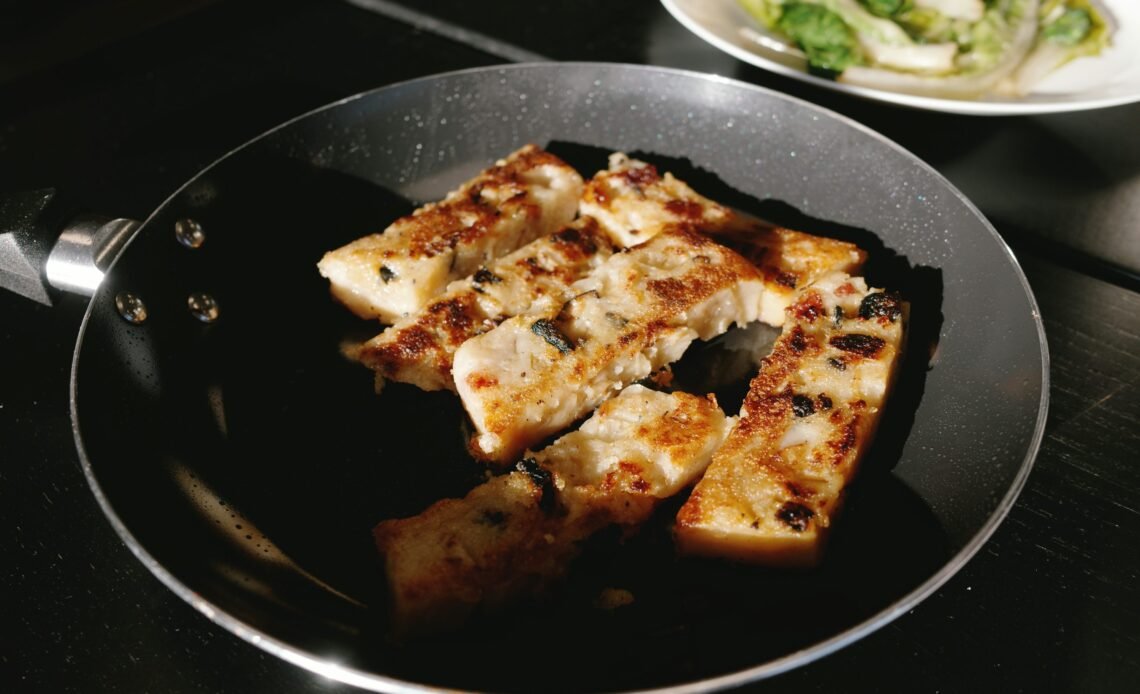
Let the cake cool to room temperature, then refrigerate, uncovered, for at least 4 hours or overnight — this firms the starch enough to slice cleanly, a step most home versions skip and then wonder why the cake falls apart in the pan. The next day, cut into slices about 1cm (½ inch) thick and pan-fry in a thin film of oil over medium heat, 3-4 minutes per side, without moving the slices until a deep golden crust forms. Serve immediately with hoisin sauce, sriracha, or XO sauce.
Soft First, Crisp Later
The two-stage cooking isn’t optional theater — it’s two different textures layered into one dish. Steaming sets the starch gently and lets the radish’s natural sweetness and the sausage’s fat perfume the whole cake without any browning to mask them, which is why Hung argues steaming suits winter best, and why Kwong now serves his version that way more often than fried. Pan-frying afterward is a separate, optional second act that trades some of that delicate flavor for a crisp, almost custardy-inside contrast — and it’s the step most prone to failure, since a cake with too little flour or not enough chilling time will simply collapse into the oil rather than holding a slice. Kwong and Chan both pour pu’er alongside the fried version because its bitterness cuts the sausage fat; Rùn instead pairs a chamomile-based white tea to offset saltiness rather than grease. However it’s served, the test hasn’t changed since it was a cheap teahouse snack in Qing-dynasty Guangzhou: a good lo bak go should taste mostly of radish, with everything else — the shrimp, the sausage, the crisp edge — arranged to support it rather than bury it.