On the afternoon of May 14, 1940, German bombers reduced Rotterdam’s entire historic city centre to rubble in roughly fifteen minutes, flattening more than six centuries of accumulated building. Most European cities that suffered that kind of wartime destruction rebuilt in facsimile — new stone cut to look like the old. Rotterdam’s planners did almost the opposite: they treated the cleared ground as a blank canvas and built the most aggressively modern city in the Netherlands on top of it. That decision is why Rotterdam, alone among Dutch cities, looks like it belongs to the 20th and 21st centuries rather than the 17th — and why three days spent walking it reads less like a sightseeing checklist and more like a tour through eighty years of architects arguing, in concrete and steel, about what a rebuilt city should be.

Day 1: The Reconstruction City
Start at the Lijnbaan, a few minutes’ walk from Rotterdam Centraal. It opened on October 9, 1953, designed by Jo van den Broek and Jacob Bakema, and it’s widely credited as Europe’s first purpose-built pedestrian shopping street — car-free by design at a time when that was close to unthinkable. Crowds were so large on opening day that police let shoppers in ten at a time, and the model later influenced pedestrian streets in Warsaw, Prague, and Hamburg. The street sits exactly where Rotterdam’s old shopping district stood before the 1940 bombing — city architect W.G. Witteveen had a rough reconstruction outline drafted within ten days of the raid, later developed into the Van Traa Basic Plan, the reason Rotterdam’s downtown grid looks nothing like its pre-war self.
From there, walk to Museumpark, home to two buildings that argue opposite philosophies about showing architecture to the public. Het Nieuwe Instituut, the Netherlands’ national museum for architecture, design, and digital culture, occupies a 1993 Jo Coenen building and runs changing exhibitions on the built environment (Tue-Sun, hours vary by day — check nieuweinstituut.nl before going). Next door, the Depot Boijmans Van Beuningen is the more photographed of the two: a mirrored, bowl-shaped structure by MVRDV that opened in November 2021, topped by a public rooftop forest and, inside, open storage that lets visitors watch the museum’s own art-handling staff work. Full admission is €20, timed-entry tickets only, open Tuesday-Sunday 11am-5pm. Have lunch nearby in the Witte de Withstraat gallery district, then close the day at the Kunsthal, Rem Koolhaas’s 1992 exhibition hall, for a sense of how long Rotterdam has been using its own rebuilding as a design laboratory.
Day 2: The Blaak Icons
Head to Blaak station for Rotterdam’s two most photographed buildings, both within a five-minute walk of each other. The Markthal, a horseshoe-shaped glass-and-steel market hall by MVRDV, opened in 2014 with a food market on the ground floor and apartments wrapped around and over it — a 11,000-square-metre digital artwork, “Horn of Plenty” by Arno Coenen, covers the vaulted ceiling above the stalls. Entry is free; regular hours are 10am-8pm Monday-Thursday and Saturday, 10am-9pm Friday, and noon-6pm Sunday. Eat there — it’s a genuine local food market, not a tourist food court, with stalls for cheese, raw herring, stroopwafels, and a sit-down Turkish restaurant, Ekmekci, that’s become one of the hall’s anchor tenants.
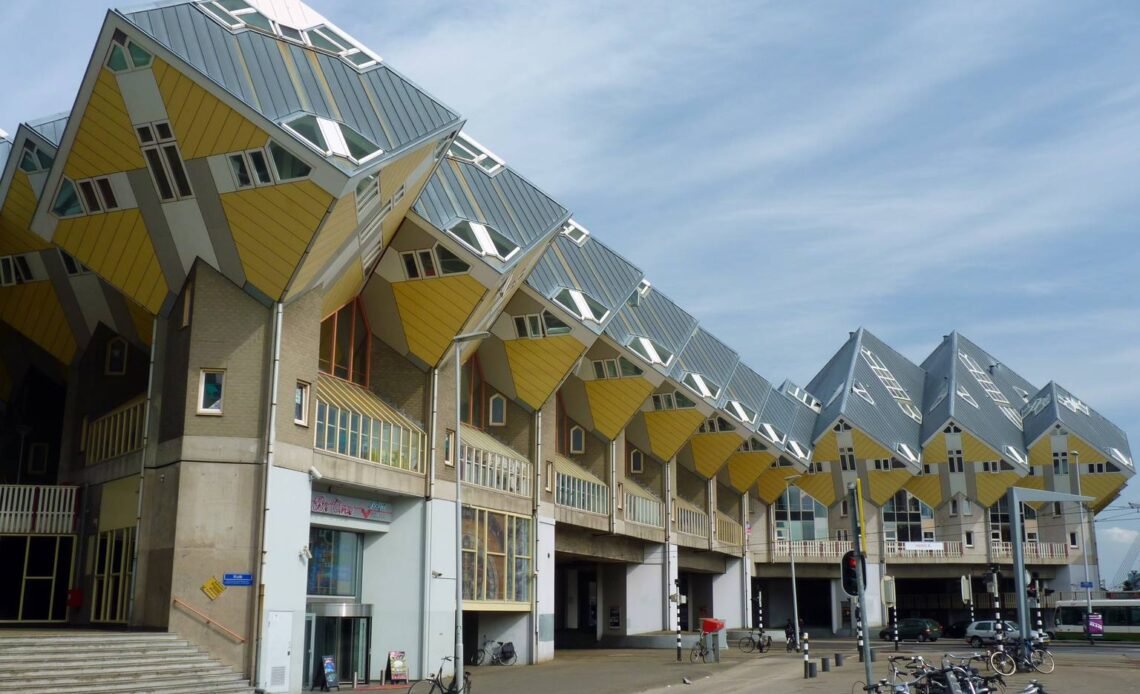
Across the square sit the Kubuswoningen — the Cube Houses — Piet Blom’s 1984 complex of 38 tilted cubic homes balanced on hexagonal pylons, built as his vision of a “forest” where each “tree-house” shares space with its neighbors. One cube, the Kijk-Kubus at Overblaak 70, is set up as a show home open to the public; admission is around €3.50 (discounted for students and seniors, free under age 5). People genuinely live in the other 37, which makes it one of the few architectural icons in Europe you can gawk at from outside a resident’s actual living room. Round out the afternoon at Rotterdam’s Central Library nearby, nicknamed “het Potlood” (the Pencil) for its yellow tubular exterior, then walk the few minutes to the Oude Haven, the city’s oldest harbor, for a beer with the cubes reflected in the water at dusk.
Day 3: The Waterfront
Cross to Kop van Zuid, the former dockland Rotterdam built into its “second downtown” starting in the 1990s. Hotel New York occupies the 1901 Jugendstil-style former headquarters of the Holland America Line, the shipping company that carried close to two million European emigrants toward New York between the 1870s and the early 20th century — many of them boarding at the same quay the hotel now overlooks. The company moved its headquarters out in 1978; the building reopened as a hotel in 1993 and is worth a coffee on its ground floor even if you’re not staying there.
Walk across the Erasmusbrug, Ben van Berkel’s 1996 cable-stayed bridge nicknamed “De Zwaan” (the Swan) for its single asymmetrical 139-metre pylon, inspired partly by Santiago Calatrava’s Alamillo Bridge in Seville — it’s been the city’s unofficial symbol since Queen Beatrix opened it. On the far bank stands De Rotterdam, Rem Koolhaas and OMA’s 2013 complex of three shifted towers sharing one base, the largest multi-purpose building in the Netherlands at roughly 160,000 square metres. Koolhaas has said the project “nearly died” in the 2008 financial crisis and was revived by the next one. Finish at the Euromast, built in 1960 for that year’s Floriade garden exhibition, still Rotterdam’s tallest viewing platform at 185 metres with the Euroscoop add-on; standard lookout tickets run in the €12-18 range depending on season and whether you add the rotating Euroscoop capsule. From the top, the whole three-day argument is visible at once: Gothic church towers, 1950s reconstruction blocks, and glass towers from the last five years, all sharing one skyline because the city never stopped rebuilding itself on purpose.
Practical Notes
Rotterdam is compact enough to cover these three days almost entirely on foot or by metro — an OV-chipkaart or contactless bank card works across trams, metro, and buses. Base near Centraal Station or the Blaak area for the shortest walks between sights. Spring and early autumn bring milder weather and shorter waits for the Depot’s timed-entry slots than peak summer. Budget roughly €50-80 a day per person outside lodging once you’ve covered Depot admission, the Cube House museum, Markthal food, and the Euromast; the Rotterdam Welcome Card (sold at the tourist office and online) bundles discounts on several of these if you’re hitting most of them. Rotterdam Centraal itself is a direct high-speed rail connection from Amsterdam (about 40 minutes) or Brussels (under an hour), making this an easy add-on to either city rather than a trip that needs its own flight.
