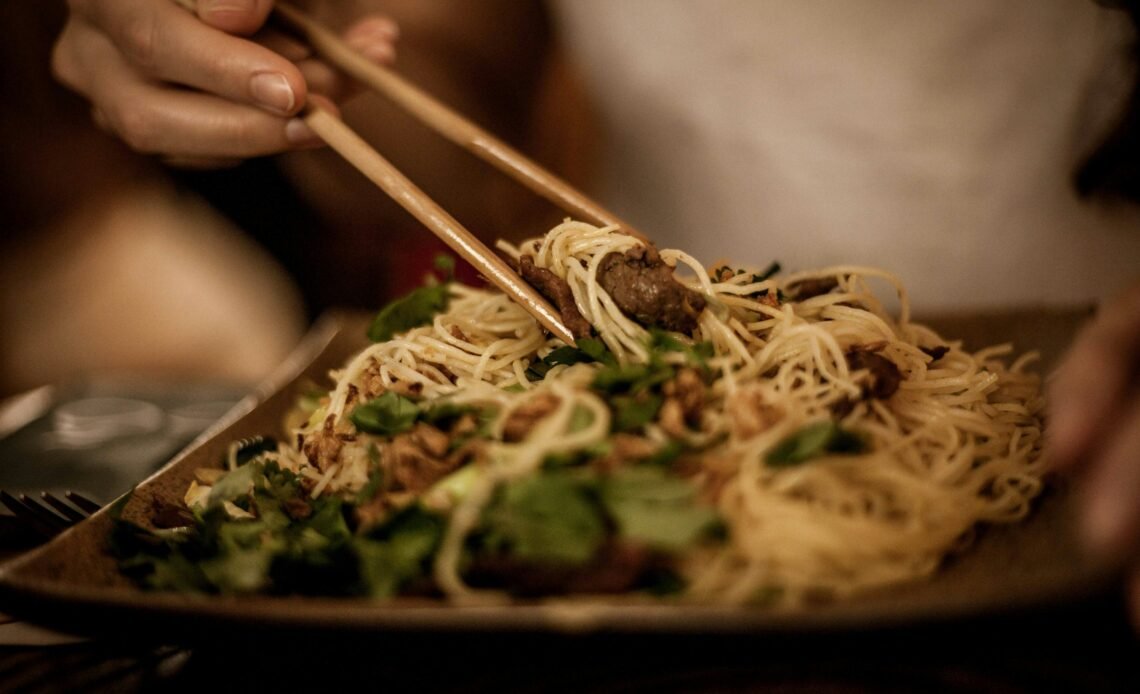
Ask a Hong Kong home cook which dish they’d never bother making at home, and 乾炒牛河 — dry-fried beef chow fun — comes up more than almost anything else. It looks simple: wide rice noodles, sliced beef, bean sprouts, scallions, a splash of soy. It’s also the dish cooks use to test each other, because there’s nowhere to hide a weak wok arm. Too little heat and the noodles turn gluey instead of charred; too rough a toss and the ribbons snap into mush.

A Shahe Noodle, a Wartime Legend, and Why “Dry” Matters
The dish’s full Cantonese name, gōn cháau ngàuh hó (乾炒牛河), translates roughly to “dry-fried beef Shahe noodle” — Shahe being the town near Guangzhou credited with the wide, flat rice noodle itself. Chow fun can technically be made two ways: “wet-fried,” thickened into a light gravy, or “dry-fried,” tossed with nothing but soy sauce and whatever clings to the pan. The dry version is so dominant today that most menus don’t even bother specifying it — if a menu just says “beef chow fun,” it means dry. Food writers trace one popular origin story to Guangzhou street stalls around 1938, when a vendor reportedly ran out of the cornstarch needed to thicken the usual gravy and served the noodles dry instead; it’s treated as kitchen folklore rather than documented history, but the dish’s roots in Guangdong’s dai pai dong stalls are solid. From there it spread into Hong Kong’s cha chaan tengs and yum cha restaurants, where it’s now closer to a local standard than an import.
Wok Hei: The Part You Can’t Buy in a Bottle
What separates a good plate from a forgettable one is wok hei (鑊氣) — literally “the breath of the wok.” It’s not a seasoning or an ingredient; it’s the smoky, slightly charred depth that comes from food searing against scorching metal rather than steaming in its own moisture, helped along by droplets of oil and sauce briefly flaring against the wok’s surface. Cantonese restaurant kitchens run stoves built for this specifically — high-output burners, often fan-assisted, feeding a thin, two-handled wok that a cook keeps constantly moving. A Post Magazine feature on Cantonese chefs quoted veteran chef Tsang Chiu-king comparing the skill to martial arts: years of repetition before the timing becomes instinct. It’s also, notably, a concept that’s specific to Cantonese cooking — none of China’s other seven major regional cuisines name it as its own technique. A home stove without that firepower can still get respectably close with the right prep, which is the part that actually matters for cooking this at home.
The Recipe
Serves 2-3. Slice 10 oz (280g) flank steak against the grain into pieces about 1/8 inch thick — thin enough that it cooks through in under a minute. Marinate it in 1 teaspoon baking soda (this is velveting — it tenderizes the beef and helps it stay juicy under high heat), 1 tablespoon cornstarch, 1 tablespoon oyster sauce, 1 tablespoon light soy sauce, 1 teaspoon dark soy sauce, 1 teaspoon Shaoxing wine, 1 teaspoon sugar, ¼ teaspoon white pepper, and 2 tablespoons water. Mix well and let it sit 15-20 minutes at room temperature, no longer — oversoaking in baking soda turns the texture spongy rather than tender.
While the beef rests, loosen 1 lb (450g) fresh wide rice noodles by hand so the strands separate without tearing; if they’ve been refrigerated and are stiff, steam or microwave them covered for 30-45 seconds first. Mix a sauce of 1 tablespoon light soy sauce, 1 teaspoon dark soy sauce, 1 tablespoon oyster sauce, and a pinch of sugar — dark soy here is mainly for color, giving the noodles their characteristic brown-black streaks, not heavy salt. Have 2 cups mung bean sprouts and 3 scallions, cut into 2-inch lengths with whites and greens separated, ready at the stove.
Heat a wok (carbon steel, if you have one) until it’s lightly smoking. Add 1 tablespoon oil, sear the beef in a single layer, undisturbed, for 30-45 seconds per side, then remove it immediately — it should still be slightly underdone, since it goes back in later. Wipe the wok, add 2 more tablespoons oil, and add the noodles. Resist the urge to stir constantly here: let them sit against the hot metal for 20-30 seconds at a time between tosses so they actually char rather than just heat through, drizzling a little of the sauce along the way. Push the noodles to one side, add the scallion whites and bean sprouts to the cleared space, then return the beef to the wok, pour over the remaining sauce, and toss everything together hard over the highest flame your stove has for 30-60 seconds. Add the scallion greens in the last 10 seconds, plate immediately, and eat it hot — chow fun left sitting even five minutes loses the one thing it was made for.
Why It’s a Standing Test
Line cooks in Hong Kong still talk about chow fun as the dish a chef gets handed early to prove they can actually run a wok station — not because the ingredient list is hard, but because every mistake shows immediately. Broken noodles mean the toss was too rough; pale, soft noodles mean the wok never got hot enough; a greasy, flat-tasting plate means the cook never let the pan breathe between additions. There’s no sauce thick enough to cover for bad technique, which is exactly why it’s remained one of the most reliable ways to judge a Cantonese kitchen — including your own.
